Description
Key Technical Specifications
-
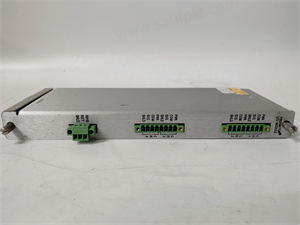
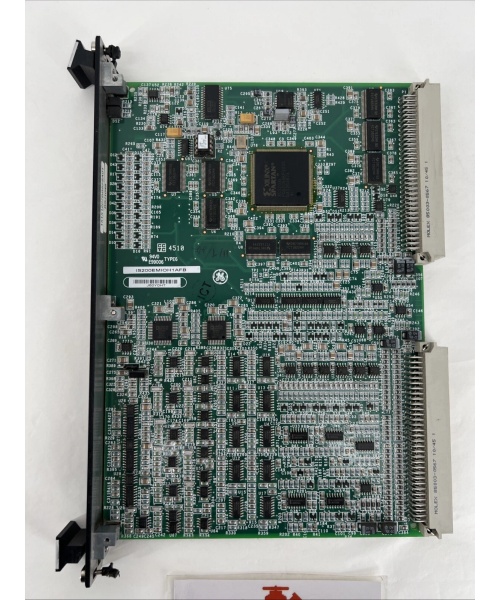
Model Number: IS200EMIOH1AFB
-
Manufacturer: General Electric
-
Power Supply: 24 VDC ±10 %, 0.8 A typical (derived from VME back-plane)
-
Analog I/O: PT & CT inputs (0-120 VAC, 0-5 AAC), 12-bit resolution, 2 kHz sample rate
-
Discrete I/O: 16 opto-isolated 24 VDC inputs, 8 relay outputs (Form-C, 2 A)
-
Gate Pulses: Six 5 V CMOS pairs → fiber ST ports (850 nm, 5 MBd) to ESEL/EGPA cards
-
Field Flashing: Drives 53A & 53A flashing relays via on-board drivers
-
Isolation: 1500 Vrms field-to-logic, 500 V channel-to-channel
-
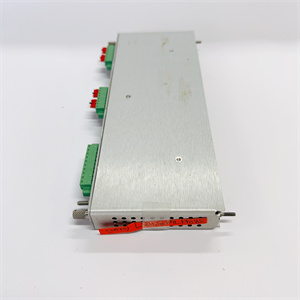
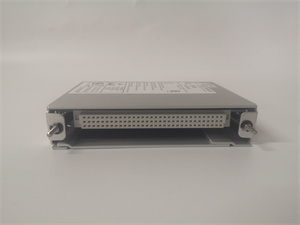
Connectors: 96-pin DIN VME, three 20-position pluggable for PT/CT/contacts, six ST fiber
-
Diagnostics: Green “BOARD OK,” red “FAULT” LEDs visible through bezel
-
Operating Temperature: –40 °C to +70 °C (conformal-coated)
-
Dimensions / Weight: 100 × 80 × 20 mm, 0.22 kg

IS200EMIOH1AFB
Field Application & Problem Solved
In a 200-MW combined-cycle block the EX2100 static exciter doesn’t read field volts or breaker status with copper—it reads them through the IS200EMIOH1AFB. This card sits in the VME rack, scales PT/CT signals, debounces contact inputs, and fires six 5 V gate-pulse pairs out to the ESEL board which drives the EGPA gate amplifiers. When the card fails you lose PT feedback, the VAR loop opens, and you trip on “EXCOMM FAULT”; swap the board, snap the ST fibers and 20-pin plugs back in, and the exciter comes back online—no re-cal, no firmware flash. You’ll find this PCB in every EX2100 cabinet from 50 MW peakers to 400 MW combined-cycle blocks. Its value is centralization: one card handles flashing relays, PT/CT scaling, and gate-pulse timing so you don’t have to land 200 wires on individual terminals.
In a 200-MW combined-cycle block the EX2100 static exciter doesn’t read field volts or breaker status with copper—it reads them through the IS200EMIOH1AFB. This card sits in the VME rack, scales PT/CT signals, debounces contact inputs, and fires six 5 V gate-pulse pairs out to the ESEL board which drives the EGPA gate amplifiers. When the card fails you lose PT feedback, the VAR loop opens, and you trip on “EXCOMM FAULT”; swap the board, snap the ST fibers and 20-pin plugs back in, and the exciter comes back online—no re-cal, no firmware flash. You’ll find this PCB in every EX2100 cabinet from 50 MW peakers to 400 MW combined-cycle blocks. Its value is centralization: one card handles flashing relays, PT/CT scaling, and gate-pulse timing so you don’t have to land 200 wires on individual terminals.
Installation & Maintenance Pitfalls (Expert Tips)
Gate-pulse fiber reversed—15 V on 1.7 V LED cooks the transmitter
The six ST ports are keyed alike but fiber polarity matters. Flip TX/RX and you stuff 15 V back into the 1.7 V LED—poof, no light. Always match the white wire-stripe to the silk-screen arrow before you push the connector home.
The six ST ports are keyed alike but fiber polarity matters. Flip TX/RX and you stuff 15 V back into the 1.7 V LED—poof, no light. Always match the white wire-stripe to the silk-screen arrow before you push the connector home.
PT fuse missing—120 V hits the divider, blows the trace
Each PT input has a 2 A 250 V ferrite fuse on the card edge. If someone jumpered it out and a surge arrives, the 2 kΩ divider burns open and you lose voltage feedback. Check the fuse first—if it’s blown, replace it, don’t jumper.
Each PT input has a 2 A 250 V ferrite fuse on the card edge. If someone jumpered it out and a surge arrives, the 2 kΩ divider burns open and you lose voltage feedback. Check the fuse first—if it’s blown, replace it, don’t jumper.
Conformal coat cracked—salt fog kills the 2.5 V reference
The board is coated, but the 20-pin edge is masked. If the coat cracks, salt bridges the precision reference and you see 5 % offset on every channel. Scrape the salt, hit the edge with 2100-FTG, and re-coat—problem gone for another decade.
The board is coated, but the 20-pin edge is masked. If the coat cracks, salt bridges the precision reference and you see 5 % offset on every channel. Scrape the salt, hit the edge with 2100-FTG, and re-coat—problem gone for another decade.
Missing shoulder washers—card arcs to rack
The four corner holes are through-plated. Forget the fiber washers and the card edge sits 0.5 mm proud; 125 V PT finds the rack paint, arcs, and blows a hole in the ground plane. Use the original GE shoulder washers—torque to 8 in-lb, no more.
The four corner holes are through-plated. Forget the fiber washers and the card edge sits 0.5 mm proud; 125 V PT finds the rack paint, arcs, and blows a hole in the ground plane. Use the original GE shoulder washers—torque to 8 in-lb, no more.
Technical Deep Dive & Overview
IS200EMIOH1AFB is the central I/O hub for the EX2100 exciter frozen in 2000 silicon. A 32-channel DSP samples PT/CT at 2 kHz, debounces 24 V contacts, and drives six fiber LEDs with 5 V gate-pulse pairs. Because the card carries both analog and light signals, you can swap it hot and the exciter never knows—just kill the 24 VDC field supply first or you’ll arc-weld the 20-pin plugs. Treat the ST ferrules like optical jewels and the board will keep the generator floating at exactly 13.8 kV for another thirty years
IS200EMIOH1AFB is the central I/O hub for the EX2100 exciter frozen in 2000 silicon. A 32-channel DSP samples PT/CT at 2 kHz, debounces 24 V contacts, and drives six fiber LEDs with 5 V gate-pulse pairs. Because the card carries both analog and light signals, you can swap it hot and the exciter never knows—just kill the 24 VDC field supply first or you’ll arc-weld the 20-pin plugs. Treat the ST ferrules like optical jewels and the board will keep the generator floating at exactly 13.8 kV for another thirty years
.