Description
Key Technical Specifications
-
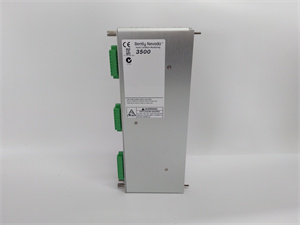
Model Number: IS200EISBH1AAA
-
Manufacturer: General Electric (Salem, VA)
-
Power Supply: 24 VDC ±10 %, 0.8 A typical
-
Fiber Ports: 6 × multimode ST, 850 nm, 5 MBd, 1500 V isolation
-
Analog Feedback: Receives gen-field volts/amps & ground-leakage via fiber
-
Communication: Ethernet RS-485 service port, VME back-plane to Mark VI CPU
-
Isolation: 1500 Vrms fiber-to-logic, 500 V channel-to-channel
-
Operating Temperature: –40 °C to +70 °C (conformal-coated)
-
Dimensions / Weight: 260 × 20 × 187 mm, 0.63 kg

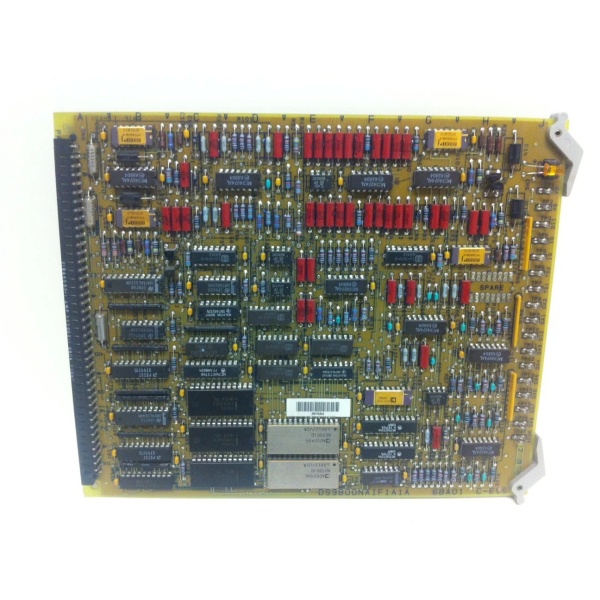
GE DS3800NAIF1A1A
Field Application & Problem Solved
In a 200-MW combined-cycle block the EX2100 static exciter doesn’t talk copper—it talks light. The IS200EISBH1AAA is the fiber-optic mailbox. It sits in the 13-slot VME frame, receives gen-field voltage, current, and ground-leakage data over glass, and ships it to the Mark VI CPU at 100 Mb/s so the VAR loop can trim the SCR bridge in < 10 ms. When the board fails you lose all field feedback, the exciter folds back to manual, and the unit drops to 85 % reactive; swap the card, snap the six ST connectors back in, and the loop closes without re-configuring a single parameter. You’ll find this PCB in every EX2100 cabinet from 50 MW peakers to 400 MW combined-cycle blocks. Its value is noise immunity: fiber can’t be bothered by 6.9 kV switch-gear hash, so the exciter stays stable even when the yard looks like a lightning storm
In a 200-MW combined-cycle block the EX2100 static exciter doesn’t talk copper—it talks light. The IS200EISBH1AAA is the fiber-optic mailbox. It sits in the 13-slot VME frame, receives gen-field voltage, current, and ground-leakage data over glass, and ships it to the Mark VI CPU at 100 Mb/s so the VAR loop can trim the SCR bridge in < 10 ms. When the board fails you lose all field feedback, the exciter folds back to manual, and the unit drops to 85 % reactive; swap the card, snap the six ST connectors back in, and the loop closes without re-configuring a single parameter. You’ll find this PCB in every EX2100 cabinet from 50 MW peakers to 400 MW combined-cycle blocks. Its value is noise immunity: fiber can’t be bothered by 6.9 kV switch-gear hash, so the exciter stays stable even when the yard looks like a lightning storm
.
Installation & Maintenance Pitfalls (Expert Tips)
Fiber bend radius—break a strand and field volts drift
ISBus multimode fiber needs 1.5 in minimum bend radius. Techs zip-tie it tight to tidy the door and fracture the core; you see 2 % low field volts and hunt for weeks. Use stick-on radius clips and leave a 3 in service loop—problem gone for life.
ISBus multimode fiber needs 1.5 in minimum bend radius. Techs zip-tie it tight to tidy the door and fracture the core; you see 2 % low field volts and hunt for weeks. Use stick-on radius clips and leave a 3 in service loop—problem gone for life.
Dirty ST ferrule—bit-error rate jumps, exciter trips
Coal dust on the ferrule scatters 850 nm light; BER climbs and the Mark VI flags “EXCOMM FAULT.” Hit every ST with one-shot cleaner before you close the door—30 s of housekeeping saves a 2 hr climb.
Coal dust on the ferrule scatters 850 nm light; BER climbs and the Mark VI flags “EXCOMM FAULT.” Hit every ST with one-shot cleaner before you close the door—30 s of housekeeping saves a 2 hr climb.
24 V fuse fatigues—opens under vibration
The 24 V input fuse is soldered pigtail-style. After ten years of nacelle shake it opens under cold-start inrush. If you measure 0 V on the front-panel test jack but 28 V at the bulk supply, cut the fuse out and drop in a panel-mount holder—five-cent part, five-minute fix.
The 24 V input fuse is soldered pigtail-style. After ten years of nacelle shake it opens under cold-start inrush. If you measure 0 V on the front-panel test jack but 28 V at the bulk supply, cut the fuse out and drop in a panel-mount holder—five-cent part, five-minute fix.
Wrong suffix—H1AAA needs H1A BIOS
H1AAA and H1AAB share the same slot but boot from different EEPROM offsets. Drop the wrong image and the board faults on “BIOS MISMATCH.” Always burn the correct *.BIN file before you ride the lift—tower time costs more than the card.
H1AAA and H1AAB share the same slot but boot from different EEPROM offsets. Drop the wrong image and the board faults on “BIOS MISMATCH.” Always burn the correct *.BIN file before you ride the lift—tower time costs more than the card.
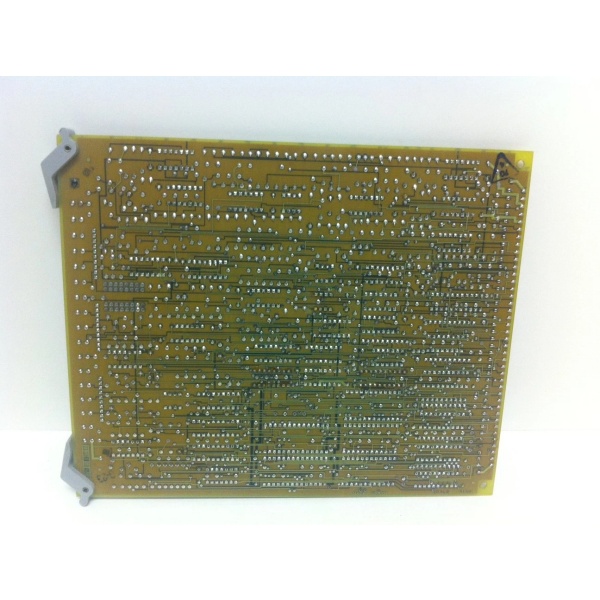
GE DS3800NAIF1A1A
Technical Deep Dive & Overview
IS200EISBH1AAA is a fiber-optic ISBus node frozen in 2000 silicon. A 32-bit MCU converts light pulses to 16-bit data, latches it into VME, and echoes status back down the same glass. Six ST ports carry gen-field volts, exciter amps, and ground-detect leakage; the Mark VI uses the data to close the VAR loop in < 10 ms. Battery-backed SRAM holds calibration offsets; when the cell dies you lose scaling, but the CPU keeps running because the firmware shadows to RAM. Treat the fiber like fragile glass and the board will keep the generator floating at exactly 13.8 kV for another thirty years
IS200EISBH1AAA is a fiber-optic ISBus node frozen in 2000 silicon. A 32-bit MCU converts light pulses to 16-bit data, latches it into VME, and echoes status back down the same glass. Six ST ports carry gen-field volts, exciter amps, and ground-detect leakage; the Mark VI uses the data to close the VAR loop in < 10 ms. Battery-backed SRAM holds calibration offsets; when the cell dies you lose scaling, but the CPU keeps running because the firmware shadows to RAM. Treat the fiber like fragile glass and the board will keep the generator floating at exactly 13.8 kV for another thirty years
.