Description
Key Technical Specifications
-
Model Number: IS200EBKPG1CAA
-
Manufacturer: General Electric
-
Sections: M1 (ACLAs, DSPX), M2 (EMIO, EISB), C (DSPX, EISB, optional EMIO)
-
Connectors: 96-pin DIN for each plug-in board, three 12-pos terminal blocks for field I/O
-
Power Rails: +5 V @ 15 A, ±12 V @ 3 A, 24 V @ 2 A distributed to each section
-
Signal Count: 24 differential pairs, 16 opto-isolated DI, 8 relay DO routed through card edge
-
Isolation: 1500 Vrms section-to-section, 500 V channel-to-channel
-
Cooling: Two 120 mm brush-less fans mounted on top of rack, temp-controlled 0-60 °C
-
Test Points: Three groups (M1/M2/C) with seven points each for differential scope shots
-
Dimensions: 260 × 199 × 187 mm (H×W×D), 1.1 kg aluminum frame
-
Operating Temperature: 0 – 60 °C per EX2100 spec

IS200EBKPG1CAA
Field Application & Problem Solved
In a 200 MW combined-cycle block the EX2100 isn’t a single card—it’s a 19-inch rack full of them. The IS200EBKPG1CAA is the sheet-metal and copper that ties everything together. It slides into the bottom of the rack, gives every board a 96-pin DIN seat, and routes power, fiber, and field I/O so the ACLA, DSPX, EMIO, and EISB cards can talk without you having to land 200 wires on individual terminals. When the back-plane fails—usually a cracked power plane after ten years of vibration—you lose entire sections of the exciter, the generator volts collapse, and you trip on “EXCOMM FAIL”; swap the whole back-plane (fans and all) and you’re back to full VARs in under an hour. You’ll find this assembly in every EX2100 cabinet from 50 MW peakers to 400 MW combined-cycle blocks. Its value is modularity: you can pull any control board hot without touching a single field wire, keeping the unit online during maintenance.
In a 200 MW combined-cycle block the EX2100 isn’t a single card—it’s a 19-inch rack full of them. The IS200EBKPG1CAA is the sheet-metal and copper that ties everything together. It slides into the bottom of the rack, gives every board a 96-pin DIN seat, and routes power, fiber, and field I/O so the ACLA, DSPX, EMIO, and EISB cards can talk without you having to land 200 wires on individual terminals. When the back-plane fails—usually a cracked power plane after ten years of vibration—you lose entire sections of the exciter, the generator volts collapse, and you trip on “EXCOMM FAIL”; swap the whole back-plane (fans and all) and you’re back to full VARs in under an hour. You’ll find this assembly in every EX2100 cabinet from 50 MW peakers to 400 MW combined-cycle blocks. Its value is modularity: you can pull any control board hot without touching a single field wire, keeping the unit online during maintenance.
Installation & Maintenance Pitfalls (Expert Tips)
Cracked power plane—intermittent 5 V, random EXCOMM
The back-plane is eight-layer FR-4. After a decade of nacelle shake the +5 V plane can crack; you’ll see 4.7 V at one board and 5.0 V at its neighbor and chase ghosts. If the fault moves with the card, not the card slot, swap the entire back-plane—there’s no field repair for internal planes.
The back-plane is eight-layer FR-4. After a decade of nacelle shake the +5 V plane can crack; you’ll see 4.7 V at one board and 5.0 V at its neighbor and chase ghosts. If the fault moves with the card, not the card slot, swap the entire back-plane—there’s no field repair for internal planes.
Fan filter clogged—60 °C overtemps the fiber TX
The two 120 mm fans draw air through a foam filter. When it’s plugged with coal dust the internal temp hits 70 °C and the fiber transmitters start dropping bits. Pull the filter, wash with dish soap, dry, and reinstall—do it every outage or you’ll be climbing again.
The two 120 mm fans draw air through a foam filter. When it’s plugged with coal dust the internal temp hits 70 °C and the fiber transmitters start dropping bits. Pull the filter, wash with dish soap, dry, and reinstall—do it every outage or you’ll be climbing again.
Wrong keying—120 VAC on 24 V pin blows the trace
The three field terminal blocks are keyed alike but pin-outs differ by section. Land a 120 VAC PT on the 24 VDC digital header and you vaporize the copper. Always meter pin-to-pin before you torque; the silk-screen legend is your friend.
The three field terminal blocks are keyed alike but pin-outs differ by section. Land a 120 VAC PT on the 24 VDC digital header and you vaporize the copper. Always meter pin-to-pin before you torque; the silk-screen legend is your friend.
Missing shoulder washers—card arcs to rack, kills the ground plane
The four corner holes are through-plated. Forget the fiber washers and the back-plane edge sits 0.5 mm proud; 125 V field voltage finds the rack paint, arcs, and blows a hole through the ground plane. Use the original GE shoulder washers—torque to 8 in-lb, no more.
The four corner holes are through-plated. Forget the fiber washers and the back-plane edge sits 0.5 mm proud; 125 V field voltage finds the rack paint, arcs, and blows a hole through the ground plane. Use the original GE shoulder washers—torque to 8 in-lb, no more.
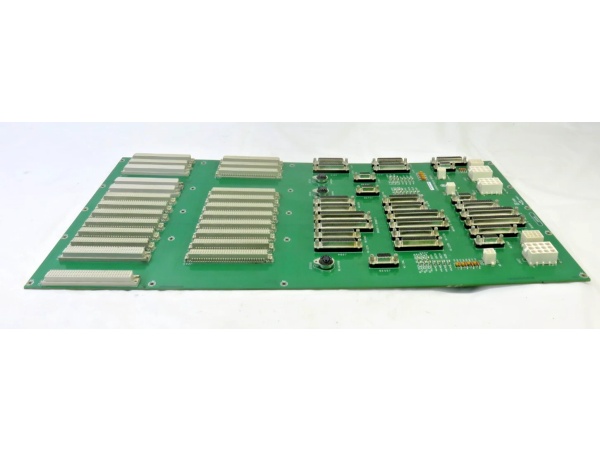
IS200EBKPG1CAA
Technical Deep Dive & Overview
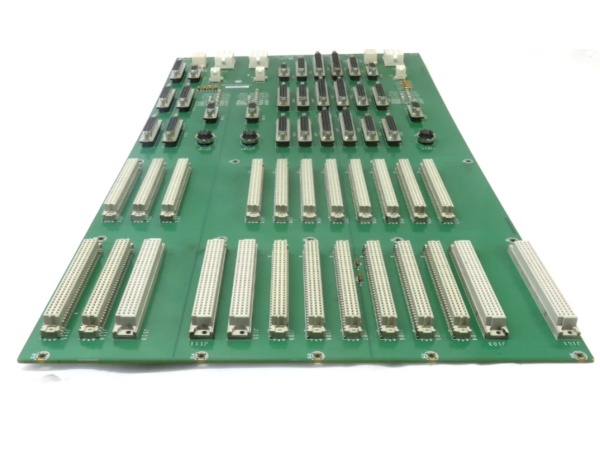
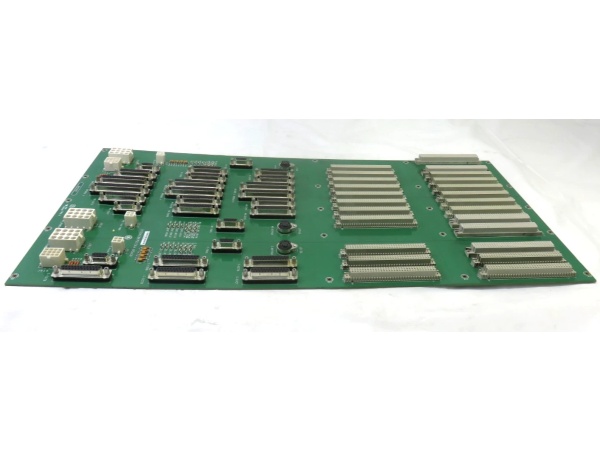
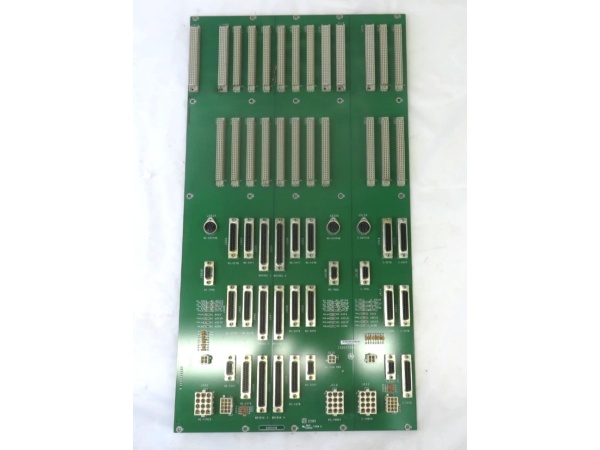
IS200EBKPG1CAA is basically a passive wiring plane with a few power planes and test-point lands—no micro, no firmware. It gives every control board a seat, distributes fused power, and brings field wiring to three plug-in terminal blocks so you can swap boards hot without landing a single wire. Because it’s the backbone, you can’t repair it in the field; treat it like a motherboard in a PC—if it cracks, swap the whole unit and keep the old one for spare hardware.
IS200EBKPG1CAA is basically a passive wiring plane with a few power planes and test-point lands—no micro, no firmware. It gives every control board a seat, distributes fused power, and brings field wiring to three plug-in terminal blocks so you can swap boards hot without landing a single wire. Because it’s the backbone, you can’t repair it in the field; treat it like a motherboard in a PC—if it cracks, swap the whole unit and keep the old one for spare hardware.