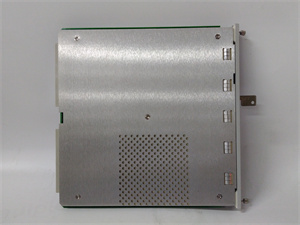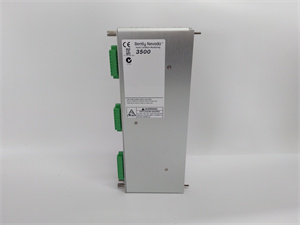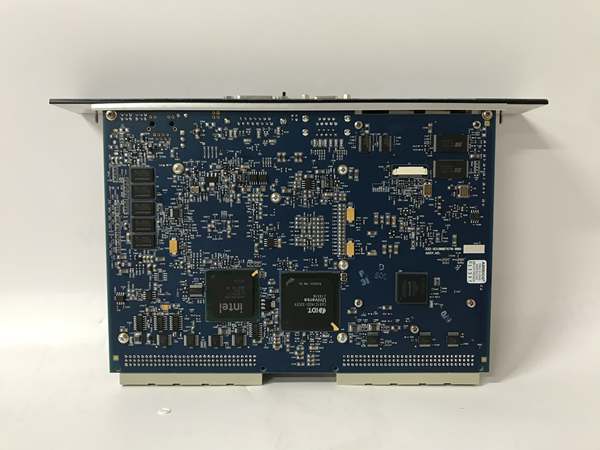
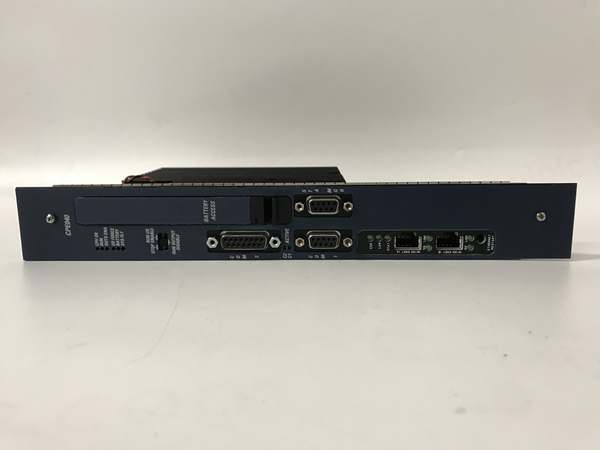
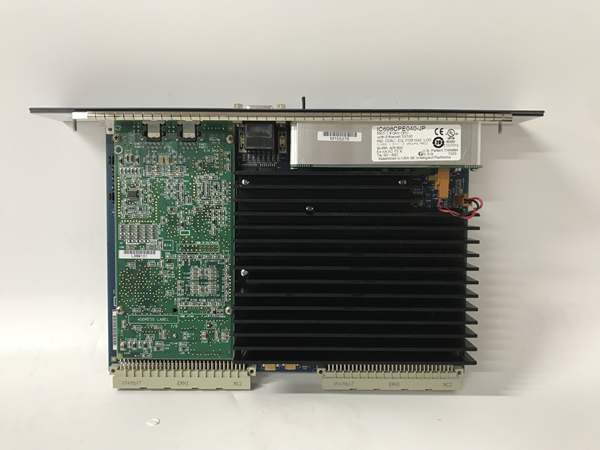
Description
Hard-Numbers: Technical Specifications
-
Processor: 1.8 GHz Intel Pentium M (32-bit x86 architecture)
-
User Memory: 64 MB battery-backed RAM + 64 MB non-volatile flash
-
I/O Capacity: Up to 32,768 discrete inputs / 32,768 discrete outputs; 32,768 analog words
-
Scan Rate: 0.02391 ms per 1000 Boolean contacts/coils (deterministic)
-
Backplane: VME64 (64-bit data path, high-speed serial backplane up to 17.5 MB/s)
-
Ethernet: 2× RJ45 ports (10/100 Mbps, auto-sensing, auto-crossover)
-
Serial Ports: 1× RS-232, 1× RS-485, 1× RS-232 station manager port
-
Protocols: SRTP, Modbus TCP Server/Client, Ethernet Global Data (EGD), Modbus RTU Slave, SNP
-
Web Server: Built-in HTTP/FTP server (up to 16 concurrent connections)
-
Programming: Proficy Machine Edition (ME), IEC 61131-3 languages + C language
-
Power Consumption: 6.8 A @ +5 VDC (typical), 0.003 A @ ±12 VDC
-
Operating Temperature: 0°C to +60°C (requires fan kit for cooling)
-
Storage Temperature: -40°C to +85°C
-
Battery: External lithium battery pack required (e.g., IC698ACC701) for RAM retention
-
Certifications: CE, UL, cUL, VCCI (Japan), FCC
-
Dimensions: Standard VME 6U form factor (233.35 mm × 160 mm)
-
Weight: Approximately 0.5 kg (1.1 lbs)

GE IC698CPE040-JP
The Real-World Problem It Solves
You know the frustration: legacy Series 90-70 systems that can’t handle modern Ethernet protocols, or compact PLCs that choke on complex floating-point math for turbine fuel algorithms. The IC698CPE040-JP drops a 1.8 GHz Pentium M into a VME64 chassis—giving you PC-class processing power with industrial-grade determinism. It runs full Windows development tools for offline programming, then executes real-time control with sub-millisecond scan consistency. The dual Ethernet ports let you segregate control traffic (EGD/SRTP) from SCADA traffic (Modbus TCP) without adding switches.
Where you’ll typically find it:
-
RX7i control racks in Japanese power plants and water treatment facilities (VCCI compliance required)
-
Upgraded turbine control systems replacing aging Series 90-70 CPUs with modern Ethernet capability
-
High-speed packaging lines and material handling systems requiring deterministic motion control
Bottom line: It brings modern computing performance and native Ethernet connectivity to VME-based control architectures without forcing a rip-and-replace of your I/O infrastructure.
Hardware Architecture & Under-the-Hood Logic
The IC698CPE040-JP mounts in Slot 0 of an RX7i VME64 chassis. It’s a complete Pentium M computer on a single board, running a real-time operating system (likely VxWorks or GE’s proprietary RTOS) that handles deterministic control execution alongside general-purpose computing tasks. The VME64 backplane provides high-speed access to RX7i I/O modules, while the dual Ethernet ports connect to plant networks.
Signal flow and processing logic:
-
Control Execution: The 1.8 GHz Pentium M executes ladder logic, structured text, and C programs with floating-point support for complex algorithms (PID, model predictive control)
-
Memory Architecture: 64 MB battery-backed RAM stores the active program and data; 64 MB flash holds firmware and backup configuration—data survives power loss via external battery pack
-
I/O Handling: The CPU scans RX7i I/O modules across the VME64 backplane at configurable rates (typically 1-10 ms), updating discrete and analog points deterministically
-
Network Communication: Ethernet Port 1 handles control protocols (EGD, SRTP) for peer-to-peer data exchange; Port 2 handles SCADA/Modbus TCP traffic—isolating real-time control from supervisory data
-
Web Services: Embedded HTTP server provides remote diagnostics, data monitoring, and firmware upload capability without requiring dedicated HMI software
GE IC698CPE040-JP
Field Service Pitfalls: What Rookies Get Wrong
Confusing CPE with CRE Versions Rookies order the IC698CPE040-JP thinking it has built-in redundancy like the IC698CRE040. It doesn’t. The “CPE” (Control Processor Enhanced) is single CPU only; “CRE” (Control Redundancy Enabled) is required for hot-standby. You can’t make a CPE redundant by adding firmware—it lacks the hardware sync logic.
Field Rule: Verify your application needs redundancy before ordering. If you need hot-standby, order IC698CRE040-JP and IC698RMX016 memory exchange modules. The CPE040-JP is for non-redundant applications only—mixing them in a redundant rack causes immediate fault.
Ignoring the VCCI Compliance Requirement The “-JP” suffix indicates Japan-market VCCI electromagnetic compliance. Rookies install these in non-Japanese facilities thinking “a CPU is a CPU,” but VCCI-rated hardware has specific filtering and shielding that may conflict with local EMC regulations or frequency allocations.
Quick Fix: Verify regional compliance requirements before installation. The IC698CPE040-JP will function technically anywhere, but for non-Japanese installations, order the standard IC698CPE040 (without -JP) to ensure local regulatory compliance and avoid inspection failures.
Forgetting the External Battery The 64 MB RAM requires external battery backup (IC698ACC701) to retain data during power loss. Rookies install the CPU, program it, power cycle the rack, and lose all configuration because they never connected the battery cable.
Field Rule: The battery cable must be connected to the CPU’s battery connector before first power-up. Verify battery voltage >3.0V with a meter—old batteries show good on LED but fail under load. Document battery installation date; replace every 3-5 years regardless of LED status. A dead battery means total program loss on power cycle.