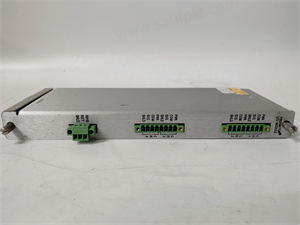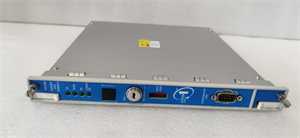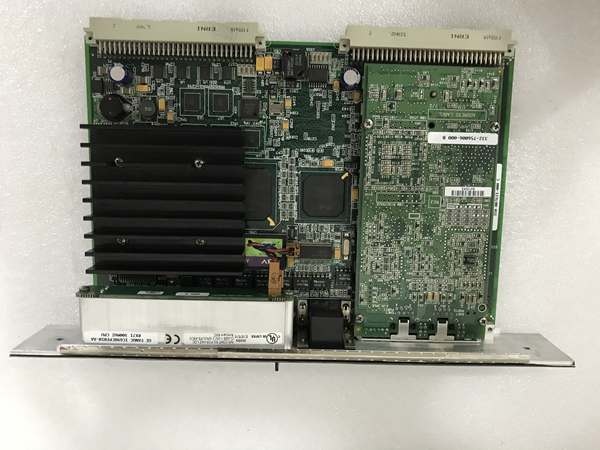
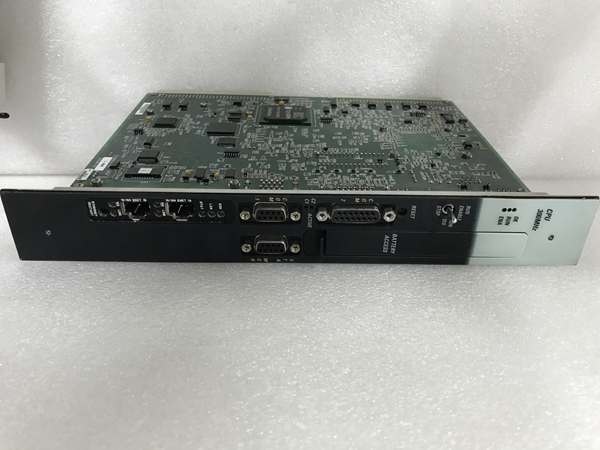
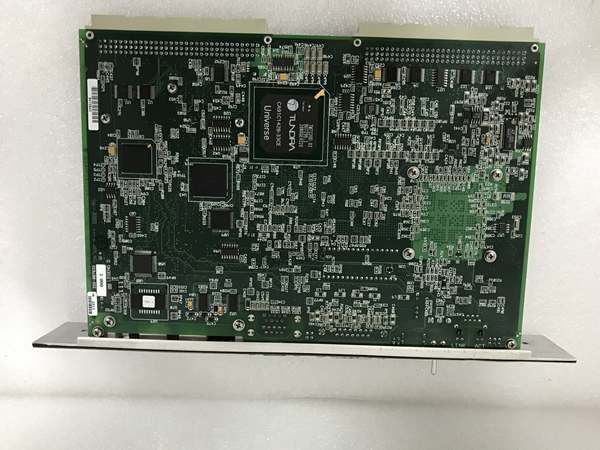
Description
Hard-Numbers: Technical Specifications
-
Processor: 300 MHz Intel Celeron (x86 architecture)
-
User Memory: 10 MB battery-backed RAM (lithium battery) + 10 MB non-volatile flash
-
I/O Capacity: 32 Kbits discrete inputs/outputs, 32 Kwords analog inputs/outputs
-
Scan Rate: 0.33 ms per 1000 Boolean contacts/coils
-
Program Capacity: 512 program blocks max, 128 KB per block
-
Backplane: VME64 (ANSI/VITA 1 standard), 64-bit data path
-
Ethernet: 2× 10/100 Mbps RJ45 ports (auto-negotiating)
-
Serial Ports: 3× isolated serial ports (RS-232, RS-485, RS-232 Station Manager)
-
Power Consumption: +5 VDC at 3.2A nominal, +12 VDC at 0.042A, -12 VDC at 0.008A
-
Operating Temperature: 0°C to +60°C (with fan tray)
-
Boolean Execution: Floating-point and Boolean operations supported
-
Programming: Ladder Diagram, Structured Text, Function Block Diagram, C language
-
Protocols: SRTP, Modbus TCP Server/Client, Ethernet Global Data (EGD), Modbus RTU Slave, SNP
-
Web Server: Built-in HTTP/FTP server (up to 16 connections)
-
Configuration: Proficy Machine Edition Logic Developer PLC v4.0 or later
-
Dimensions: Standard 6U VME single-slot
-
Weight: ~0.5-1.0 kg

GE IC698CPE010
The Real-World Problem It Solves
You know the scenario: legacy Series 90-70 systems that need more processing power and Ethernet connectivity, but you can’t justify the cost of a complete rip-and-replace. The IC698CPE010 bridges that gap—it’s the entry-level RX7i CPU that drops into a VME64 chassis, talks to your existing Series 90-70 I/O modules, and adds modern dual Ethernet for HMI/SCADA integration. It’s not the fastest CPU in the RX7i line (that’s the CPE040 with 1.8 GHz), but it’s the workhorse that gets the job done for medium-complexity control applications without breaking the budget.
Where you’ll typically find it:
-
RX7i upgrade projects replacing aging Series 90-70 CPUs (IC697CPM790/925) while keeping the existing I/O
-
Manufacturing lines and material handling systems requiring deterministic control with moderate I/O counts
-
Water/wastewater treatment plants where the 0.33 ms scan rate is sufficient for pump and valve control
Bottom line: It brings modern Ethernet connectivity and expanded memory to VME-based control systems while maintaining backward compatibility with legacy GE I/O—providing a migration path without forklift upgrades.
Hardware Architecture & Under-the-Hood Logic
The IC698CPE010 mounts in Slot 1 of an RX7i VME64 rack. It’s a complete Celeron-based computer on a single board, running a real-time operating system (likely VxWorks or GE proprietary) that handles deterministic control execution. The VME64 interface provides high-speed access to Series 90-70 I/O modules, while the dual Ethernet ports connect to modern networks.
Signal flow and processing logic:
-
Control Execution: The 300 MHz Celeron executes ladder logic, structured text, or C programs with a 0.33 ms scan rate for 1000 Boolean contacts—sufficient for most industrial applications
-
Memory Management: 10 MB battery-backed RAM stores the active program and data; 10 MB flash holds firmware and backup configuration. The lithium battery maintains RAM during power outages
-
VME Interface: The CPU acts as VME bus master, polling I/O modules across the VME64 backplane at each scan cycle, updating discrete and analog points
-
Network Communication: Ethernet Port 1 typically handles EGD (Ethernet Global Data) for HMI/SCADA; Port 2 can be configured for Modbus TCP or redundant network paths
-
Serial Backup: The RS-485 and RS-232 ports provide legacy serial communication for drives, barcode readers, or third-party devices that don’t support Ethernet
GE IC698CPE010
Field Service Pitfalls: What Rookies Get Wrong
Confusing CPE010 with CPE020 or CPE040 Rookies see “IC698CPE” and order the cheapest variant without checking processor speed. The CPE010 has a 300 MHz Celeron (0.33 ms/kIL), while the CPE020 has a 700 MHz Pentium III (0.14 ms/kIL), and the CPE040 has a 1.8 GHz Pentium M (0.023 ms/kIL). If your application needs fast floating-point math or complex algorithms, the CPE010 will bog down.
Field Rule: Check your scan time requirements before ordering. For simple discrete logic and slow analog loops, the CPE010 is fine. For motion control, high-speed counting, or complex PID with multiple cascades, step up to the CPE020 or CPE040. The part number suffix matters—010, 020, and 040 are not interchangeable for performance-critical applications.
Forgetting the Battery Backup The 10 MB RAM requires a lithium battery (IC698ACC701) to retain data during power loss. Rookies install the CPU, program it, power cycle the rack, and lose all configuration because they never installed the battery or it’s dead after 5 years.
Quick Fix: Verify battery voltage >3.0V with a meter before installation. The battery mounts on the front panel—check the LED (if equipped) or use Proficy Machine Edition to view battery status. Replace every 3-5 years regardless of LED status. A dead battery means total program loss on power cycle, and you’ll be re-downloading from your laptop at 2 AM.
Mixing Up Ethernet Port Functions The dual Ethernet ports are not automatically redundant. Rookies plug both into the same switch and create a loop, or they plug Port 2 into the control network when it’s supposed to be on the corporate LAN.
Field Rule: Ethernet Port 1 (ETH1) is typically the primary control network for EGD and SRTP. Port 2 (ETH2) can be configured for Modbus TCP to a DCS, or for media redundancy (LAN redundancy), but this requires specific configuration in Proficy Machine Edition. Don’t assume plug-and-play redundancy—verify the “Media Redundancy” checkbox is enabled in the CPU configuration, or you’ll just have two independent ports that don’t failover.
Ignoring the VME64 Compatibility The CPE010 is VME64, not VME32. Rookies try to use it in old Series 90-70 racks with VME32 backplanes. The physical connectors fit, but the timing and data width differences cause intermittent I/O faults.
Field Rule: Verify your rack is VME64 compliant (RX7i rack or later Series 90-70 VME64 rack). Look for the VME64 logo or check the backplane revision. If you’re upgrading from an old IC697 system, you may need to replace the rack backplane, not just the CPU. The CPE010 will not work reliably in pre-VME64 hardware—don’t force it.