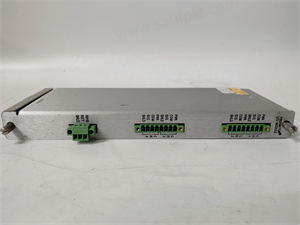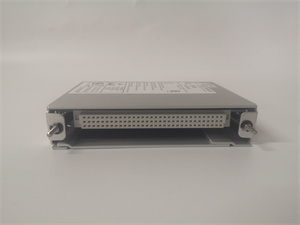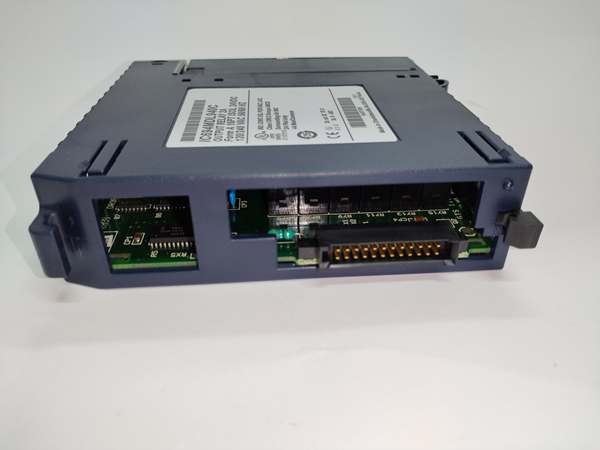
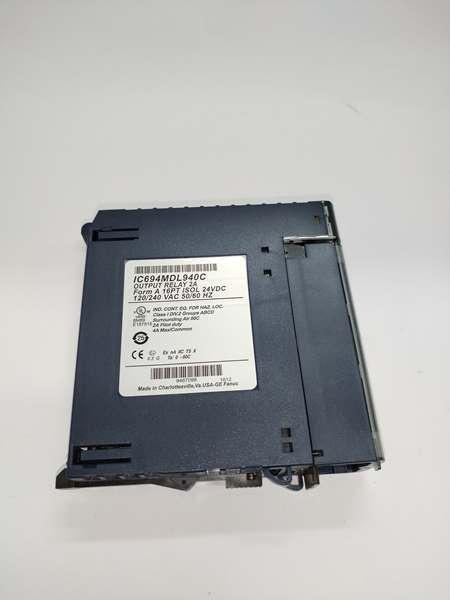
Description
Hard-Numbers: Technical Specifications
- Channel Count: 12 isolated differential input channels .
- Signal Types: Thermocouples (J, K, T, E, R, S, B, N, C types); Millivolt signals (±150mV, ±50mV) .
- Resolution: 32-bit IEEE floating-point or 16-bit integer (in a 32-bit field) input data format .
- Conversion Time: Configurable from 15 ms (28 Hz) to 120 ms (2.3 Hz) per channel .
- Accuracy: ±0.1% of voltage span at 25°C; ±0.25% of span over the full temperature range .
- Isolation Rating: 250 VAC continuous channel-to-channel; 1500 VAC for 1 minute; 2550 VDC for 1 second .
- Input Impedance: ≥500 kΩ .
- Noise Rejection: Improved by 10 dB .
- ADC Type: Sigma-Delta (Σ-Δ) .
- Power Consumption: 425 mA @ 5V or 400 mA @ 3.3V from the backplane .
- Operating Temperature: 0°C to +60°C (32°F to 140°F) .
- Storage Temperature: -40°C to +85°C (-40°F to 185°F) .
- Shock/Vibration: 15G shock for 11 ms; 10-57 Hz vibration rating .
- Required Terminal Block: Removable RTB (e.g., IC694TBB032, IC694TBS032, IC694TBC032) .
- Diagnostics: Open wire, short circuit, positive/negative rate-of-change, high, high-high, low, low-low alarms .
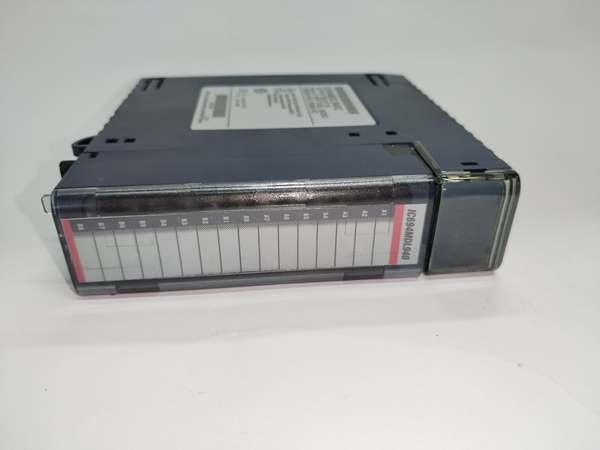
IC694MDL940
The Real-World Problem It Solves
Connecting sensitive strain gauges or thermocouples to a standard analog input module requires expensive external signal conditioners, introduces additional wiring points of failure, and complicates calibration. This module eliminates the middleman, providing a direct, high-impedance, isolated interface for these low-level signals right on the PLC rack.
Where you’ll typically find it:
- Weighing and Force Measurement: On tank scales, conveyor belt weighers, and press force monitoring systems where strain gauge load cells output millivolt signals.
- High-Temperature Process Monitoring: In furnaces, kilns, and reactors using Type R, S, or B thermocouples for temperatures exceeding 1000°C.
- Structural Health Monitoring: On bridges, cranes, or large machinery where strain gauges measure stress and fatigue.
- Precision Temperature Control: In laboratory ovens, environmental chambers, or semiconductor processing equipment requiring direct thermocouple connection for fast response.
It consolidates signal conditioning, isolation, and digitization into one slot, reducing cost, complexity, and potential noise ingress.
Hardware Architecture & Under-the-Hood Logic
This module is a precision instrument amplifier and ADC array designed for microvolt-level signals. Each channel is a fully isolated, programmable measurement chain.
- Programmable Front-End: Each differential input channel connects to a programmable gain instrumentation amplifier (PGIA). The gain is set based on the configured input type (e.g., ±50mV, ±150mV, or thermocouple type) to maximize the ADC’s dynamic range .
- Sigma-Delta ADC & Filtering: The amplified signal is fed into a high-resolution Σ-Δ ADC. This architecture oversamples the signal at a high rate and uses digital filtering to achieve excellent noise rejection and resolution. The configurable update rate (15-120 ms) trades off speed for increased noise immunity .
- Cold Junction Compensation (CJC): For thermocouple inputs, the module uses an integrated temperature sensor at the terminal block to measure the “cold junction” temperature. This value is used to compensate the thermocouple voltage reading, converting it to an accurate process temperature .
- Linearization & Scaling: The digitized value undergoes mathematical linearization (for thermocouples) and user-configured scaling. The result is presented to the CPU as a 32-bit floating-point engineering value (e.g., °C, mV, or microstrain) .
- Comprehensive Diagnostics: The circuitry continuously monitors for open wires (by checking for a broken loop), shorts, and signal out-of-range conditions. It also tracks the rate of change, flagging unrealistic signal spikes that could indicate a sensor fault .
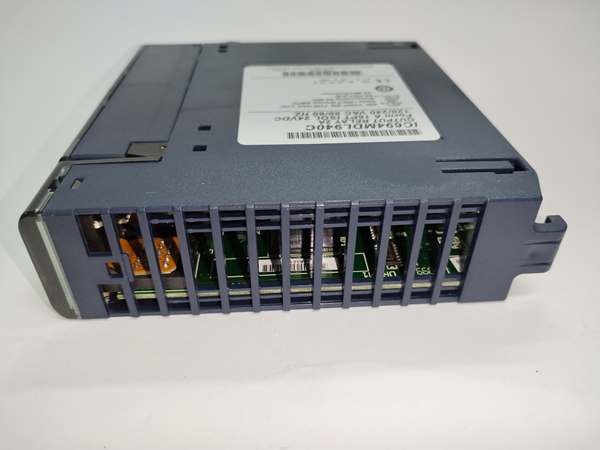
IC694MDL940
Field Service Pitfalls: What Rookies Get Wrong
Using Standard Shielded Cable for Strain Gauges
Using generic instrument cable for strain gauge connections. The capacitance of standard cable can attenuate the tiny mV signal and introduce noise, making readings unstable.
- Field Rule: Use low-noise, low-capacitance strain gauge cable specifically designed for bridge-based sensors. Keep cable runs as short as possible and away from power lines.
Forgetting to Enable the Excitation Source for Strain Gauges
A strain gauge is a passive resistor bridge that requires an excitation voltage. Rookies wire it up but forget to configure and enable the module’s internal excitation source in the software, resulting in a zero reading.
- Quick Fix: In the hardware configuration for the channel, ensure the Input Type is set to “Strain Gauge” or “mV” and that the Excitation parameter is enabled and set to the correct voltage (e.g., 10V) for your specific gauge.
Ignoring the “Open Wire” Detection for Thermocouples
The module can detect a broken thermocouple wire. If this diagnostic is not enabled or ignored in the program, a failed sensor reads as ambient temperature (due to the CJC sensor), not a fault, leading to a dangerous undetected process deviation.
- Field Rule: Always enable the Open Wire Detection diagnostic for all thermocouple channels. Program the PLC to latch an alarm and initiate a safe shutdown procedure if this fault is detected on critical loops.
Mismatching Thermocouple Type in Software and Hardware
You install a Type K thermocouple but the channel is configured for Type J in the software. The linearization curve is wrong, giving you a temperature reading that’s off by tens or hundreds of degrees.
- Field Rule: Create a channel configuration checklist. Before commissioning, physically verify each sensor type and cross-reference it with the configured type in Proficy Machine Edition for every single channel on the module.
Please note: The listed price is for reference only and is not binding. Final pricing and terms are subject to negotiation based on current market conditions and availability.