Description
Hard-Numbers: Technical Specifications
- Rated Voltage: 12/24 VDC
- Output Voltage Range: 12 to 24 VDC (+20%, -15%)
- Outputs per Module: 16 points (2 groups of 8)
- Output Current: 1 Amp maximum per point; 4 Amps per group @ 50°C; 3 Amps per group @ 60°C
- Response Time: 2ms maximum (on and off)
- Inrush Current: 5.2 Amps for 10ms
- Isolation Rating: 250VAC continuous / 1500VAC for 1 minute (field to backplane, optical); 250VAC continuous group-to-group
- Output Voltage Drop: 1.2V maximum at rated load
- Off-State Leakage: 1mA maximum
- Power Consumption: 130mA from 5V backplane bus (all outputs on)
- Operating Temperature: 0°C to +60°C (+32°F to +140°F)
- Hot Swap: Supported on RX3i universal backplane
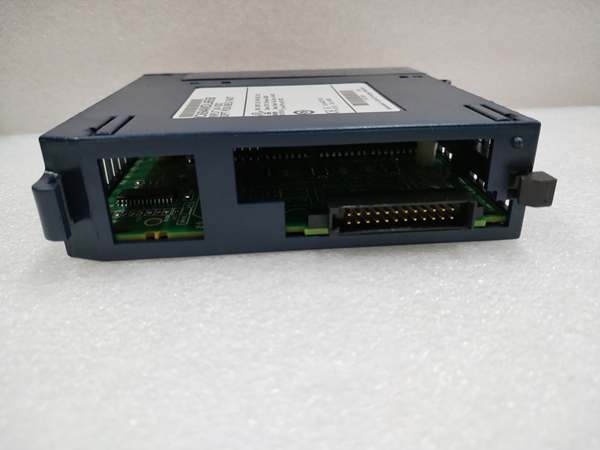
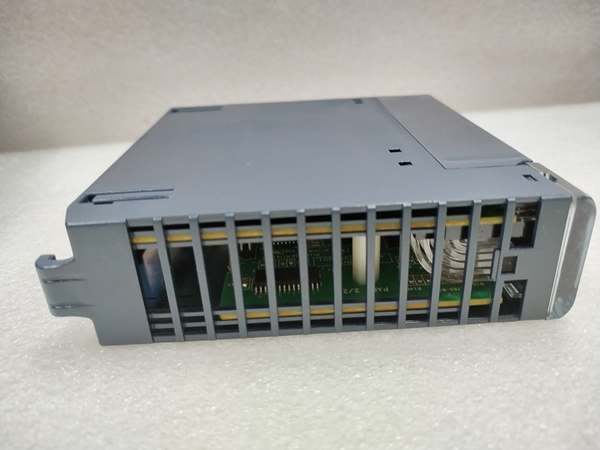
GE IC694MDL655
The Real-World Problem It Solves
Standard DC output modules cook themselves when a field wire shorts to ground or a solenoid coil fails. You either install external fuses for every channel (expensive, takes panel space) or you accept the downtime when a 0.50 wire fault takes out a 500 module. The IC694MDL742 eliminates that trade-off by baking electronic short circuit protection directly into each group. When a fault hits, the module kills the affected outputs and flags the fault – it doesn’t fry.
Where you’ll typically find it:
- Offshore platforms and hazloc environments where fuse replacement is a maintenance nightmare
- Safety-critical isolation valve command circuits where a single short must not cascade to other outputs
- Skid-mounted equipment shipped without spare modules – ESCP keeps the skid running until a replacement arrives
Bottom line: It’s the module you specify when the cost of an unscheduled shutdown exceeds the cost of built-in protection.
Hardware Architecture & Under-the-Hood Logic
The IC694MDL742 is a dumb output card – no onboard microprocessor. It’s a solid-state switch array controlled directly by the CPU through the backplane. What separates it from the MDL740 is the ESCP circuitry: each group of 8 outputs has an independent electronic protection circuit that monitors current and shuts down the group if it detects a short.
Signal flow:
- CPU writes to the output image table (%Q memory) via backplane communication
- Optical isolators translate backplane logic levels to field-side drive circuits
- Each output channel drives a MOSFET sourcing current from the user-supplied DC+ bus
- ESCP circuits continuously monitor group current – if any channel exceeds the trip threshold, the entire group shuts down and the red FAULT LED illuminates
- 16 green LEDs show individual point status; the red “F” LED indicates ESCP trip
Power architecture:
- Backplane 5V: Powers the communication interface and optical isolators (130mA draw)
- External DC power supply (12-24V): Powers the field loads – the module does NOT supply field power, it only switches it
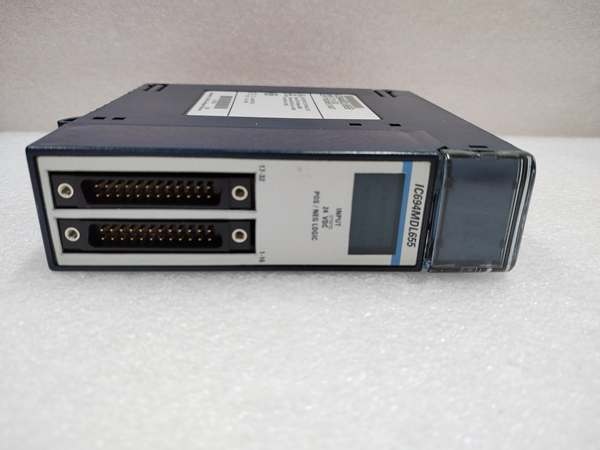
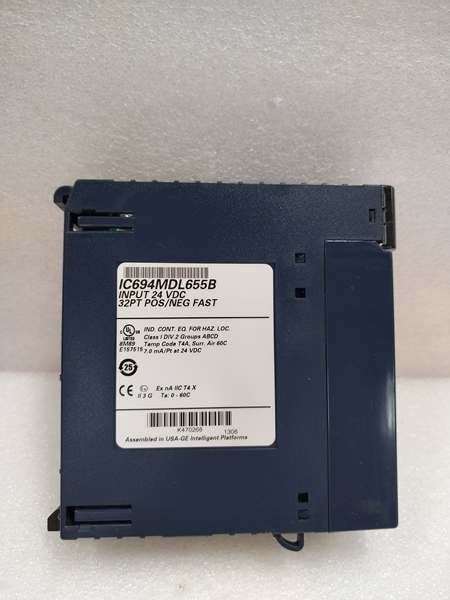
GE IC694MDL655
Field Service Pitfalls: What Rookies Get Wrong
ESCP Is Per-Group, Not Per-Channel
A short on channel 1 trips the entire group (channels 1-8). When the FAULT LED lights up, check all 8 channels in that group, not just the one you think failed. I’ve seen techs waste hours replacing “bad” modules when the real problem was a crushed wire on a different channel they didn’t check.
- Field Rule: Clear the short, cycle module power or reset via software – the ESCP latch doesn’t auto-reset. The fault persists until you remove power or the CPU commands a reset.
Confusing Positive vs. Negative Logic
This is a positive logic (sourcing) module – current flows OUT of the output terminals to the loads. Your loads connect between the output terminal and DC-. I’ve found fresh-from-school techs wiring loads between DC+ and the output terminal (negative logic configuration) and wondering why nothing turns on.
- Quick Fix: Draw the current path on paper before wiring: DC+ → Load → Output terminal → Internal switch → DC-. If the arrow doesn’t point OUT of the module, you’re wired wrong.
Exceeding Group Current Rating
1A per point doesn’t mean 8A per group. At 60°C ambient, you’re limited to 3A total per group. In a hot cabinet packed with VFDs and servo drives, cabinet temperature hits 55°C easily. If you load all 8 channels at 1A each, you’ll trip ESCP from overcurrent even with no short.
- Field Rule: Derate to 0.5A per point in hot cabinets (>50°C ambient), or use a fan to keep the module within thermal limits.
Assuming Hot Swap Means Live Wiring
Hot swap lets you pull the module from the backplane under power. It does NOT let you connect or disconnect field wires with power on. The ESCP circuits can trip from the transient of connecting an inductive load live. I’ve seen operators cause nuisance faults by hot-plugging solenoid connectors.
- Quick Fix: Always de-energize the field DC supply before touching terminal block wiring. Hot swap is for module replacement only, not live field wiring.
Commercial Availability & Pricing Note
Please note: The listed price is for reference only and is not binding. Final pricing and terms are subject to negotiation based on current market conditions and availability.