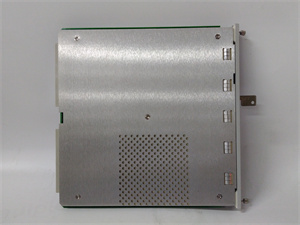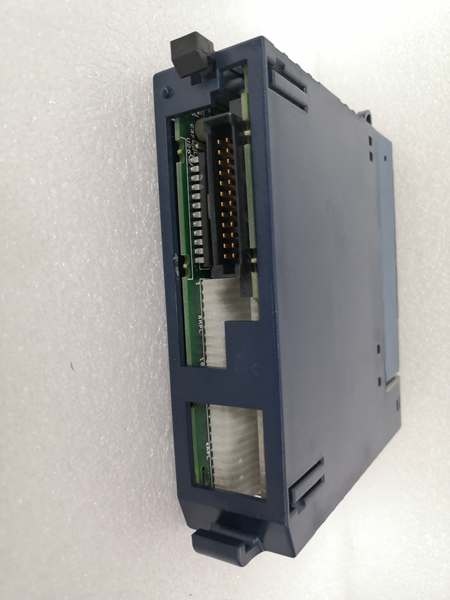
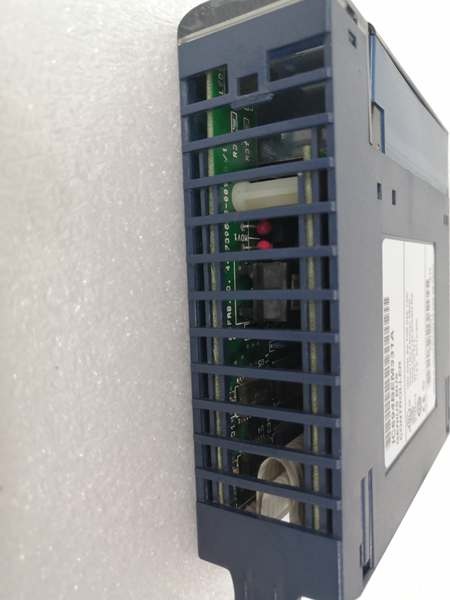
Description
Hard-Numbers: Technical Specifications
- Number of Inputs: 16 points (single group with shared common)
- Rated Voltage: 24V AC or 24V DC (50/60 Hz for AC)
- Input Voltage Range: 0 to +30V DC or 0 to +30V AC
- On-State Voltage: 11.5V to 30V AC or DC (guaranteed ON)
- Off-State Voltage: 0V to +4V AC or DC (guaranteed OFF)
- Input Current: 7 mA typical at rated voltage
- On-State Current: 3.2 mA minimum
- Off-State Current: 1 mA maximum
- Response Time: 12ms ON / 28ms OFF (typical)
- Isolation Rating: 250V AC continuous (field to backplane); 1500V AC for 60 seconds (field to frame)
- Backplane Power Draw: 80 mA @ 5V DC + 125 mA @ 24V DC (all inputs ON)
- Operating Temperature: 0°C to 60°C (32°F to 140°F)
- Input Circuit Type: Reactive filtering with optical isolation
- LED Indicators: 16 green LEDs (one per input point)
- Logic Mode: Positive logic (sinking) or negative logic (sourcing) in DC mode
- Hot Swap: Supported on RX3i universal backplanes (IC695CHS series)
- Terminal Block: 20-position removable terminal block
- Certifications: UL 508, CSA C22.2 No. 142, Class I Div 2 (Groups A, B, C, D)
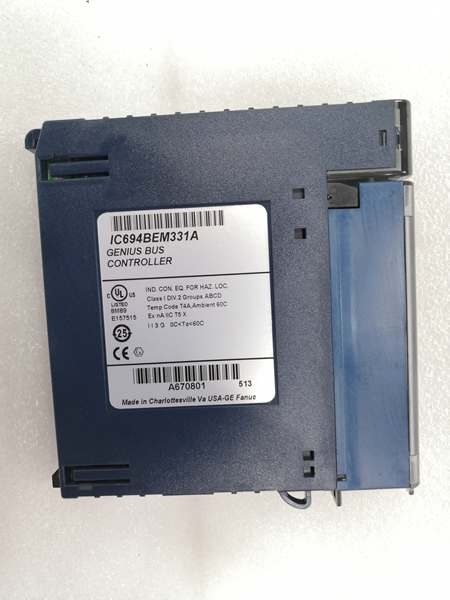
GE IC694BEM331
The Real-World Problem It Solves
This module is a “universal” 24V input that accepts both AC and DC signals in the same package. That flexibility matters when you’re working on a mixed-voltage control panel—some field devices are 24V DC (sensors, PLC outputs), others are 24V AC (older contactors, transformer-fed relays). Instead of buying separate AC and DC input modules, you standardize on the IC694MDL241 and wire whatever shows up at the terminal block.
Where you’ll typically find it:
- Control panels with legacy 24V AC control circuits alongside modern 24V DC sensors
- OEM machinery where different customers specify different control voltages
- Retrofit jobs where the existing field wiring is 24V AC but new devices are 24V DC
Bottom line: One module handles both 24V AC and DC inputs, reducing spare parts inventory and simplifying panel design for mixed-voltage applications.
Hardware Architecture & Under-the-Hood Logic
The IC694MDL241 is a 16-channel input module with all 16 points sharing a single common terminal. This is a grouped input design, not isolated like the IC694MDL231. The module uses optical isolation between the field side (all 16 inputs plus common) and the backplane logic, but all 16 inputs are referenced to the same common rail internally.
Signal Flow & Internal Architecture:
- Field Wiring Terminals: 16 input terminals (terminals 2-17) plus one shared common terminal (terminal 1). Terminal 18 provides 24V DC output from the backplane supply, and terminal 19 provides 0V return.
- Input Filter Network: Each channel has an RC filter that determines the 12ms ON / 28ms OFF response time. This filter rejects contact bounce and high-frequency noise but adds deliberate delay.
- Optical Isolation Barrier: All 16 input signals pass through a shared optical isolator bank. The isolation is between the field side (all inputs + common) and the backplane logic side—not between individual input points.
- Logic Mode Selection (DC Only): When wired for DC operation, the module can be configured for positive logic (sinking—current flows into the input terminal) or negative logic (sourcing—current flows out of the input terminal). This is determined by how you wire the common terminal relative to the field power supply.
- Logic Processing: After isolation, the filtered DC signals are sampled and mapped to the input status table (%I addresses). The module reports the state of all 16 points to the CPU via the backplane bus.
- Backplane Power Terminals: Terminals 18 (24V OUT) and 19 (0V OUT) provide access to the isolated 24V backplane supply. You can use this to power DC field devices without a separate external supply—but this reduces the isolation rating to 50V AC continuous (see Field Service Pitfalls).
GE IC694BEM331
Field Service Pitfalls: What Rookies Get Wrong
Using the Backplane 24V Output and Losing Isolation Rating
Terminals 18 and 19 give you access to the 24V isolated backplane supply. Tempting to use this to power your field devices. But if you connect field sensors or switches to this backplane-derived 24V, you’ve now tied the field side directly to the backplane power system through the common terminal. The isolation specification drops from 250V AC continuous to 50V AC continuous—and 500V AC for 1 minute instead of 1500V AC.
- Field Rule: If you need the full 250V isolation rating, do not use terminals 18 and 19. Power your field devices from a separate external 24V supply. Only use the backplane 24V output if your field wiring is confined to the same control panel and you don’t need high-voltage isolation.
Mixing AC and DC Inputs on the Same Module
The module accepts both AC and DC, but not simultaneously. All 16 inputs must be either AC or DC—they cannot be mixed. The input filter and detection circuit are optimized for one mode or the other. Mixing AC and DC on different points within the same module leads to erratic behavior, false triggers, or inputs that never register.
- Quick Fix: Choose one voltage type per module. If you have both AC and DC field signals, use separate modules: one IC694MDL241 for AC, another for DC, or use dedicated AC/DC modules like IC694MDL230 (120V AC) or IC694MDL645 (24V DC).
Wiring Positive vs. Negative Logic Incorrectly (DC Mode)
In DC mode, the module can be wired for positive logic (common = 0V DC, inputs = +24V DC) or negative logic (common = +24V DC, inputs = 0V DC). Rookies sometimes wire it backwards—connecting the field device to switch the 0V side while the common is tied to 0V. Result: the input never sees voltage difference, never turns ON.
- Field Rule:
- Positive logic (sinking): Connect common (terminal 1) to 0V DC. Field device switches +24V DC to the input terminal. Current flows INTO the input.
- Negative logic (sourcing): Connect common (terminal 1) to +24V DC. Field device switches 0V DC to the input terminal. Current flows OUT OF the input.
Assuming Fast Response for High-Speed Signals
The 12ms ON / 28ms OFF response time is slower than dedicated high-speed DC input modules. If you’re trying to catch encoder pulses, high-speed counter signals, or fast machine cycle indicators, this module will miss pulses shorter than ~30ms.
- Field Rule: Use this module for general-purpose discrete signals—pushbuttons, selector switches, limit switches, relay contacts. For high-speed pulse detection, use IC694APU300 (high-speed counter) or a fast-response DC input module.
Forgetting That All Inputs Share a Common
Unlike the isolated IC694MDL231, all 16 inputs on the IC694MDL241 share one common terminal. If you’re trying to connect field devices powered by different power sources (e.g., some sensors on 24V supply A, others on 24V supply B), you’ll create ground loops or short the supplies together through the common.
- Quick Fix: All field devices connected to this module must be powered from the same source. If you need to mix power sources, use an isolated input module (IC694MDL231) or use interposing relays to create separate circuits.
Commercial Availability & Pricing Note
Please note: The listed price is for reference only and is not binding. Final pricing and terms are subject to negotiation based on current market conditions and availability.