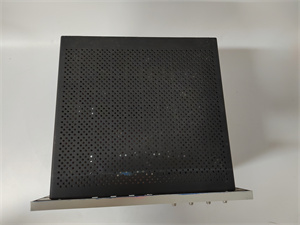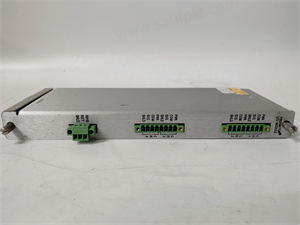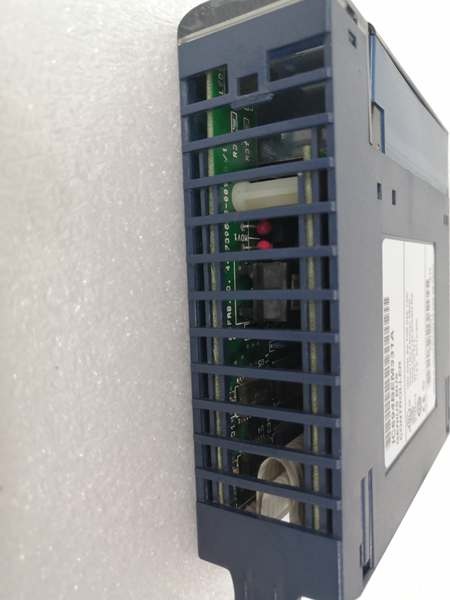
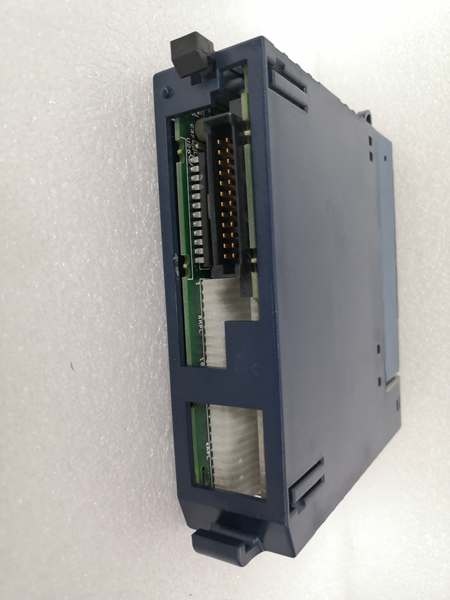
Description
Hard-Numbers: Technical Specifications
- Protocol Support: GE Genius I/O serial bus (proprietary token-passing)
- Baud Rates: 38.4 Kbaud, 76.8 Kbaud, 153.6 Kbaud (standard and extended)—software configurable
- Data Exchange: 128 bytes per device per bus scan
- Global Data: 128 bytes sent / 128 bytes received per bus scan
- Maximum Devices: 32 devices (all baud rates except 38.4K); 16 devices at 38.4 Kbaud
- Maximum Bus Length: 7,800 ft @ 38.4Kbaud / 4,500 ft @ 76.8Kbaud / 3,500 ft @ 153.6K extended / 2,000 ft @ 153.6K standard
- Bus Termination: 75, 100, 120, or 150Ω resistor at both ends (cable-dependent)
- Cable Types: Shielded twisted-pair, Twinax, or fiber optic with modems
- Isolation Rating: 2000V Hi-Pot / 1500V transient common-mode rejection
- Backplane Power: 300 mA @ 5 VDC (1.5W)
- Operating Temperature: 0°C to 60°C (32°F to 140°F)
- LED Indicators: OK (module status), COM (bus communication status)
- Max Modules per RX3i System: 8
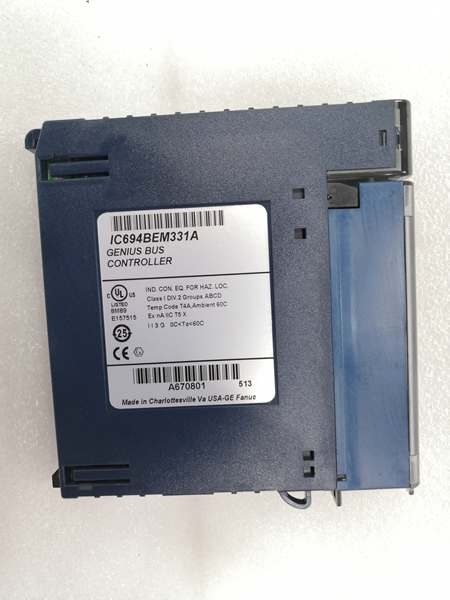
GE IC694BEM331
The Real-World Problem It S
olves
The IC694BEM331C is a hardware revision of the standard IC694BEM331 Genius Bus Controller. Same function, same specs, same wiring—just a later manufacturing revision. When you’re ordering replacements and the supplier ships IC694BEM331C instead of IC694BEM331, it’s a direct swap. No configuration changes, no firmware updates required.
Where you’ll typically find it:
- Maintenance stock for plants still running Genius I/O infrastructure
- Direct field replacements when original IC694BEM331 modules fail
- New installations where suppliers provide the latest hardware revision
Bottom line: It’s the same bus controller with a revision letter. Don’t overthink it—install and move on.
Hardware Architecture & Under-the-Hood Logic
The IC694BEM331C is functionally identical to the base IC694BEM331. It’s a single-slot module that bridges the RX3i backplane to the external Genius serial bus, with its own communication processor handling token-passing arbitration, data exchange scheduling, and diagnostic reporting independent of the CPU scan.
- Configuration Download – On power-up, the CPU sends bus configuration to the GBC: baud rate, device serial numbers, Global Data mappings, and reference addresses (%I, %Q, %AI, %AQ).
- Token-Passing Arbitration – The GBC participates in token rotation. When holding the token, it polls each device, exchanges data, and collects diagnostic messages.
- Data Exchange Execution – Up to 128 bytes of input data per device are read into CPU reference memory; up to 128 bytes of output data are written—deterministic bus scan times of 2–5 ms typical.
- Global Data Broadcast – 128 bytes of Global Data transmitted every token rotation; other GBCs on the bus receive and store in configured reference addresses—no ladder logic needed.
- Fault Collection & Reporting – Genius blocks autonomously report faults and alarms to the GBC, which stores messages for CPU retrieval into the fault table.
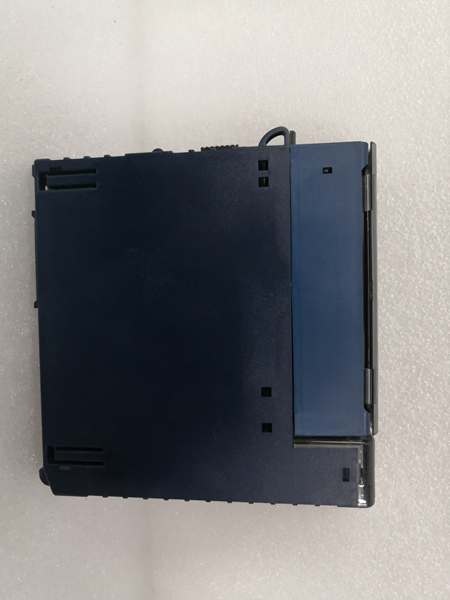
GE IC694BEM331
Field Service Pitfalls: What Rookies Get Wrong
Assuming “C” Suffix Means Different Specs
The “C” suffix on IC694BEM331C indicates a hardware revision, not a functional change. I’ve seen techs waste hours checking documentation for “what’s different” when the answer is: nothing that matters in the field. Same terminals, same LEDs, same Proficy configuration, same bus wiring.
Field Rule: Treat IC694BEM331C as a direct replacement for IC694BEM331. Swap and go.
Mixing Revisions on the Same Bus
While the IC694BEM331 and IC694BEM331C are functionally interchangeable, some sites have policies about maintaining consistent hardware revisions across a control system. If your plant has that policy, document what you’re installing.
Quick Fix: If replacing a failed module, note the revision on your work order. If your site requires revision consistency and you’re mixing old and new, flag it for the controls engineer—but know that functionally, it will work.
Missing Bus Termination After Swap
This isn’t unique to the “C” revision, but it’s the #1 issue I see on Genius bus swaps. When pulling a bad module, termination resistors can get knocked loose or forgotten on re-installation.
Field Rule: After any module swap, verify termination resistors are in place at both ends of the bus before walking away. COM LED solid green = good. Blinking or off = check your terminators.
Commercial Availability & Pricing Note
The is the current production revision of the Genius Bus Controller. Suppliers may ship when you order , as they are functionally interchangeable.
Typical Price Range (Reference Only):
- New unit: 800 – 1,200 USD
- Reconditioned/exchange: 400 – 700 USD
- Repair service: 200 – 400 USD
Please note: The listed price is for reference only and is not binding. Final pricing and terms are subject to negotiation based on current market conditions and availability.