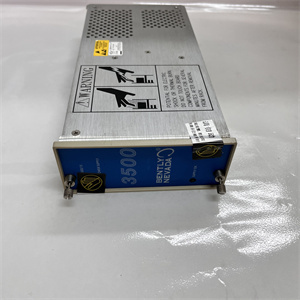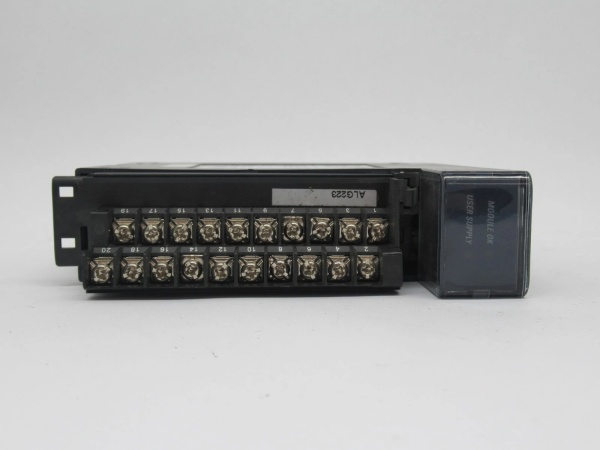
Description
Hard-Numbers: Technical Specifications
- Maximum Count Rate: 1 MHz (duty cycle 25%–87%, pulse width ≥ 416 ns)
- Minimum Count Rate: 50 Hz (pulse width ≥ 10 ms)
- Counter Width: 16-bit (Classic mode) / 32-bit (Enhanced mode)
- Inputs: 12 single-ended positive logic inputs OR 6 differential inputs (jumper configurable)
- Outputs: 4 positive logic outputs with ESCP (Electronic Short Circuit Protection)
- Input Voltage Range: 5 VDC (TTL) OR 10–30 VDC (jumper selectable via TSEL)
- Output Voltage Range: 4.7–40 VDC @ 1.5A max per output (resistive load), 6A total module limit
- Backplane Power Draw: 250 mA @ 5 VDC (1.25W)
- Isolation Rating: 250 VAC continuous / 1500 VAC for 1 minute (field-to-backplane)
- Operating Temperature: 0°C to 60°C (32°F to 140°F)
- Response Time: ≤ 100 µs input-to-output (independent of CPU scan)
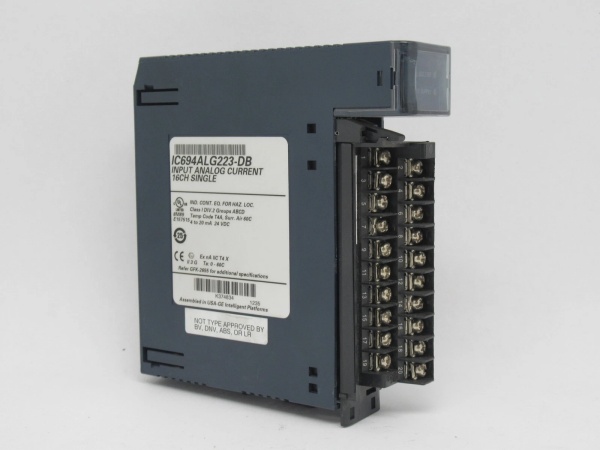
GE IC694ALG223
The Real-World Problem It Solves
Standard discrete I/O on a PLC can’t reliably count pulses faster than a few hundred Hz. Hook up a turbine flowmeter or rotary encoder running at 10,000+ pulses per second, and you’ll lose counts between scan cycles—or miss them entirely. The IC694APU300 embeds its own processor that counts, compares, and triggers outputs in under 100 µs, completely decoupled from the main CPU.
Where you’ll typically find it:
- Turbine and positive-displacement flowmeter totalizers in custody transfer skids
- Rotary encoder feedback on cut-to-length lines and winding machines
- High-speed event counting on punch presses, stamping dies, and packaging equipment
Bottom line: It turns what would be a scan-time nightmare into a set-and-forget hardware solution.
Hardware Architecture & Under-the-Hood Logic
The IC694APU300 isn’t just another input card—it carries an independent on-board processor that handles all counting, comparison, and output logic autonomously. The main CPU reads and writes to the module via configured reference addresses (%I, %Q, %AI, %AQ), but the timing-critical work stays local to the module.
- Signal arrives at input terminals – Configured as single-ended or differential based on jumper and software setup. Input voltage range is set by TSEL jumper (5 VDC or 10–30 VDC).
- On-board processor captures edges – Counts rising or falling edges (configurable) at up to 1 MHz. Quadrature decoding available in Enhanced mode for encoder direction detection.
- Compare logic evaluates preset values – Current count is compared against up to 16 preset values per counter. When a match occurs, outputs can be triggered, strobed, or held.
- Outputs fire within 100 µs – Four positive logic outputs respond based on compare results, strobe commands, or external preload signals—no CPU scan delay.
- Data exchanges with main CPU – Status, current count, and control commands pass through configured reference addresses. The CPU can read live counts, force presets, or reset counters via ladder logic.
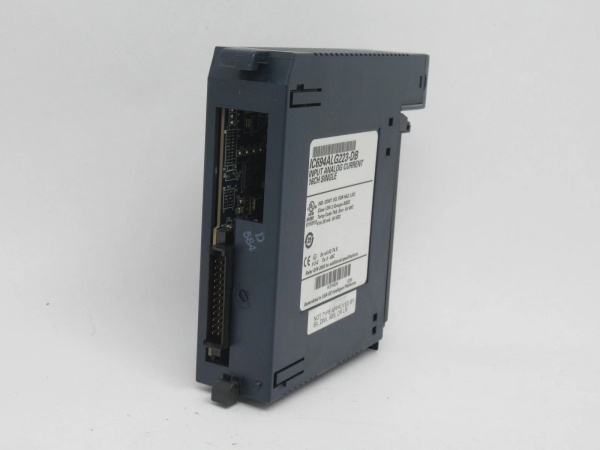
GE IC694ALG223
Field Service Pitfalls: What Rookies Get Wrong
Duty Cycle Limits at High Frequencies
The 1 MHz spec assumes 25%–87% duty cycle. Narrow spikes or asymmetric pulses outside this range will cause missed counts. I’ve seen techs chase “faulty modules” when the real problem was a sensor outputting 10% duty-cycle pulses.
Field Rule: Always verify pulse width and duty cycle with an oscilloscope—not just frequency—before commissioning high-speed applications.
Forgetting to Configure Enhanced Mode
Classic mode ships as default. If you need 32-bit counters, differential encoder support, or Z-input capture, you must explicitly enable Enhanced mode in Proficy hardware configuration. No amount of logic changes will unlock those features otherwise.
Quick Fix: After hardware config, verify mode status in the module’s status word before going online with the process.
Wrong Input Voltage Jumper Setting
The TSEL jumper defaults to 10–30 VDC mode. Use a 5 VDC TTL encoder without moving the jumper, and the inputs won’t read reliably. Go the other way—jumper for 5 VDC and feed 24 VDC—and you’ll overdrive the input circuit.
Field Rule: Check TSEL jumper position before landing wires. Match it to your encoder or sensor output voltage, not the field supply.
Commercial Availability & Pricing Note
The IC694APU300 remains actively supported in the GE PACSystems RX3i platform. New units, reconditioned exchanges, and repair services are available through authorized GE distributors and industrial automation specialists.
Typical Price Range (Reference Only):
- New unit: 1,800 – 2,400 USD
- Reconditioned/exchange: 900 – 1,400 USD
- Repair service: 400 – 700 USD
Please note: The listed price is for reference only and is not binding. Final pricing and terms are subject to negotiation based on current market conditions and availability.