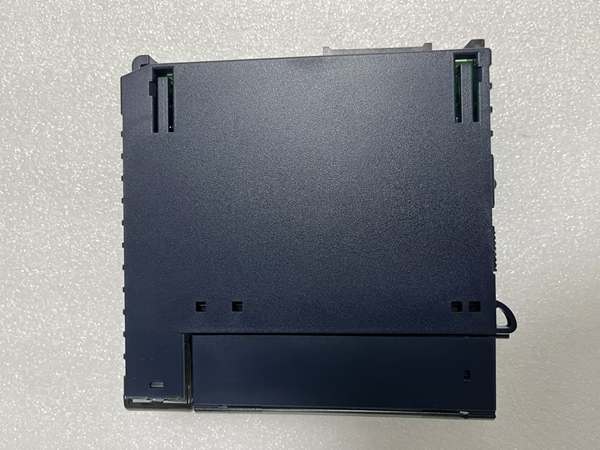
Description
Hard-Numbers: Technical Specifications
- Input Channels: 16 single-ended OR 8 differential (software-configurable)
- Voltage Range: 0 to +10V (unipolar) / -10V to +10V (bipolar)
- Resolution: 12-bit; 2.5mV/count (0-10V) / 5mV/count (±10V)
- Update Rate: 6ms (all 16 SE channels) / 3ms (all 8 diff channels)
- Accuracy: ±0.25% of full scale @ 25°C (77°F)
- Input Impedance: >500kΩ (single-ended mode)
- Isolation Rating: 250VAC continuous / 1500VAC for 1 minute (field-to-backplane, optical)
- Cross-Channel Rejection: >80dB
- Input Filter: 41Hz (single-ended) / 82Hz (differential)
- Operating Temperature: 0°C to +60°C (32°F to 140°F)
- Power Draw: 112mA @ +5VDC (backplane) + 41mA @ +24VDC isolated (external supply required for main rack)
- Hot Swap: Yes—module can be replaced under power
- Certifications: UL, CE, ATEX, Class I Div 2, marine (ABS, BV, DNV, GL, LR)
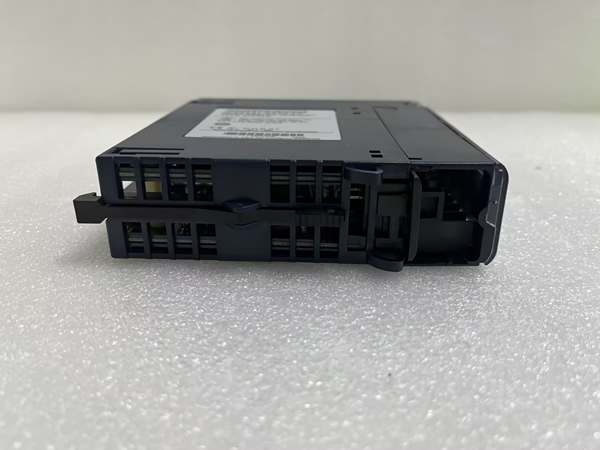
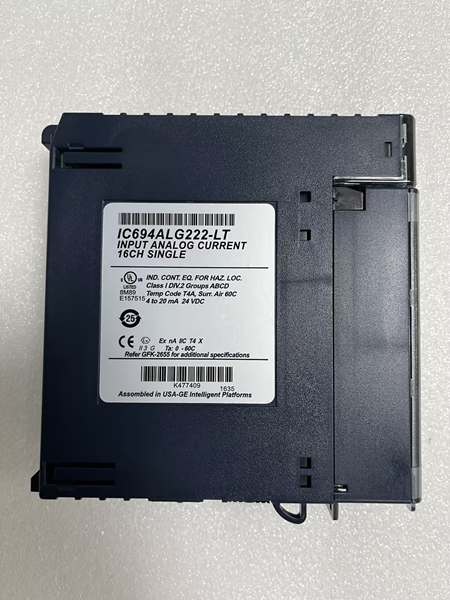
GE IC694ALG222
The Real-World Problem It Solves
You’ve got a dozen position feedback signals from valve actuators, drive speed references, and level transmitters—all putting out 0-10V or ±10V. You need them in one rack slot, not three. The ALG222 packs 16 channels into a single-width module, giving you density without sacrificing isolation.
Where you’ll typically find it:
- Turbine governor systems reading LVDT position feedback (±10V bipolar)
- Paper machine drive stands monitoring speed reference voltages (0-10V)
- Process skids with multiple voltage-output transmitters in tight panel space
Bottom line: Maximum channel count in minimum rack real estate—if your signals are clean enough for single-ended wiring, you get 16 points per card.
Hardware Architecture & Under-the-Hood Logic
The ALG222 sits on the RX3i backplane as an intelligent I/O module with its own A/D conversion circuitry. It does not have an onboard microprocessor for autonomous processing—all configuration and scaling happens in the CPU. The module uses a multiplexed architecture: all channels share a single A/D converter, which is why the scan time increases with channel count.
Signal path step-by-step:
- Field wiring terminates at a 20-screw terminal block (included). Each input connects to a dedicated analog front-end with overvoltage protection.
- Input signal passes through a passive RC filter (41Hz cutoff for SE, 82Hz for diff) to knock down high-frequency noise before sampling.
- A multiplexer selects one channel at a time and routes it to the 12-bit successive-approximation ADC. Conversion takes roughly 0.4ms per channel.
- Optical isolation sits between field side and backplane logic—1500VAC for one minute is the test spec, 250VAC continuous is the working limit. No channel-to-channel isolation; all inputs share a common reference in SE mode.
- Digital value is written to the backplane via the serial bus. The CPU reads it on the next scan.
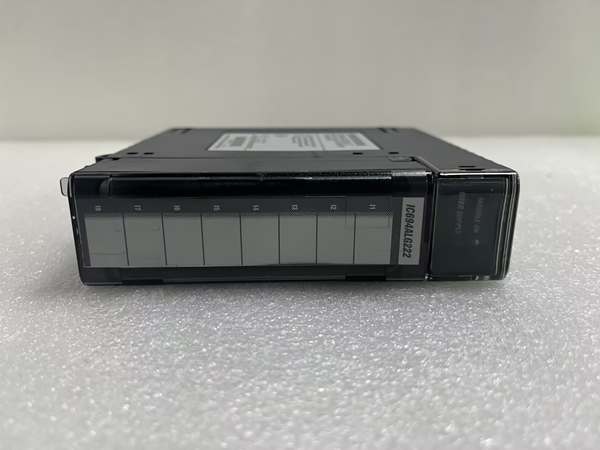
GE IC694ALG222
Field Service Pitfalls: What Rookies Get Wrong
Wiring Mode Trap: Single-Ended vs. DifferentialThe module gives you 16 channels OR 8 channels—not both. Rookies wire up 16 signals in single-ended mode, then wonder why they’re picking up VFD hash. Single-ended references all signals to a common ground at the module. If your field devices have different ground potentials, you get ground loops. Differential mode uses two wires per signal and rejects common-mode noise, but it halves your channel count.
- Field Rule: Use differential for any signal running more than 10 meters, near VFDs, or in electrically noisy areas. Single-ended is fine for short, clean runs inside a cabinet.
External 24VDC Power RequirementThis module needs isolated +24VDC to power its field-side circuitry. If you plug it into a Universal Backplane (main rack), it won’t power up without an external supply connected to TB1 on the left side of the backplane. Expansion racks have built-in 24V supplies. I’ve seen guys swap modules into the main rack and stare at a dark “Module P/S” LED for an hour.
- Quick Fix: Check where the module lives. Main rack = external 24VDC. Expansion rack = backplane supply. The LED tells you—Module P/S should be solid green.
No Channel-to-Channel IsolationThe isolation is field-to-backplane only. All 16 inputs share a common internal ground in single-ended mode. If you short one input to 24V, you can damage the entire input stage. If you’re mixing 4-20mA loops (current) with voltage inputs, don’t—this module is voltage-only. ALG221/223 are for current.
- Field Rule: Never mix signal types on the same card. If one channel smokes, the whole module is suspect.
Commercial Availability & Pricing Note
Please note: The listed price is for reference only and is not binding. Final pricing and terms are subject to negotiation based on current market conditions and availability.