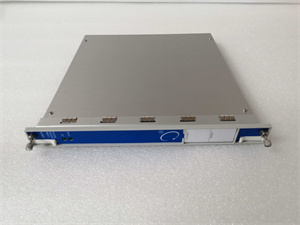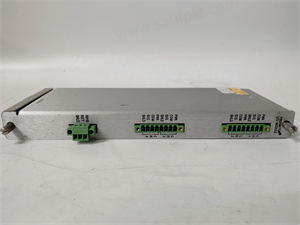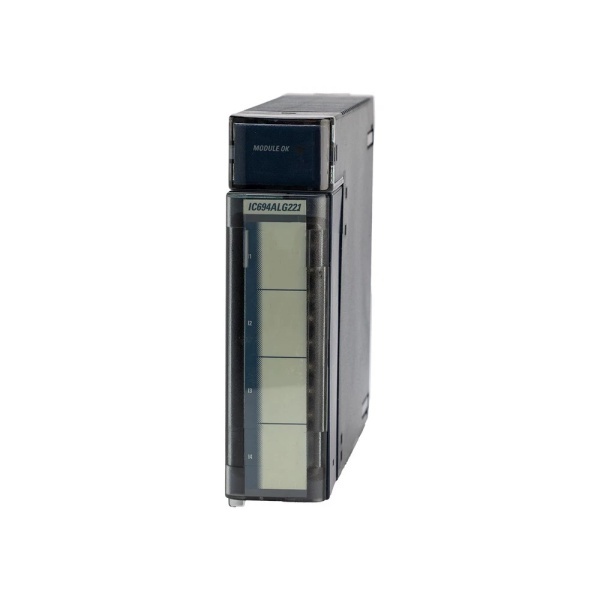
Description
Hard-Numbers: Technical Specifications
- Channels: 4 analog inputs (differential)
- Current Range: 4-20 mA (default) / 0-20 mA (jumper selected)
- Resolution: 12-bit (4 µA/count at 4-20mA; 5 µA/count at 0-20mA)
- Conversion Speed: 0.5 ms per channel
- Update Rate: 2 ms for all four channels
- Input Filter Response: 325 Hz
- Input Impedance: 250 ohms
- Common Mode Voltage: 200 V (survives with reduced performance)
- Isolation Rating: 250 VAC continuous; 1500 VAC for 1 minute (optical, field-to-backplane)
- Common Mode Rejection: >70 dB at DC and 60 Hz
- Cross-Channel Rejection: >80 dB (DC to 1 kHz)
- Absolute Accuracy: 0.1% full scale + 0.1% reading
- Power Draw: 25 mA @ +5VDC (backplane) + 100 mA @ +24VDC isolated
- Calibration: Factory calibrated (no field trim pots)
- Hot Swap: Not supported—power down before insertion/removal
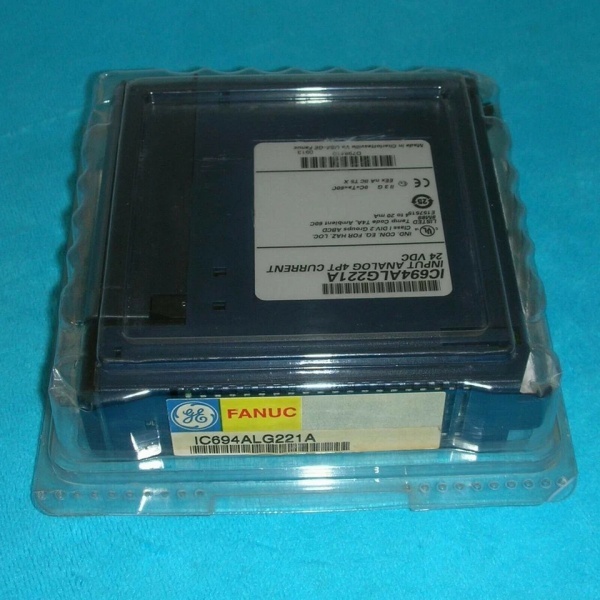
GE IC694ALG221
The Real-World Problem It Solves
Your process transmitters—pressure, level, flow, temperature—put out standard 4-20mA loop signals. You need to read them accurately without burning channels on a voltage input card. This module is purpose-built for current loops, with the internal 250Ω burden resistor already on the board. No external shunts, no jumper hacks.
Where you’ll typically find it:
- Pressure and level transmitter inputs in water/wastewater plants
- Flow meter signal conditioning in chemical processing
- Temperature transmitter loops where 4-20mA is the standard
If your signal is current-only, this card eliminates the guesswork. Don’t use it for voltage—use the ALG220 for that.
Hardware Architecture & Under-the-Hood Logic
This module uses optical isolation between field wiring and the backplane, which is your first line of defense against ground loops and transient spikes. The 250Ω input impedance creates the voltage drop that the ADC reads—4mA gives you 1V, 20mA gives you 5V internally.
- Current Loop Entry – The 4-20mA signal enters through the (+) terminal, passes through a precision 250Ω resistor inside the module, and exits through the (-) terminal. This resistor converts current to voltage for the ADC.
- Range Selection via Jumpers – Two hardware jumpers on the terminal block select between 4-20mA (default, no jumper) and 0-20mA (jumper installed). Jumper 1 controls channels 1-2; Jumper 2 controls channels 3-4. You can’t mix ranges within a jumper pair.
- A/D Conversion and Multiplexing – Each channel converts in 0.5 ms. The multiplexer cycles through all four, giving a 2 ms update across the board. The 12-bit ADC outputs raw counts directly to the CPU—scaling happens in your PLC program, not in hardware.
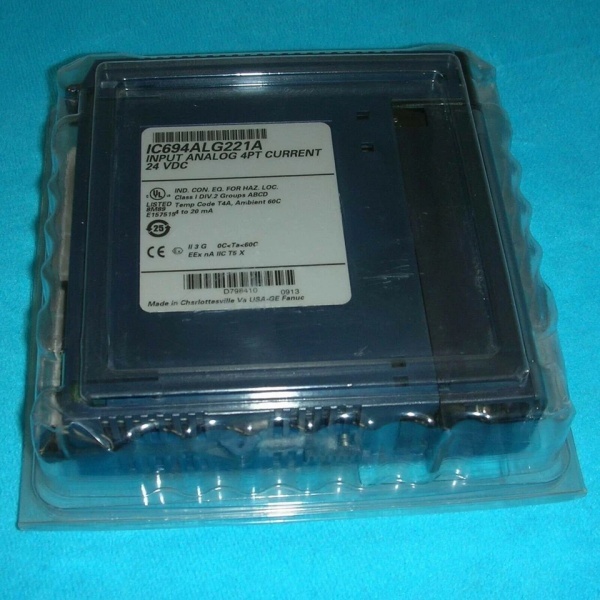
GE IC694ALG221
Field Service Pitfalls: What Rookies Get Wrong
Confusing Range Jumper PositionThe default is 4-20mA with the jumper removed. Rookies install the jumper thinking they’re enabling the channel, but they’re actually switching it to 0-20mA range. Now the 4mA live zero reads as 20% of scale instead of 0%.
- Quick Fix: No jumper = 4-20mA. Jumper installed = 0-20mA. Check your terminal block before powering up, and verify the expected raw count matches the transmitter output.
Wiring a Voltage Signal to a Current CardSomeone grabs the wrong card or the wrong terminal block slot and lands a 0-10V signal here. The module sees near-zero current because the input impedance is only 250Ω—the voltage source can’t push enough current through that low resistance.
- Field Rule: If you’re seeing flatlined inputs on a supposedly healthy transmitter, check whether you’ve landed a voltage signal on a current card. Swap to ALG220 or rewire the signal.
Loop Power from the Wrong SourceThis module does not power the loop. It’s a passive input. If your transmitter needs 24V loop power, you must supply it externally. Hook up a two-wire transmitter with no external supply, and you’ll read nothing.
- Quick Fix: Verify loop power before wiring. Two-wire transmitters need an external 24VDC supply in series. Four-wire transmitters have their own power—just land the signal wires.
Commercial Availability & Pricing Note
Please note: The listed price is for reference only and is not binding. Final pricing and terms are subject to negotiation based on current market conditions and availability.