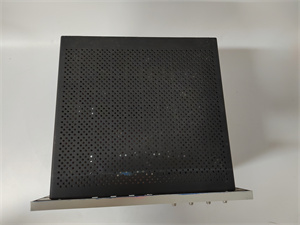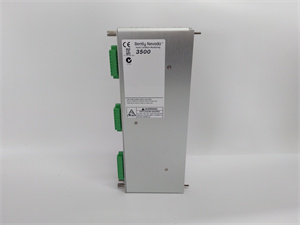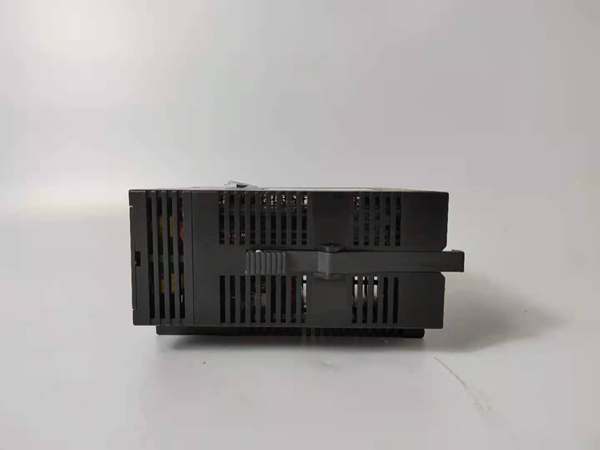
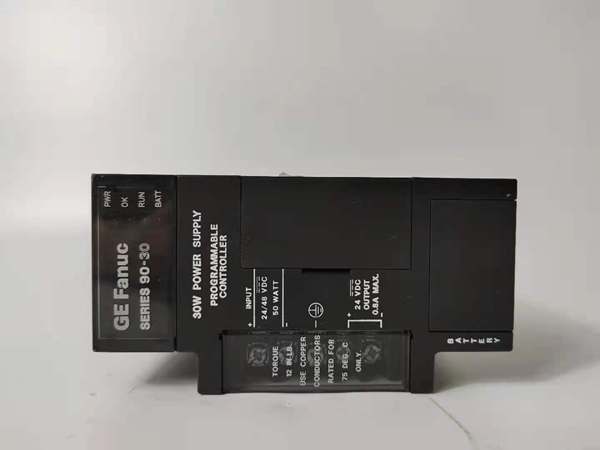
Description
Hard-Numbers: Technical Specifications
- Input Voltage: 120/240 VAC or 125 VDC nominal
- AC Input Range: 85-264 VAC (50/60Hz)
- DC Input Range: 100-300 VDC
- Total Output Capacity: 100W maximum
- +5VDC Output: 5.0-5.2VDC (5.1VDC nominal), 40W max
- +24VDC Relay Output: 24-28VDC, 30W max
- +24VDC Isolated Output: 21.5-28VDC, 40W max
- +5VDC Backplane Current: Approximately 8A maximum
- Input Power: 120VA (AC) / 70W (DC) at full load
- Inrush Current: 10A peak, 250ms maximum
- Holdup Time: 20ms minimum
- Overvoltage Protection: 6.4-7VDC on +5V rail
- Overcurrent Protection: 8A maximum on +5V rail
- Communication: RS-485 serial port (9-pin sub-D connector)
- Operating Temperature: 0-60°C
- Mounting Location: Leftmost slot of baseplate only
- Internal Fuse: GE catalog 44A724627-109 or revision-specific equivalent (verify fuse rating on your specific unit)
- Certifications: CE compliant, cULus listed, Class I Division 2 rated
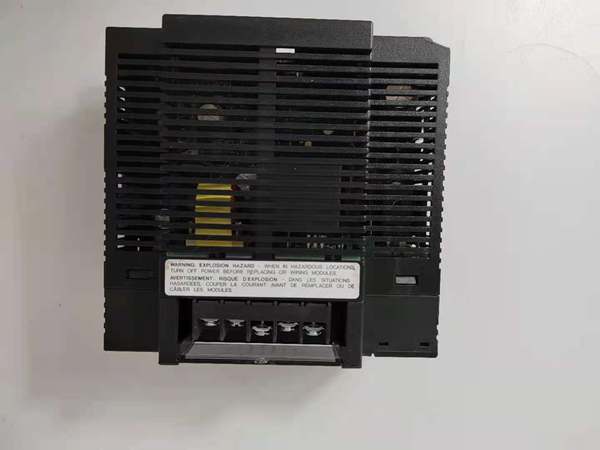
GE IC693PWR322
The Real-World Problem It Solves
The PWR322J solves the same core problem as base PWR322—eliminating dual power supplies in heavily loaded racks where PWR321’s 30W limit causes brownouts. Revision J includes component-level refinements that improve long-term reliability: further upgraded electrolytic capacitors with extended lifespan ratings, reinforced PCB trace routing for the +5VDC high-current path (reducing voltage drop under load), and enhanced thermal coupling between heat-generating components and the heatsink. These aren’t listed in the standard spec sheet, but in the field they translate to fewer voltage sag complaints and better heat dissipation in packed cabinets.
Where you’ll typically find it:
- Oil & gas platform control cabinets with analog-heavy instrumentation racks
- Pulp & paper mill drive line PLCs requiring high current for multiple communication modules
- Metal rolling mill automation systems where cabinet temperatures regularly hit 55-60°C
Bottom line: PWR322J delivers the same 100W punch as earlier PWR322 revisions, but Revision J’s component and thermal improvements make it more resilient in environments that cook lesser supplies.
Hardware Architecture & Under-the-Hood Logic
PWR322J shares identical electrical architecture to base PWR322—AC/DC input, EMI filtering, bridge rectification, high-frequency switching at 100W capacity. The Revision J updates focus on thermal management and current path reinforcement: heavier copper pours on the PCB for the +5VDC output traces (reducing resistance and voltage drop under 8A load), upgraded electrolytic capacitors with 2000-3000 hour lifespan at 105°C (vs 1000-2000 hours in earlier revisions), and improved thermal interface material between power semiconductors and the heatsink.
Internal signal flow and protection logic:
- Input stage: Same beefy EMI filter and bridge rectifier as base PWR322, but Revision J uses higher-lifespan capacitors and improved ferrite material for better EMI suppression in electrically noisy environments.
- Primary switching: Same high-power DC-DC converter architecture. Revision J may include updated switching transistors with lower thermal resistance and improved PCB copper pours for better heat dissipation from the switching stage.
- Output isolation: Three separate secondary windings with higher current capability. Revision J uses upgraded rectifier diodes with better thermal characteristics and reinforced +5VDC output traces to minimize voltage drop under full 8A load.
- Protection circuitry: Same scaled current limiters (8A for +5VDC). Revision J may include improved thermal sensing on the protection circuits—faster thermal shutdown response prevents component damage during overcurrent events that drag on.
- Diagnostic monitoring: Same supervisory circuit architecture. Revision J might include updated threshold tuning on the RS-485 diagnostic registers to provide earlier warning of thermal stress before shutdown occurs—critical in high-ambient applications.

GE IC693PWR322
Field Service Pitfalls: What Rookies Get Wrong
Voltage Drop Misdiagnosis on +5VDC RailRevision J’s reinforced +5VDC traces reduce but don’t eliminate voltage drop under full 8A load. Techs swap earlier revision PWR322 for Revision J expecting to fix “voltage sag” complaints, but the root cause is undersized backplane wiring or corroded terminal connections. The +5VDC still drops 0.2-0.3V under full load—that’s normal, not a supply defect.
Field Rule: Measure voltage at the supply terminals first. If you see 5.1VDC at the supply but 4.7VDC at the far end of the backplane, your problem is wiring or terminal resistance, not the supply. Revision J helps, but it can’t fix undersized conductors or corroded connections.
Fuse Rating Revision MismatchRevision J might use a different internal fuse rating than earlier PWR322 revisions due to component updates. Techs blindly install GE 44A724627-109 (standard PWR321 fuse) without checking Revision J spec sheet and experience premature failures or inadequate protection.
Quick Fix: Pull the fuse from your specific PWR322J unit before replacement and read the catalog number stamped on the fuse end cap. Don’t assume earlier revision fuse ratings carry over—Revision J components might require different protection characteristics. Match the exact catalog number or use a verified cross-reference from GE documentation.
Thermal Expectations in High-Ambient CabinetsRevision J includes better thermal coupling and heatsink interface material, but techs treat it like a magical heat reducer and jam it into already-overheated 60°C ambient cabinets. 100W output is still 100W of heat that needs to go somewhere—Revision J manages it better but doesn’t eliminate the need for proper ventilation.
Field Rule: Design your cabinet thermal management for worst-case 100W load regardless of revision. If your ambient is regularly above 50°C, add forced ventilation or relocate the module away from other heat sources. Don’t bank on Revision J’s thermal improvements to solve a pre-existing cooling problem.
Backplane Current Overconfidence on “Improved” TracesRevision J’s reinforced PCB copper pours reduce voltage drop under load, but techs load it to 100% thinking “the traces can handle it now.” The improvements reduce losses but don’t increase the supply’s rated 8A capacity. Loading to 8A continuous still causes accelerated wear and thermal stress.
Quick Fix: Derate to 80% of rated capacity (6.4A continuous on +5VDC) for reliable operation regardless of revision. Revision J might handle full load slightly longer, but you’re still operating beyond recommended design margins. If you need more than 6.4A continuous, install a second PWR322J rather than pushing one unit to its limit.
Revision Mixing in Existing InstallationsTechs replace a failed PWR322F or PWR322Y with Revision J in an existing installation without checking alarm logic. If your PLC code has hard-coded diagnostic thresholds or alarm delays tuned for earlier revision behavior, Revision J’s improved thermal sensing might trigger nuisance alarms or fail to trigger expected alarms.
Field Rule: After swapping in Revision J, monitor your system for unexpected alarm behavior or missed diagnostics. Revision J’s thermal thresholds might be tighter—your existing alarm logic might need adjustment. Don’t disable alarms; tune them to Revision J’s response characteristics.
Capacitor Aging MisconceptionRevision J uses extended-lifespan capacitors (2000-3000 hours at 105°C), but techs assume this means “never replace” and ignore scheduled maintenance. Extended lifespan buys you time, but doesn’t eliminate aging—especially in high-ambient installations where actual operating temperature exceeds 105°C.
Field Rule: Implement scheduled replacement based on actual operating conditions, not just published specs. If your cabinet runs at 55-60°C ambient, Revision J capacitors still degrade faster than spec sheet suggests. Track installation dates and plan preventive replacement before failure—don’t wait for the red FAULT light.
Commercial Availability & Pricing Note
Please note: The listed price is for reference only and is not binding. Final pricing and terms are subject to negotiation based on current market conditions and availability.