Description
System Architecture & Operational Principle
The IC693MDL930 occupies a single slot on the GE 90-30 universal backplane, functioning as a discrete AC input interface at Level 1 of the Purdue Model (Basic Control). It receives 120V AC signals from field devices (dry contacts, limit switches, pushbuttons) and converts these signals into logic levels readable by the CPU. Upstream, the CPU reads the input state via %I memory mapping during each scan; downstream, the module provides optical isolation and zero-crossing detection to prevent false triggering from contact bounce or voltage transients.
The module’s architectural advantage lies in its 8-point isolation groups—each group of 8 inputs shares a common reference, but groups are isolated from each other. This design prevents ground loops when inputs are sourced from different power supplies or referenced to different grounds, a common issue in facilities with mixed AC grounding schemes. The zero-crossing detection circuitry ensures input state changes are only recognized when the AC waveform crosses zero volts, reducing susceptibility to noise spikes and contact bounce. This makes the IC693MDL930 particularly suitable for noisy electrical environments where DC inputs would be prone to false triggering.
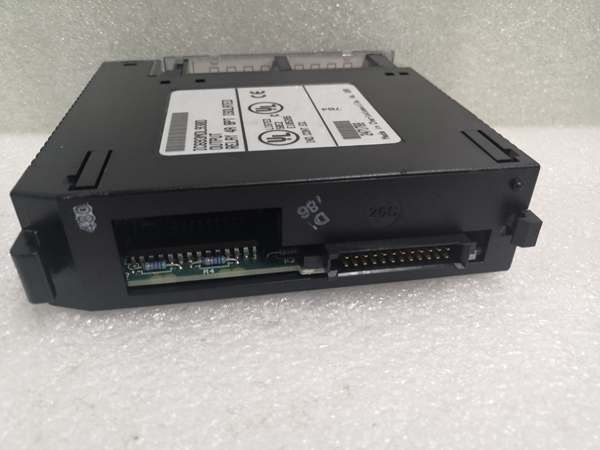
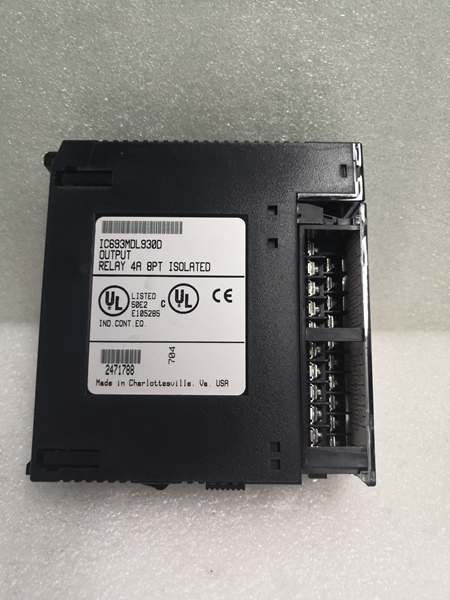
GE IC693MDL930
Core Technical Specifications
- Physical Interface: 40-pin terminal block (2 connectors, 16 points each) or front-facing removable terminal block option
- Input Type: 32-point discrete input, 120V AC, isolated inputs (8-point groups)
- Input Voltage Range: 90-132V AC at 47-63 Hz (nominal 120V AC)
- Input Current: 12mA per point at 120V AC
- Isolation: 1500V RMS optical isolation between field side and backplane; 250V RMS isolation between input groups (8 points per group)
- Backplane Current Draw: Approximately 480mA @ 5V DC
- Response Time: 20-40ms typical (zero-crossing detection adds inherent delay)
- LED Indicators: Individual LEDs per input point (ON when input energized) plus module status LEDs
- Environmental: Operating temperature 0°C to 60°C (32°F to 140°F), humidity 5-95% non-condensing
- Terminal Block: 40-pin plug-in terminal block, supports wire gauges 22-14 AWG
- Field Wiring: Each 8-point group requires a dedicated neutral connection; inputs accept dry contacts or sourcing 120V AC signals
- Diagnostic Capabilities: No onboard diagnostics beyond LED indication (discrete module, not intelligent)
- Zero-Crossing Detection: Input state changes recognized only at AC zero-crossing points (every 8.3ms at 60Hz)
Customer Value & Operational Benefits
Isolated Input Groups Eliminate Ground Loop Issues
The IC693MDL930’s 8-point isolation groups are the module’s defining advantage over non-isolated AC input modules. In facilities where inputs are sourced from different 120V AC circuits or referenced to different grounds (common in older plants with expanded electrical infrastructure), ground loops can cause false triggering or input flickering on non-isolated modules. The 930’s group isolation prevents this—each group operates independently, so a ground reference issue on one group does not affect others. This reduces installation complexity in brownfield projects where existing field wiring must be retained, as technicians can mix inputs from different electrical systems without concerns about common-mode noise or ground conflicts.
Zero-Crossing Detection Provides Noise Immunity
The zero-crossing detection circuitry ensures that input state changes are only recognized when the AC waveform crosses zero volts, providing inherent immunity to voltage spikes and contact bounce. In noisy electrical environments (near large motors, transformers, or welding equipment), DC inputs or non-isolated AC inputs may false-trigger from transient noise. The 930’s zero-crossing requirement means that momentary voltage spikes occurring during the AC waveform’s peak are ignored—the input only recognizes sustained signals that span multiple zero-crossings. This reduces nuisance faults and eliminates the need for external filters or signal conditioners in many applications, lowering hardware cost and improving reliability.
32-Point Density Maximizes Cabinet Space Efficiency
With 32 input points in a single slot, the IC693MDL930 reduces the number of I/O modules required for applications with high discrete point counts. Each 32-point module replaces two 16-point modules, freeing backplane slots for other module types or reducing the physical rack size. In space-constrained installations (marine control panels, skid-mounted equipment), this density is critical—it allows more I/O capacity per cabinet footprint without sacrificing individual point indication. The per-point LED status indicators provide fast visual troubleshooting without the need for a laptop or multimeter.
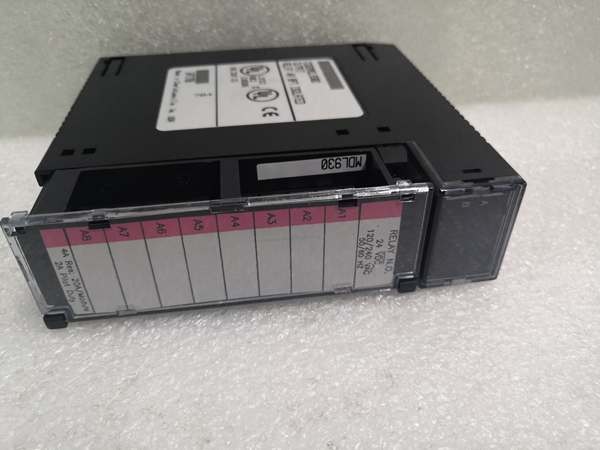
GE IC693MDL930
Field Engineer’s Notes (From the Trenches)
Here’s a gotcha that’s burned me twice on 930 installations: the neutral connections are not shared across all 32 inputs—each 8-point group has its own neutral terminal. I’ve seen techs assume there’s a single common neutral for the entire module and wire all 32 inputs to one neutral, which causes intermittent behavior and potential ground loop issues. The lesson? Verify your terminal block wiring diagram before connecting power. Each group of 8 inputs requires its own neutral connection from the 120V AC source. Also, pay attention to the response time—20-40ms with zero-crossing detection is significantly slower than DC inputs (1-10ms). I’ve seen applications where techs specified a 930 for a high-speed counter input on a conveyor system, then wondered why counts were being missed. The 930 is not suitable for high-speed applications requiring sub-20ms response. Use DC input modules (like the IC693MDL753 series) for photoeyes or encoder inputs where response time matters. Finally, the 930’s backplane current draw is approximately 480mA at 5V DC—higher than many DC input modules. If you’re loading a rack with multiple 930 modules and analog modules, calculate your total backplane current. I’ve encountered cabinets where adding just one 930 pushed the 5V supply from 80% to 95% load, causing intermittent CPU faults during I/O storms.
Real-World Applications
Legacy Manufacturing Equipment Retrofit
In older manufacturing facilities with extensive 120V AC field device infrastructure, the IC693MDL930 enables PLC modernization without replacing hundreds of field devices. The module monitors limit switches, pushbuttons, and selector switches installed decades ago, using existing 120V AC wiring. The isolated input groups accommodate the facility’s mixed electrical infrastructure—some inputs referenced to a grounded neutral, others to an ungrounded system. The zero-crossing detection provides noise immunity in environments with large induction motors and legacy transformers that generate significant electrical noise. Input states map to interlock and sequencing logic—if any critical limit switch or emergency 终止 is activated, the PLC immediately halts the associated process, maintaining the original safety architecture while adding modern PLC control capabilities.
Water Treatment Plant Pump Station Control
In water treatment facilities, the IC693MDL930 monitors 32 discrete inputs from pump status contacts, valve position switches, and level switches across multiple pump stations. The isolated input groups accommodate inputs from different 120V AC control transformers at each station, preventing ground loop issues that would plague non-isolated modules. The zero-crossing detection eliminates false triggers from contact bounce on mechanical level switches and from electrical noise generated by VFD-driven pumps. The per-point LED indicators enable rapid troubleshooting—technicians can visually identify which pump status contact or level switch triggered a process alarm without connecting to the PLC. Input consolidation into a single 32-point module reduces wiring complexity in the crowded control cabinet, and the module’s AC input capability eliminates the need for external AC-to-DC converters.
High-Frequency Troubleshooting FAQ
The primary difference is isolation: provides 8-point isolation groups (250V RMS between groups), while IC693MDL940 has a single common reference for all 32 inputs (non-isolated). The 930 is suitable for applications where inputs are sourced from different 120V AC circuits or different ground references, as each group operates independently. The 940 is designed for applications where all inputs share a common 120V AC source and ground reference. Functionally, both modules are identical in terms of input voltage range, response time, and current draw. Choose the 930 for mixed-source installations or environments prone to ground loop issues; choose the 940 for simpler installations with a common AC source where isolation is not required.
No, the is rated for 120V AC only (90-132V AC range). Applying 240V AC to the inputs will damage the module’s input circuitry and may cause catastrophic failure including smoke or fire. If your application requires 240V AC inputs, use a dedicated 240V AC input module such as the IC693MDL931. Never attempt to use a 930 with 240V AC signals—even momentary overvoltage can destroy the optoisolators and damage the backplane. Always verify the voltage rating of field devices before wiring, and use appropriately rated input modules for each voltage level.
Why do my inputs flicker even with zero-crossing detection?
Input flickering on the , despite zero-crossing detection, typically indicates marginal input voltage, poor contact resistance, or intermittent wiring issues. Measure the input voltage at the terminal block—if it’s below 90V AC or above 132V AC, the input is outside the guaranteed operating range. Common causes include long cable runs with excessive voltage drop, corroded terminal connections, or failing field device contacts. Zero-crossing detection provides noise immunity but does not compensate for marginal voltage sources. If voltage is within range, suspect intermittent connections—check terminal tightness and verify field device contact integrity. The 930’s LEDs respond directly to actual input state, so LED flickering indicates the input signal itself is unreliable.
How do I wire a neutral connection for each 8-point group?
The ‘s terminal block includes separate neutral terminals for each 8-point input group (typically labeled N1, N2, N3, N4). Connect the neutral conductor from your 120V AC source to the appropriate neutral terminal for each group of 8 inputs. Do not daisy-chain neutrals between groups or use a single neutral for the entire module—this violates the isolation design and can cause ground loop issues or intermittent behavior. Each group operates as an independent input circuit with its own reference. When wiring, refer to the terminal block diagram in the module documentation to identify which inputs belong to which group, and ensure each group has its own dedicated neutral connection from the source.
Commercial Availability & Pricing
Please note: The listed price is not the actual final price. It is for reference only and is subject to appropriate negotiation based on current market conditions, quantity, and availability.