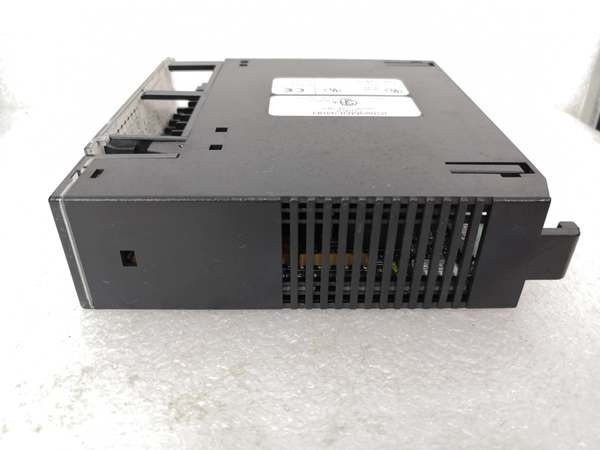
Description
Key Technical Specifications
-
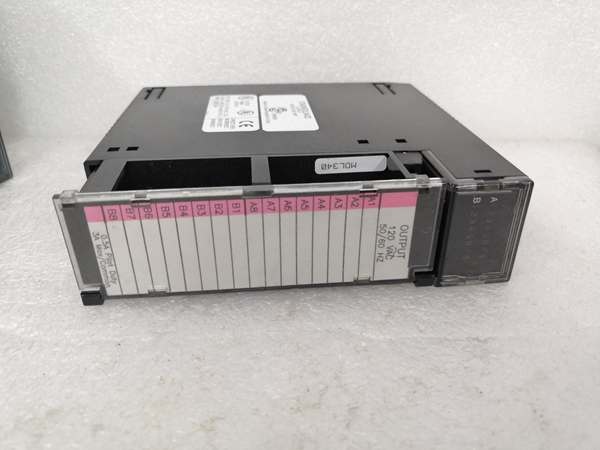
Model Number: IC693MDL340
-
Manufacturer: GE Fanuc / Emerson
-
Output Type: Sourcing (positive logic) AC triac
-
Channels: 16 outputs arranged in two isolated groups of 8
-
Voltage Range: 85–132 VAC, 47–63 Hz (nominal 120 VAC)
-
Current Rating: 0.5 A max per point; 3 A max per group; 4 A total module
-
Inrush Capacity: 20 A for one cycle
-
On-State Drop: 1.5 V max @ 0.5 A
-
Leakage: 1 mA max @ 120 VAC
-
Response Time: ≤ 1 ms ON; ≤ ½ cycle OFF
-
Snubber: RC network on every output for transient protection
-
Fusing: 3 A slow-blow fuse per group (internal, not user-replaceable)
-
Status Indication: 16 green LEDs (one per point); red “F” LED indicates blown group fuse
-
Power Consumption: 315 mA from +5 V back-plane bus when all outputs ON
-
Connector: 20-terminal integrated spring-clamp block (AWG 14-22)
-
Isolation: 1500 VAC for 1 min between field and logic; 500 V group-to-group
- Operating Temperature: 0 °C to +60 °C (conformal-coated)

IC693MDL340
Field Application & Problem Solved
A Series 90-30 PLC controlling a packaging line doesn’t want sixteen separate relays—it wants one card that can drive contactors and pilot lights straight from the 120 VAC plant supply. Slide the IC693MDL340 into any I/O slot, land two wires per point, and you have fused, LED-indicated, snubber-protected outputs ready for PLC commands. When the card fails the whole group drops out and the line stops; swap the module (draw-out style), snap the terminal block back in, and the outputs re-energize exactly as before—no software reload, no re-addressing. Found in every Series 90-30 remote drop from automotive body shops to water-treatment plants. Value is consolidation: one card replaces sixteen relays, a fuse block, and a handful of MOV suppressors.
A Series 90-30 PLC controlling a packaging line doesn’t want sixteen separate relays—it wants one card that can drive contactors and pilot lights straight from the 120 VAC plant supply. Slide the IC693MDL340 into any I/O slot, land two wires per point, and you have fused, LED-indicated, snubber-protected outputs ready for PLC commands. When the card fails the whole group drops out and the line stops; swap the module (draw-out style), snap the terminal block back in, and the outputs re-energize exactly as before—no software reload, no re-addressing. Found in every Series 90-30 remote drop from automotive body shops to water-treatment plants. Value is consolidation: one card replaces sixteen relays, a fuse block, and a handful of MOV suppressors.
Installation & Maintenance Pitfalls (Expert Tips)
Group fuse blow—red “F” LED on, all eight points dead
Each group has a 3 A internal slow-blow fuse. If an output short-circuits the fuse opens and the red “F” LED lights; the LED only works if any load is still connected. Check the LED first; if it’s dark, pull the card and meter the fuse—replace the entire module (fuse is not field-replaceable)
Each group has a 3 A internal slow-blow fuse. If an output short-circuits the fuse opens and the red “F” LED lights; the LED only works if any load is still connected. Check the LED first; if it’s dark, pull the card and meter the fuse—replace the entire module (fuse is not field-replaceable)
.
Inrush overload—contactors weld the triac
The triac can handle 20 A for one cycle. If you drive a large contactor coil with > 20 A in-rush the junction fuses and the output stays on. Size the contactor coil or add an interposing relay—otherwise you’ll be explaining why the motor won’t stop.
The triac can handle 20 A for one cycle. If you drive a large contactor coil with > 20 A in-rush the junction fuses and the output stays on. Size the contactor coil or add an interposing relay—otherwise you’ll be explaining why the motor won’t stop.
Wire size cheat—spring clamp cracks, intermittent fault
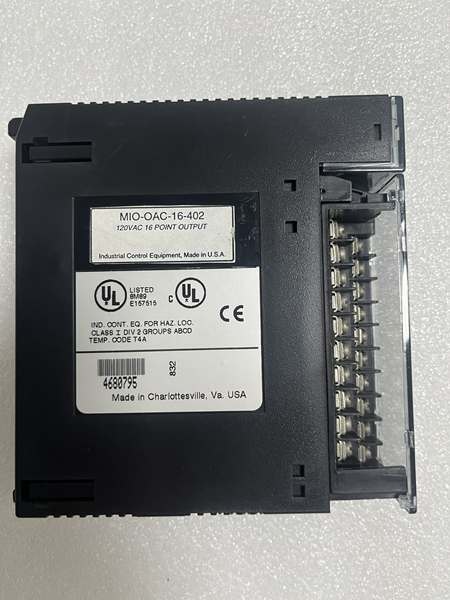
The 20-terminal block accepts AWG 14-22 one wire or two AWG 18. If you force two #14s the spring cracks and the point drops out under vibration. Use a ferrule or step down to #18 for doubles—torque to 0.5 N·m.
The 20-terminal block accepts AWG 14-22 one wire or two AWG 18. If you force two #14s the spring cracks and the point drops out under vibration. Use a ferrule or step down to #18 for doubles—torque to 0.5 N·m.
IC693MDL340
Reverse polarity on AC common—fuse blows instantly
The module is AC only; land DC on the output common and the fuse blows before you can blink. Meter the supply—verify 120 VAC, 50/60 Hz, before you energize.
The module is AC only; land DC on the output common and the fuse blows before you can blink. Meter the supply—verify 120 VAC, 50/60 Hz, before you energize.
Technical Deep Dive & Overview
IC693MDL340 is a triac-based output slice frozen in 1990s silicon. A 5 V logic interface latches the PLC word, drives sixteen triacs, and reports fuse/status back to the CPU over the internal parallel bus. Because the module is group-fused and snubber-protected you can swap it hot—just kill the 120 VAC field supply first or you’ll arc-weld the 20-terminal plug. Treat the field terminals like a DIN-rail block and the card will keep the contactors pulling for another thirty years
IC693MDL340 is a triac-based output slice frozen in 1990s silicon. A 5 V logic interface latches the PLC word, drives sixteen triacs, and reports fuse/status back to the CPU over the internal parallel bus. Because the module is group-fused and snubber-protected you can swap it hot—just kill the 120 VAC field supply first or you’ll arc-weld the 20-terminal plug. Treat the field terminals like a DIN-rail block and the card will keep the contactors pulling for another thirty years
.