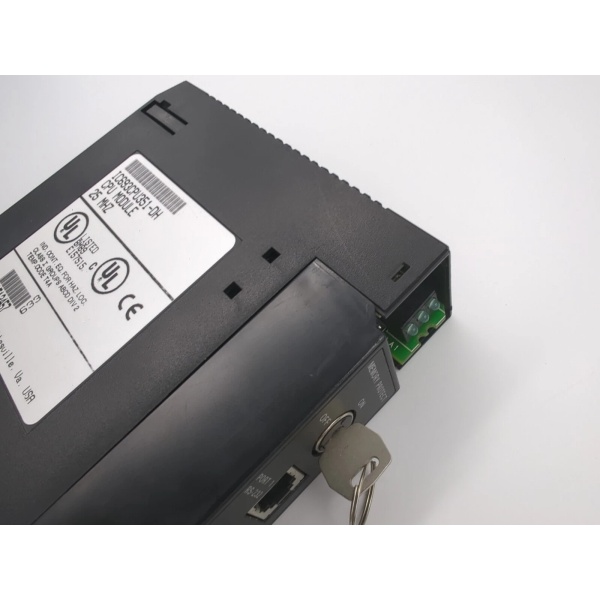
Description
Hard-Numbers: Technical Specifications
- Processor Type: Intel 80386EX
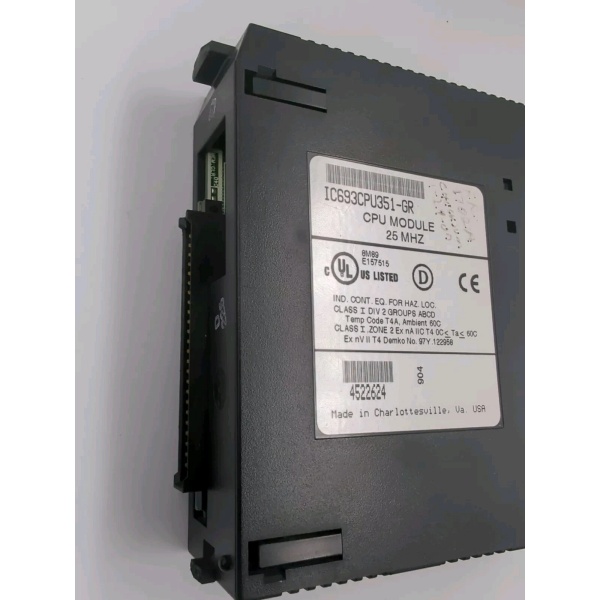
- Processor Speed: 25 MHz
- CPU Form Factor: Single-slot module
- User Memory: 240 KB maximum (Firmware 9.0+), 80 KB fixed (Firmware prior to 9.0)
- Register Memory (%R): Configurable 128 to 32,640 words (128-word increments) with Windows programmer
- Analog Input Memory (%AI): Configurable 128 to 32,640 words (128-word increments) with Windows programmer
- Analog Output Memory (%AQ): Configurable 128 to 32,640 words (128-word increments) with Windows programmer
- Discrete Input Points (%I): 2,048
- Discrete Output Points (%Q): 2,048
- Total Discrete I/O: 4,096 points (2,048 in + 2,048 out)
- Internal Coils (%M): 4,096 bits
- Temporary Coils (%T): 256 bits
- Global Memory (%G): 1,280 bits
- System Status References (%S): 128 bits (32 bits each: %S, %SA, %SB, %SC)
- Timers/Counters: >2,000 (depends on available user memory)
- Typical Scan Rate: 0.22 milliseconds per 1K of Boolean logic
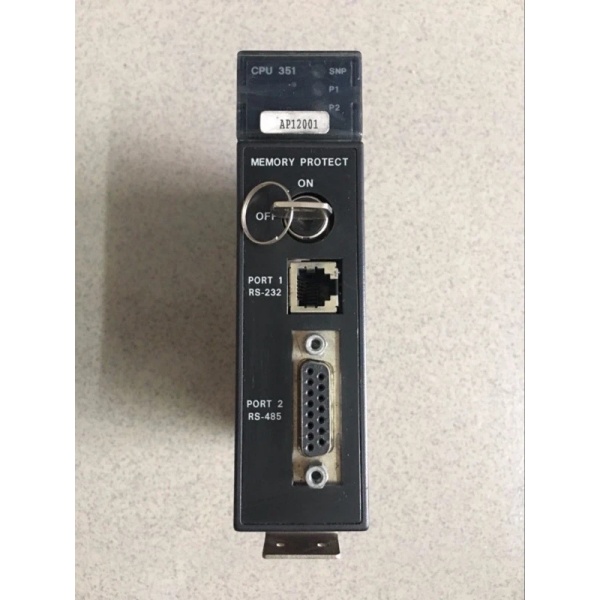
- Serial Ports: 3 (Power connector port: SNP/SNPX slave; Port 1 & 2: RS-232/RS-485, SNP/SNPX master/slave, RTU slave, Serial I/O)
- Backplane Power Requirements: 5V DC, 890 mA maximum current draw
- Operating Temperature: 0°C to 60°C (32°F to 140°F)
- Total Baseplates per System: 8 (1 CPU baseplate + 7 expansion/remote baseplates)
- Memory Type: RAM and Flash
- Battery-Backed Clock: Yes
- Override Feature: Yes
- Interrupt Support: Periodic subroutine feature supported
- Floating-Point Math: Yes (Firmware 9.0 and later)
- Programming Languages: Ladder logic, SFC, C language support
- Communication Modules Supported: Ethernet, FIP, PROFIBUS, GBC, GCM, GCM+ (requires option modules)
- Key Switch: Yes (RUN/STOP/OFF positions)

GE IC693CPU351DH
The Real-World Problem It Solves
This CPU eliminates processing bottlenecks in mid-range automation systems by providing faster scan times and larger memory capacity compared to standard Series 90-30 CPUs. Its floating-point math capability enables precise analog calculations and complex control algorithms without external coprocessors.
Where you’ll typically find it:
- Manufacturing assembly lines with complex motion control requirements
- Water treatment plants requiring extensive analog processing for PID control loops
- Material handling systems with high-speed sorting and conveyor logic
Bottom line: It’s your workhorse CPU for applications that outgrow entry-level processors but don’t require the premium cost of high-end models.
Hardware Architecture & Under-the-Hood Logic
This CPU contains its own Intel 80386EX microprocessor operating at 25 MHz, executing user programs stored in RAM and Flash memory. The processor communicates with I/O modules across the backplane via the Series 90-30 bus architecture.
Signal flow breakdown:
- Power supply provides 5V DC to backplane; CPU draws up to 890 mA for operation
- Intel 80386EX processor fetches and executes user program instructions from RAM/Flash memory
- Input data is read from discrete and analog I/O modules via backplane communication
- Processor executes control logic including Boolean operations, floating-point math, and timer/counter functions
- Output data is written to discrete and analog I/O modules via backplane communication
- Serial ports handle external communication with HMIs, SCADA systems, and programming devices
- Real-time clock maintains timestamped events with battery backup for power loss protection
- Watchdog timer monitors processor health and triggers fault actions on hardware failures
- Optional communication modules (Ethernet, PROFIBUS, etc.) interface via backplane expansion slots
- Configuration data and user parameters are stored in Flash memory for non-volatile retention
GE IC693CPU351DH
Field Service Pitfalls: What Rookies Get Wrong
Insufficient Power Supply CapacityNew engineers calculate total I/O current draw but forget the CPU alone requires 890 mA at 5V DC, leading to intermittent failures or shutdowns under load.
- Field Rule: Always verify power supply capacity includes full CPU current (890 mA) plus all module current requirements. Use a power supply with at least 20% headroom.
Firmware IncompatibilityTechs attempt to load programs requiring floating-point math onto older firmware versions (pre-9.0), causing runtime errors and unpredictable behavior.
- Field Rule: Check firmware revision before loading programs. Upgrade to firmware 9.0 or later if floating-point math is required. Always backup existing programs before firmware upgrades.
Memory Configuration ErrorsEngineers allocate excessive memory to %R, %AI, or %AQ without verifying available capacity, causing memory overflow faults and program corruption.
- Field Rule: Calculate total memory allocation (logic + %R + %AI + %AQ) and verify it stays within 240 KB limit. Use programming software memory map to monitor usage during development.
Battery Replacement TimingMaintenance teams wait for the BATT LED to illuminate before replacing the lithium battery, risking data loss during power interruptions.
- Field Rule: Replace lithium battery every 3-5 years regardless of LED status. Always perform a complete program backup before battery replacement. Power down the CPU during replacement to prevent memory corruption.
Serial Port Wiring ConfusionRookies mix up RS-232 and RS-485 wiring on Ports 1 and 2, causing communication failures with HMIs and programming devices.
- Field Rule: Port 1 is RS-232 (3-wire: TX, RX, GND) for direct device connection. Port 2 is RS-485 (2-wire: Data+, Data-) for multi-drop networks. Verify pinout diagrams before termination.
Overlooking Heat DissipationInstallers mount CPUs in cramped cabinets without adequate airflow, leading to thermal shutdowns and premature component failure in high-temperature environments.
- Field Rule: Maintain minimum 50mm clearance above and below CPU module. Ensure cabinet ventilation provides adequate airflow for ambient temperatures approaching 60°C. Monitor CPU temperature during initial startup.
Please note: The listed price is for reference only and is not binding. Final pricing and terms are subject to negotiation based on current market conditions and availability.