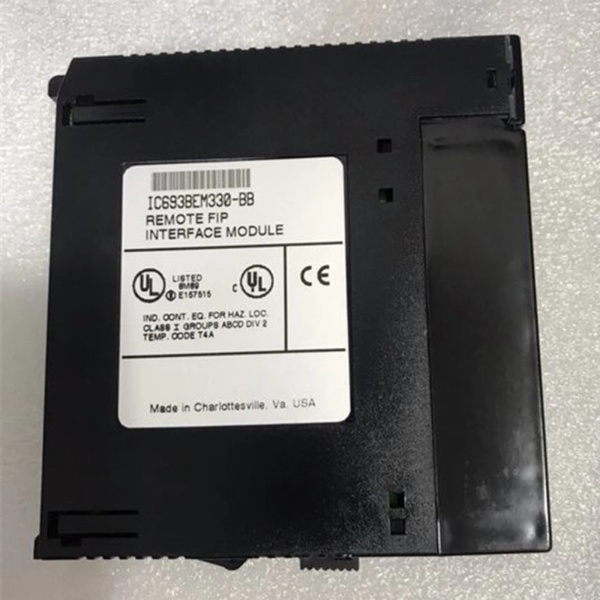
Description
Hard-Numbers: Technical Specifications
- Interface Type: Genius Bus Controller (GBC)
- Network Type: Genius I/O Serial Bus
- Physical Layer: Single twisted pair cable, RS-485 compatible
- Bus Length: Up to 7500 feet (2286 meters) per segment
- Maximum Drops: Supports 4 drop positions per module, up to 30 Genius I/O blocks total on the network
- Global Data Capacity: 1536 bytes total (768 inputs + 768 outputs)
- External Ports: 4 ports for connecting Hand-Held Monitors (HHM)
- Configuration Software: Logicmaster 90-30, VersaMax, or Proficy Machine Edition
- LED Indicators: OK, BUS, CONFIG, ERROR (status indicators for diagnostics)
- Power Consumption: 800 mA @ 5 VDC from backplane
- Isolation: 1500 VAC between field side and backplane
- Operating Temperature: 0°C to +60°C (32°F to +140°F)
- Storage Temperature: -40°C to +85°C (-40°F to +185°F)
- Humidity: 5–95% non-condensing
- Lifecycle Status: Discontinued/Obsolete

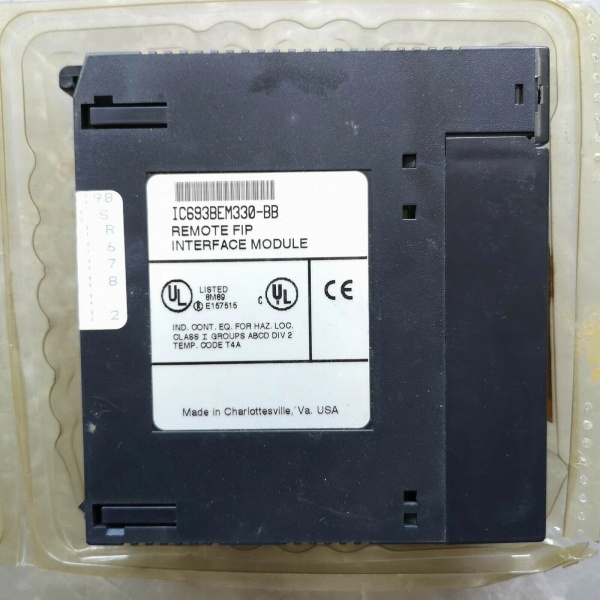
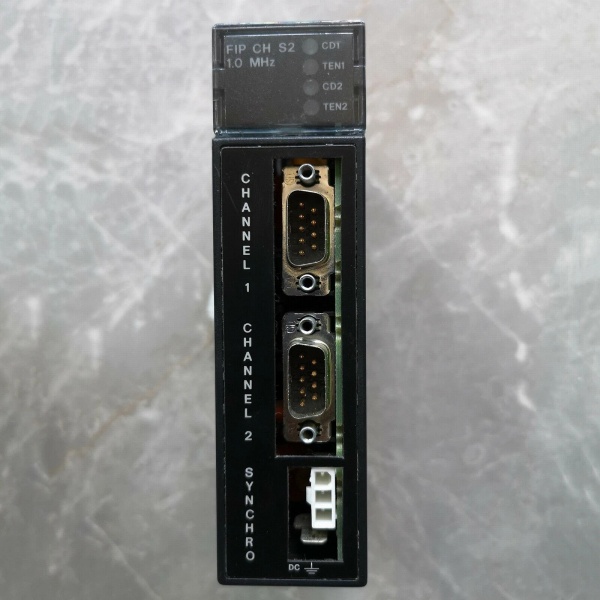
GE IC693BEM330
The Real-World Problem It Solves
Standard PLC I/O wiring requires long multi-core cable runs between remote field devices and the central controller rack, leading to high installation costs, complex troubleshooting, and vulnerability to electrical noise and cable damage. The IC693BEM330 eliminates these issues by using a single twisted-pair cable to communicate with up to 30 distributed Genius I/O blocks located thousands of feet away, reducing wiring complexity and providing robust distributed control architecture.
Where you’ll typically find it:
- Manufacturing automation: Distributed sensor and actuator control across large factory floors with multiple production lines
- Material handling: Conveyor systems, sorting systems, and automated warehouses requiring I/O points scattered across large facilities
- Process industries: Water/wastewater treatment plants with remote pump stations and tank farms
- Automotive assembly: Assembly line control with distributed I/O at multiple workstations along the line
Bottom line: The IC693BEM330 enables cost-effective, flexible distributed I/O architecture by replacing multi-core cable bundles with a single network cable, reducing installation labor and troubleshooting time while providing reliable communication over long distances.
Hardware Architecture & Under-the-Hood Logic
The IC693BEM330 is a single-slot Genius Bus Controller module that bridges the Series 90-30 backplane with the Genius I/O serial network. It manages global memory mapping between the PLC and remote Genius blocks, handles token-passing network protocols, and provides diagnostic capabilities for network health monitoring. The module operates independently of the PLC scan cycle for network communication, using a dedicated processor for bus management.
-
Network Interface Layer
- RS-485 transceiver provides physical layer connectivity over twisted pair
- Support for single-wire bus topology up to 7500 feet
- Automatic baud rate detection (supports up to 153.6 Kbps on extended bus)
- Electrical isolation (1500 VAC) between network and backplane
-
Processor & Memory Architecture
- Dedicated microprocessor manages Genius protocol and token passing
- 1536 bytes global data memory organized as 768 input + 768 output bytes
- Global memory mapping allows PLC CPU to read/write remote I/O data transparently
- Dual-port buffer architecture for non-blocking data exchange between network and backplane
-
Drop Position Management
- 4 configurable drop positions per module
- Each drop can connect multiple Genius I/O blocks via daisy-chain
- Supports up to 30 total Genius blocks across all drops on the network
- Automatic block addressing and configuration discovery
-
Global Data Exchange Mechanism
- PLC writes output data to global memory, GBC transmits to remote blocks
- Remote blocks write input data to global memory, GBC transmits to PLC
- Data exchange occurs transparently to PLC program
- Configurable update rates (default 10-20 ms scan time)
-
Hand-Held Monitor (HHM) Interface
- 4 external ports for HHM connection at different network locations
- Allows on-site diagnostics and configuration without PLC software
- Real-time monitoring of I/O status and network health
- Password protection for configuration security
-
Diagnostic & Error Handling
- LED indicators provide instant visual status (OK, BUS, CONFIG, ERROR)
- Comprehensive fault detection for network errors, communication timeouts, and block failures
- Automatic reconfiguration on block addition or removal
- Configuration stored in non-volatile memory for power-up recovery
GE IC693BEM330
Field Service Pitfalls: What Rookies Get Wrong
Exceeding the 7500-foot bus length limit
Rookies extend the Genius bus beyond 7500 feet to reach a remote pump station. Signal degradation causes intermittent communication failures, and the PLC loses contact with critical I/O blocks at random intervals.
- Field Rule: Never exceed 7500 feet per bus segment. For longer distances, install a Genius Bus Extender or create a multi-segment network with repeaters. Measure cable length during installation and document it in the as-built drawings.
Improper termination at bus ends
Rookies leave the Genius bus unterminated or install termination at the wrong locations. Signal reflections cause communication errors and the network randomly drops blocks.
- Field Rule: Install termination resistors (120 Ω) at the two physical ends of the Genius bus only. Never terminate in the middle or daisy-chain segments. Verify termination is in place using the HHM diagnostic mode.
Mixing block types on the same drop
Rookies mix analog and discrete Genius blocks on the same drop without considering data capacity. Global memory fills up and some I/O points are not updated, causing process drift and control issues.
- Field Rule: Plan global memory allocation before installation. Calculate total I/O requirements per drop and ensure they fit within the 1536-byte global memory limit. For large I/O counts, use multiple GBC modules or distribute blocks across different drops.
Using unshielded cable for long runs
Rookies run 2000-foot bus segments with unshielded twisted pair. Electrical noise from VFDs and motors causes random communication failures and corrupted data.
- Field Rule: Always use shielded twisted pair cable for Genius bus, especially for runs longer than 100 feet. Ground the shield at the GBC end only—never at both ends. For 7500-foot runs, install additional ground rods every 1000 feet and bond the cable shield at these points.
Not verifying global memory mapping
Rookies configure Genius blocks but don’t verify the global memory addresses in the PLC program. The PLC reads data from the wrong memory locations, causing incorrect I/O values and unpredictable machine behavior.
- Field Rule: After configuration, use the HHM to verify block addresses and global memory mapping. Cross-reference the global memory addresses with the PLC program %I and %Q references. Perform an I/O checkout by toggling each point and verifying PLC response.
Ignoring drop position numbering
Rookies install Genius blocks but don’t follow sequential drop numbering. The GBC misidentifies blocks and assigns incorrect addresses, causing I/O chaos.
- Field Rule: Number drop positions sequentially from 1 to 4 as they appear on the bus. Each block should have a unique address within its drop. Use the HHM to verify block addressing before finalizing the installation.
Forgetting to configure update rates
Rookies leave update rates at default settings when communicating with high-speed I/O blocks. The update rate is too slow, and the PLC misses fast-changing process signals.
- Field Rule: Configure update rates based on application requirements. For analog blocks, 100-200 ms is adequate. For high-speed discrete blocks, set update rates to 10-20 ms. Balance update rate with network traffic—faster updates consume more bandwidth.
Connecting HHM during operation
Rookies connect the Hand-Held Monitor to the network while the system is running. The connection causes a brief network interruption, dropping blocks and triggering alarms.
- Field Rule: Only connect the HHM to an unused HHM port. Never disconnect or connect HHM while the PLC is in RUN mode unless it’s an emergency diagnostic situation. For routine diagnostics, connect to a spare port and verify the network status before accessing active blocks.
Commercial Availability & Pricing Note
Please note: The listed price is for reference only and is not binding. Final pricing and terms are subject to negotiation based on current market conditions and availability.