Description
3. Key Technical Specifications
| Parameter | Value |
|---|---|
| Output Channels | 8 single-ended, individually configurable |
| Current Ranges | 4-20mA, 0-20mA |
| Voltage Ranges | 0-10V unipolar, -10V to +10V bipolar |
| Resolution | 0.5µA/LSB (4-20mA), 0.625µA/LSB (0-20mA), 0.3125mV/LSB (voltage) |
| Absolute Accuracy | ±0.1% FS (current), ±0.25% FS (voltage) @ 25°C |
| Update Rate | 8ms (all 8 channels) |
| Isolation | 250VAC continuous (field to backplane); 1500VDC for 1min |
| Power Consumption | 110mA from +5VDC backplane; 315mA from +24VDC user supply |
| External Supply | 20-30VDC (10% ripple max) |
| Hazardous Location Certification | ATEX Group 2, Category 3, II 3 GD |
| User Load (Current) | 0-850Ω (20V supply) to 1350Ω (30V supply) |
| Output Load (Voltage) | 5mA max, 2kΩ min resistance |
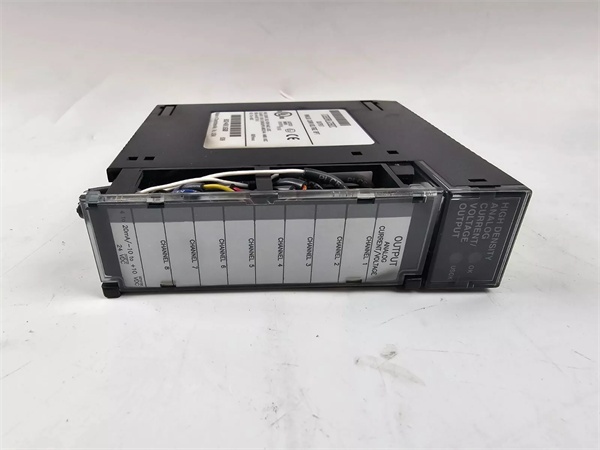
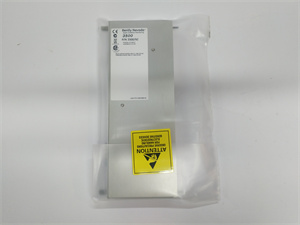
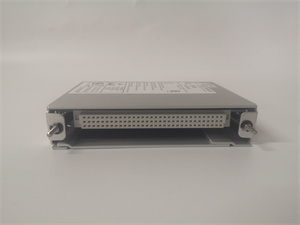
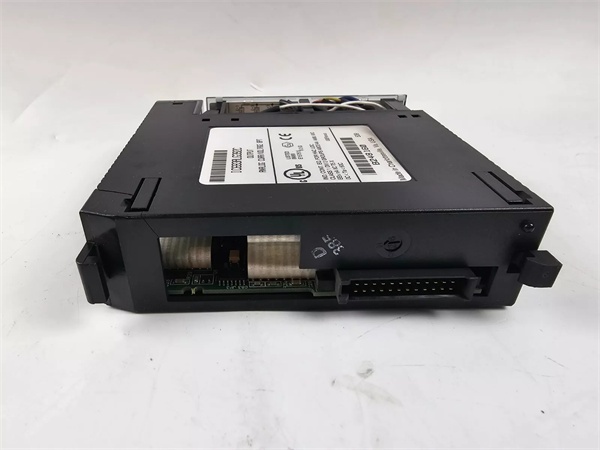
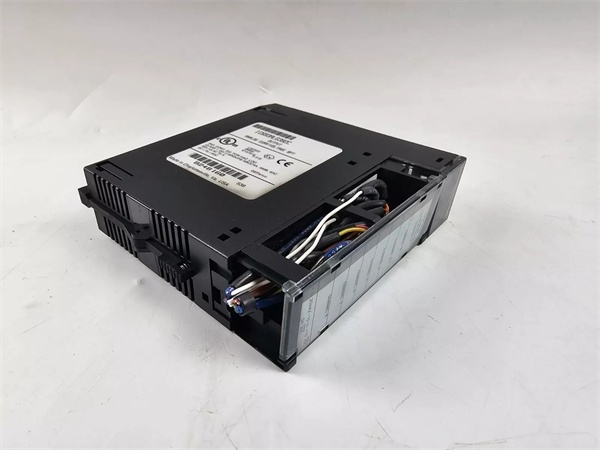
IC693ALG392
4. Product Introduction
This 8-channel analog output module is designed for Series 90-30 PLC systems requiring hazardous area certification. Each channel is independently software-configurable for multiple current (4-20mA/0-20mA) and voltage (0-10V/-10V to +10V) ranges without requiring hardware adjustments.
The unit maintains full backward compatibility with earlier revisions while adding ATEX approval for Group 2, Category 3 applications. It features isolated field-side connections and supports open-wire fault detection in current mode, making it suitable for explosive gas and dust environments under IEC 60079 standards.
5. QA & Testing SOP
-
Incoming Inspection: Verify part number and revision “C” against OEM datasheets. Check ATEX labeling and certification markings are intact. Trace lot codes to confirm manufacturing origin and certify the unit has not been exposed to prohibited environments (Group I mining applications are NOT supported).
-
Live Testing: Power up in a Series 90-30 test rack with +5VDC backplane power and +24VDC external supply connected. Write known values to %AQ registers and measure output current using a calibrated Fluke 773 milliamp clamp meter and precision resistor. Operate under full load (20mA per channel) for 24 hours to confirm stability.
-
Electrical Testing: Verify isolation resistance exceeds 10MΩ between field side and backplane (measured at 500VDC) as required for ATEX compliance. Test power supply switching by applying 24VDC external supply; confirm the controller switches from backplane to user power when external voltage >21.5V.
-
Firmware/Config Backup: Record firmware version 1.00 (C revision) and take photos of configuration parameters stored in flash memory. Document ATEX certification expiration dates if applicable (this unit has permanent ATEX approval).
-
Final QC & Packaging: Module passes final visual inspection before being tagged with QC documentation showing measured values at key test points and ATEX certification verification. It ships in anti-static packaging with original terminal block connector included.
6. Installation Pitfalls & Guide
❗ ATEX Zone CompatibilityThe device is certified for ATEX Group 2, Category 3 (Zone 2 gas, Zone 22 dust) only. It is NOT certified for Group 1 (mining) or Category 1/0 (Zone 0/1, Zone 20/21) applications. Installing in a more hazardous zone than rated violates certification and creates serious safety risks.
❗ ATEX Certification ValidityNever install a module with damaged or removed ATEX labels. The certification marking must be legible for compliance audits. Verify the specific Ex mark corresponds to your hazardous area classification (e.g., II 3 GD Ex nA IIC T3 Gc Ex tc IIIC T135°C Dc).
❗ External Power InterruptionIn hazardous environments, configure the unit to reset outputs to zero (not hold last state) upon CPU STOP or power failure. This prevents unexpected actuator movements during emergency shutdown conditions.
❗ Grounding and BondingATEX compliance requires proper equipotential bonding. Connect module frame ground to plant grounding system using minimum 4mm² conductor. Ensure shield connections to terminal 20 (GND) are made on the clean ground side, not on the field side.
4-Step Replacement Guide:
-
Pre-install: Verify hazardous area classification matches module ATEX rating. Document existing configuration and take photos of wiring. Ensure replacement unit has intact ATEX labels and valid certification.
-
Removal: Disconnect external power and backplane connections. Label field wiring to match terminal numbers for easy reconnection. Follow plant hazardous area procedures (work permit required if zone is still classified).
-
Install: Mount replacement unit in same I/O slot. Reconnect field wiring using documented labels. Connect external 24VDC power to terminals 1 (24VIN) and 19 (I COM). Verify grounding connections are secure.
-
Power-on Test: Power up, check OK/USOK LEDs (both ON = normal). Inject test values to confirm output accuracy meets OEM specifications. Document ATEX compliance verification for plant safety records.

IC693ALG392
7. FAQ
Q: What ATEX zones is this unit certified for?A: This module is ATEX Group 2, Category 3 certified for Zone 2 (gas) and Zone 22 (dust) hazardous areas. It is NOT suitable for Zone 0/1 (gas) or Zone 20/21 (dust) applications, nor Group 1 mining environments. Verify your zone classification against the Ex marking on the device label.
Q: Can I use a non-ATEX module in a Zone 2 area?A: No. Zone 2 areas require equipment with appropriate ATEX certification even for lower-risk applications. Installing a non-certified unit in a hazardous area violates local regulations and invalidates your plant’s safety compliance.
Q: Is this unit compatible with the hand-held programmer?A: Yes. Revision C still supports the Series 90-30 Hand-held Programmer, which is useful for field diagnostics in hazardous areas where laptops cannot be used due to explosion risks. Later revisions (BD, BE, CF) removed this capability.
Q: What happens if I install this in a Zone 1 environment?A: This creates a serious safety violation. The module is not designed to contain potential ignition sources that may occur under fault conditions. You could face regulatory penalties, insurance claim denial, and genuine explosion risk. Use ATEX Category 1/0 equipment for Zone 1/0 applications.
Q: Does ATEX certification expire?A: For this module, the ATEX approval is permanent for the device itself. However, the certification may become invalid if (a) the module is modified, (b) ATEX labels are removed or damaged, or (c) the module is repaired by an unauthorized shop that does not maintain ATEX certification procedures.
Q: Can I use this as a replacement for IC693ALG392-BD?A: Yes, with one key advantage: Revision C adds ATEX certification while maintaining the same functionality. If you need hazardous area capability, Revision C is superior. However, ensure your CPU firmware compatibility settings match (16%I for CPU v3.3-4.6, 8/16%I for CPU v5.0+).
Q: What is the Ex marking on this device?A: The ATEX marking is typically II 3 GD Ex nA IIC T3 Gc Ex tc IIIC T135°C Dc, indicating:
- II 3 GD: Group 2, Category 3, Gas and Dust
- Ex nA: Non-sparking for gas
- IIC T3: Gas group IIC, Temperature class T3 (200°C)
- Ex tc: Dust protection by enclosure
- IIIC T135°C: Dust group IIIC, Maximum surface temperature 135°C
- Dc: Dust ignition protection
Q: Does this unit require special installation procedures?A: Yes, beyond standard PLC mounting. Follow IEC 60079-14 requirements for electrical installations in explosive atmospheres. This includes proper conduit sealing, equipotential bonding verification, and maintaining ingress protection (IP) ratings when installed in enclosures opening to hazardous zones.