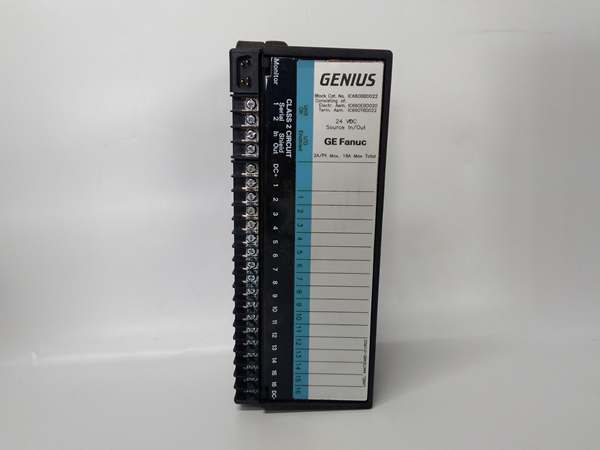
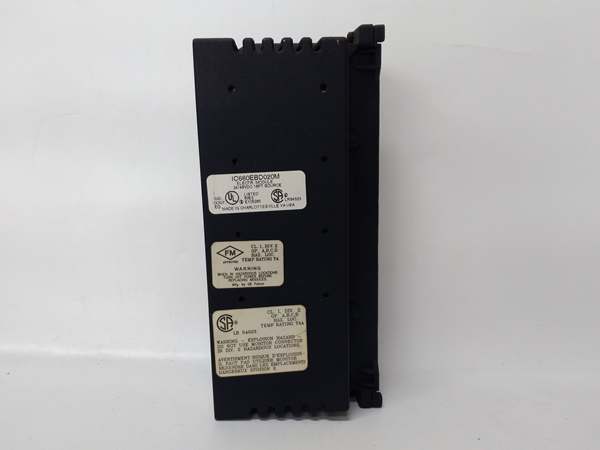
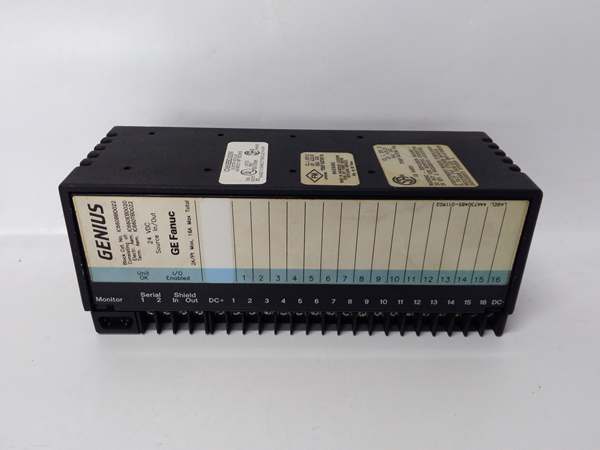
Description
Key Technical Specifications
-
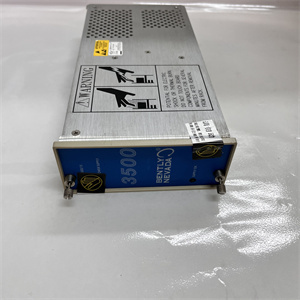
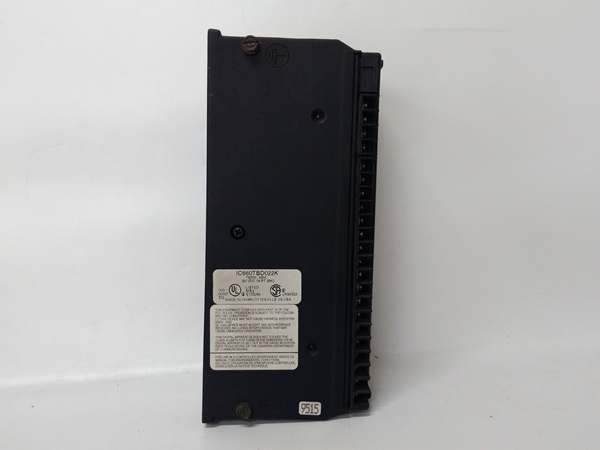
Model Number: IC660BBD022 (electronics assembly IC660EBD020 on base IC660TBD022)
-
Manufacturer: Emerson (legacy GE Fanuc)
-
Channels: 16, individually configurable as input, output, or tristate
-
Voltage Range: 18–30 VDC (24 V nominal)
-
Load Current: 2 A per circuit max, 30 A total block limit
-
Input Current: 6 mA typical @ 24 V
-
Input Impedance: ≈ 4.7 kΩ
-
Update Time: 1 ms turn-on delay, 1.7 ms input filter selectable
-
Isolation: 1500 V RMS input-to-logic; group-isolated common
-
Diagnostics: Open-wire (tristate), overload, over-temperature, short-circuit, failed-switch, no-load
-
LEDs: Unit OK, I/O Enabled, per-point logic indicators
-
Configuration: Hand-held monitor (HHM) port or host software via Genius bus
-
Bus Distance: Up to 7 500 ft (2.3 km) on Genius twinax; daisy-chain capable
-
Power Dissipation: 68.8 W max @ 2 A per circuit
-
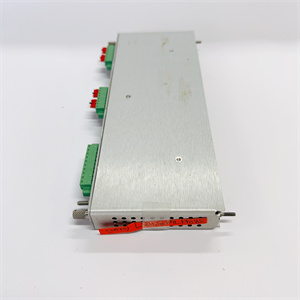
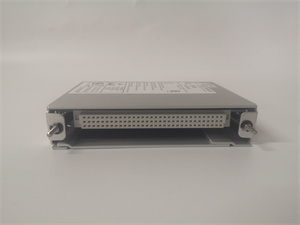
Dimensions: 8.83″ H × 4.42″ D × 3.56″ W; panel-mount, open enclosure
-
Temperature: 0 – 60 °C operating

IC660BBD022
Field Application & Problem Solved
You need sixteen 24 Vdc signals scattered across a conveyor 500 ft from the PLC rack. Drop one IC660BBD022 on a DIN rail, land two-conductor shielded cable, and you have a self-contained I/O station—no extra power supply, no junction boxes. Each point can be an input (photo-eye), an output (solenoid), or even tristate for motor starter feedback. Genius bus runs on twinax, so you daisy-chain to the next block and still hit 1 ms response. When a wire breaks the block flags “open-wire,” the PLC lights an alarm, and you fix the cable without shutting down the line. Steel mills love it because the 1500 V isolation keeps VFD noise from walking back into the CPU rack.
You need sixteen 24 Vdc signals scattered across a conveyor 500 ft from the PLC rack. Drop one IC660BBD022 on a DIN rail, land two-conductor shielded cable, and you have a self-contained I/O station—no extra power supply, no junction boxes. Each point can be an input (photo-eye), an output (solenoid), or even tristate for motor starter feedback. Genius bus runs on twinax, so you daisy-chain to the next block and still hit 1 ms response. When a wire breaks the block flags “open-wire,” the PLC lights an alarm, and you fix the cable without shutting down the line. Steel mills love it because the 1500 V isolation keeps VFD noise from walking back into the CPU rack.
Installation & Maintenance Pitfalls (Expert Tips)
Lead resistance bites on long outputs
2 A at 24 V is 48 W per point—voltage drop on 16 AWG over 500 ft can dip below 18 V and cause solenoid drop-out. Use 14 AWG or move the block closer.
Lead resistance bites on long outputs
2 A at 24 V is 48 W per point—voltage drop on 16 AWG over 500 ft can dip below 18 V and cause solenoid drop-out. Use 14 AWG or move the block closer.
Tristate mode needs the jumper
Default is straight I/O. If you want tristate (motor starter aux contact) you must set the channel to “tristate” in the HHM or software; forget and you’ll read a false “open-wire” every time the starter drops out.
Default is straight I/O. If you want tristate (motor starter aux contact) you must set the channel to “tristate” in the HHM or software; forget and you’ll read a false “open-wire” every time the starter drops out.
Bus termination is non-negotiable
Genius twinax must be 150 Ω terminated at both ends. Miss the terminator and the whole chain ghosts—random I/O flicker that clears when you wiggle the cable. Keep a terminator in the glove box.
Genius twinax must be 150 Ω terminated at both ends. Miss the terminator and the whole chain ghosts—random I/O flicker that clears when you wiggle the cable. Keep a terminator in the glove box.
Heat adds up fast
68.8 W with all outputs on means the block runs hot. Mount vertical with 2″ clearance top & bottom; stuff it flat in a crowded panel and you’ll chase “over-temp” faults on summer afternoons.
68.8 W with all outputs on means the block runs hot. Mount vertical with 2″ clearance top & bottom; stuff it flat in a crowded panel and you’ll chase “over-temp” faults on summer afternoons.
IC660BBD022
Technical Deep Dive & Overview
Internally each channel owns its own opto-isolator, current limit, and thermal sensor. A single microcontroller scans all 16 points every millisecond, builds a Genius datagram, and slaps it onto the twinax. Because configuration is stored in the electronics assembly, you can swap the base (IC660TBD022) hot without losing setup—pull the old base, land wires one-for-one, snap the electronics down, and the PLC sees the same I/O map in under five seconds
Internally each channel owns its own opto-isolator, current limit, and thermal sensor. A single microcontroller scans all 16 points every millisecond, builds a Genius datagram, and slaps it onto the twinax. Because configuration is stored in the electronics assembly, you can swap the base (IC660TBD022) hot without losing setup—pull the old base, land wires one-for-one, snap the electronics down, and the PLC sees the same I/O map in under five seconds
.