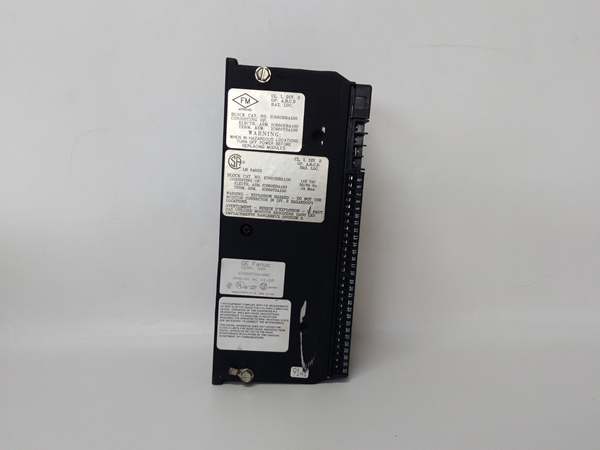
Description
Hard-Numbers: Technical Specifications
- Input Channels: 6 RTD inputs (3 isolated groups of 2)
- Supported RTD Types: Platinum (DIN 43760), Nickel (DIN 43760), Copper, Linear resistance
- Resistance Measurement Range: 0 to 5000 Ohms
- Input Resolution: 0.1°C
- Absolute Accuracy (at 25°C): Platinum/Nickel ±0.5°C typical, ±1.0°C maximum; Copper ±5°C typical, ±10°C maximum
- Input Update Frequency: 400ms, 800ms, or 1600ms (configurable)
- Measurement Resolution: 14, 15, or 16 bits (depending on update frequency)
- Power Supply: 115VAC / 125VDC nominal
- Operating Voltage Range: 93-132VAC / 105-145VDC
- Power Dissipation: 7W maximum
- Power Supply Dropout Time: 10ms
- Block-to-Block Isolation: 1500V
- Group-to-Group Isolation: 300V
- Output Units: Tenths of degrees Celsius, tenths of degrees Fahrenheit, tenths of Ohms, or counts
- Operating Temperature: -20°C to +60°C
- Storage Temperature: -40°C to +100°C

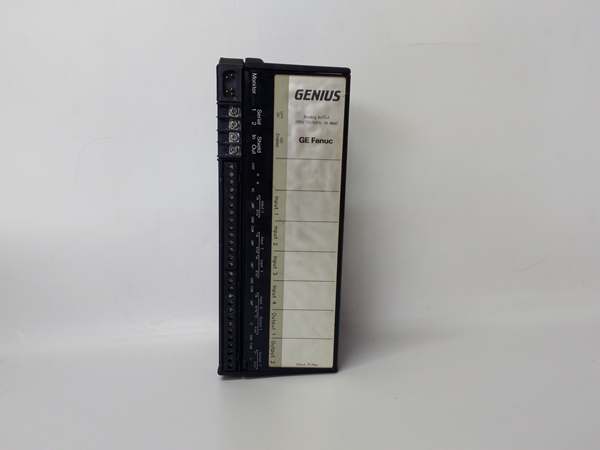
GE IC660BBA100
The Real-World Problem It Solves
This block eliminates the need for separate temperature transmitters by processing RTD signals locally and sending digital data over the Genius bus. It handles Platinum, Nickel, and Copper RTDs with automatic linearization, so you don’t need field calibration gear or individual transmitters for each sensor.
Where you’ll typically find it:
- Chemical reactor temperature monitoring using Pt100 RTDs
- Food pasteurization processes with Cu10 or Cu50 Copper RTDs
- Heat exchanger temperature arrays in power generation facilities
Bottom-line value: Cuts installation cost by up to 50% by removing transmitter hardware and analog wiring, while advanced diagnostics catch open circuits before they cause process upsets.
Hardware Architecture & Under-the-Hood Logic
This block uses a multiplexed A/D converter with synchronous voltage-to-frequency conversion and opto-isolation. Each input group shares conversion circuitry, but all six channels get independent linearization and lead resistance compensation. Configuration data lives in the Terminal Assembly, so you can swap the Electronics Assembly hot without losing setup.
Internal Signal Flow:
- RTD resistance connects to terminals, multiplexer switches between sensor and internal reference resistors
- Synchronous V/F converter converts resistance to frequency signal through opto-coupler
- Processor converts frequency to digital count and corrects for lead resistance and internal drift
- Resistance value linearized per RTD type (DIN 43760 Pt/Ni, specific Cu curves) and converted to selected units
- Diagnostics check for open wire, shorted input, wiring errors, and alarm limits on each channel
- Temperature data and fault status transmitted over Genius bus to PLC at configured update rate
GE IC660BBA100
Field Service Pitfalls: What Rookies Get Wrong
Wrong RTD Type Configuration
Technicians configure the wrong RTD type in software, assuming all RTDs behave the same. This causes significant temperature errors because linearization curves don’t match the actual sensor. A Platinum RTD configured as Nickel reads 15°C high at 100°C actual temperature.
- Field Rule: Always verify RTD type from sensor datasheet or marking. Measure resistance at room temperature with a multimeter—Pt100 reads ~100Ω at 20°C, Ni100 reads ~100Ω too but has different TCR, Cu10 reads ~10Ω. Never guess.
Sloppy 3-Wire RTD Wiring
The block compensates for lead resistance on 3-wire RTDs only if wired correctly. Techs often treat one lead wire as the RTD element itself, defeating compensation and causing errors that drift with ambient temperature. I’ve seen 3-5°C errors from wrong 3-wire hookups.
- Field Rule: On 3-wire RTDs, connect the two matching colored wires to the input terminals and the third wire to the compensation terminal. Follow the wiring diagram in the manual. Use a multimeter to verify continuity between leads before energizing.
Filter Time Mismatched to Process Dynamics
Techs default to 400ms update rate regardless of process requirements. This maximizes resolution but introduces noise in slow processes, or worse, they use 1600ms on fast reactors causing 10-20°C overshoot because the loop can’t see temperature changes in time.
- Field Rule: Match filter time to thermal mass and control speed. Use 400ms for small reactors and heat exchangers, 800ms for large tanks and ovens, 1600ms only for bulk storage or very slow processes. Never use a filter slower than your control loop needs.
Ignoring Group-to-Group Isolation
The block gives 300V isolation between the three input groups, but techs wire RTDs from different ground potential areas to the same group. This creates ground loops and common mode noise that messes up readings and triggers nuisance alarms.
- Field Rule: Leverage the isolation—wire RTDs from different equipment zones to different input groups. Put reactor RTDs on Group 1, heat exchangers on Group 2, utility RTDs on Group 3. Use isolated RTDs when connecting to grounded equipment.
Copper RTD Accuracy Limits
Technicians specify Copper RTDs for food-grade applications without checking accuracy specs. Copper RTDs have ±5°C typical accuracy versus ±0.5°C for Platinum. I’ve seen pasteurization processes fail validation because Cu10 RTDs couldn’t hold ±2°C requirements.
- Field Rule: Use Platinum RTDs for ±0.5°C accuracy needs (reactors, pharmaceutical). Use Nickel for moderate accuracy (±1-2°C) where cost matters. Reserve Copper for general monitoring where ±5°C is acceptable, like safety alarms or bulk storage.
Disabling Open Wire Diagnostics
Techs disable open wire detection to 终止 nuisance alarms during startup, then leave it disabled. This kills your predictive maintenance—when a RTD fails open, the block holds last value instead of flagging a fault. I’ve seen reactors run at setpoint while actual temperature drifted 50°C because the failed sensor wasn’t detected.
- Field Rule: Keep open wire detection enabled at all times. If it alarms during commissioning, fix the wiring problem—don’t disable the diagnostic. Open circuits are the number one RTD failure mode; you want to know about it before process excursions occur.
Commercial Availability & Pricing Note
Please note: The listed price is for reference only and is not binding. Final pricing and terms are subject to negotiation based on current market conditions and availability.