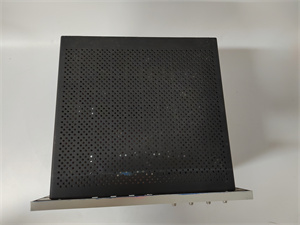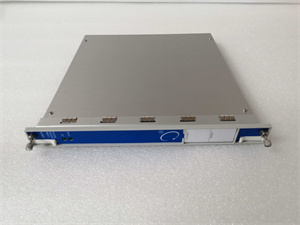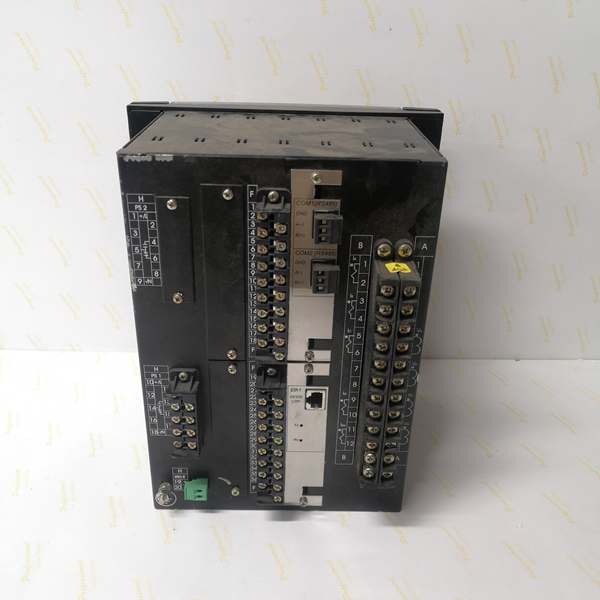
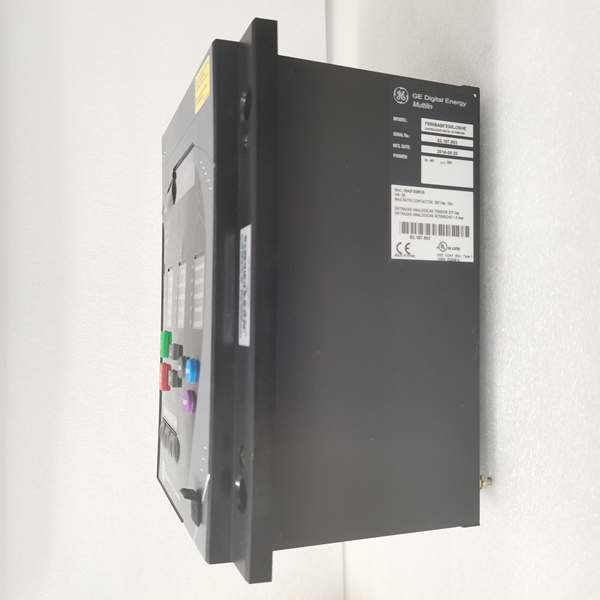
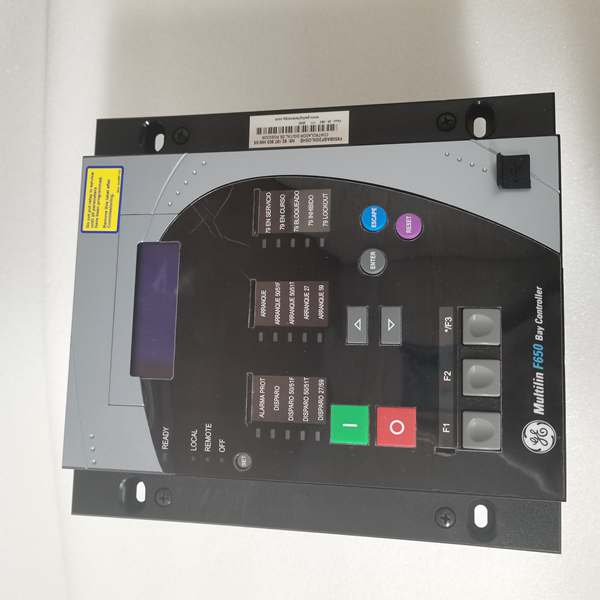
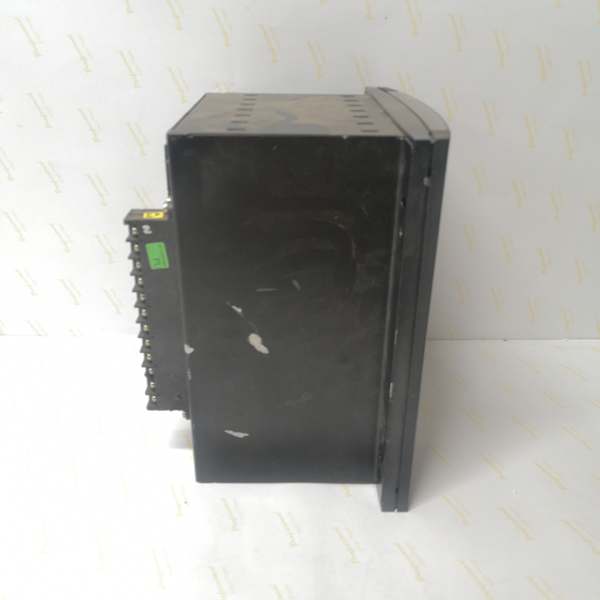
Description
Hard-Numbers: Technical Specifications
- Protection Functions: Overcurrent (50/51), Earth Fault (50N/51N), Sensitive Ground Fault (50SG/51SG), Directional Elements (67P/67G), Overvoltage/Undervoltage (59/27), Frequency (81U/O), Breaker Failure (50BF), Auto-Recloser (79), Synchrocheck (25)
- Slot F I/O: 16 Digital Inputs + 8 Form-C Outputs (Option 1 board)
- Slot G I/O: 16 Digital Inputs + 8 Form-C Outputs (Option 1 board)
- Total I/O Capacity: 48 Digital Inputs + 16 Digital Outputs
- Communication: Redundant 100BaseFX Fiber Optic Ethernet (2 ports, ST connector) + Rear Redundant RS485 Serial (2 ports) + Front RS232 Port + Graphic Display
- Protocols: IEC 61850 Edition 2, Modbus RTU/TCP, DNP 3.0 Level 2, IEC 60870-5-103/104, IEEE 1588 PTP
- Power Supply: 110-250V DC (88-300V range) / 120-230V AC (96-250V range), HI range
- Power Draw: 35-40 VA typical, 55 VA maximum
- Operating Temperature: -40°C to +70°C
- Isolation Rating: 2000V AC RMS I/O-to-chassis
- Dimensions: 168 × 150 × 55 mm (½ 19″ rack, 6U high)
- Weight: 5 kg (11 lbs)
- Language: English only (graphic display model)

The Real-World Problem It Solves
Critical transmission substations can’t tolerate single points of failure—network failure means blind protection and loss of control. This unit delivers redundant fiber optic communication, dual serial ports, dual I/O slots, and a graphic display in a single chassis, eliminating single points of failure in the protection and control path.
Where you’ll typically find it:
- EHV transmission substations (230kV-500kV) with redundant communication architectures
- Critical industrial facilities requiring zero-downtime protection and control
- Generator plant main protection schemes with parallel redundancy requirements
- Utility interconnection points with N-1 or N-2 redundancy criteria
This configuration is the apex of F650 availability—redundant communication, maximum I/O, and advanced visualization for mission-critical applications where failure is not an option.
Hardware Architecture & Under-the-Hood Logic
This is a fully redundant F650 with maximum I/O and graphic display. The “C” order code gives you a 16×40 pixel graphic LCD, the “A” provides redundant RS485 serial ports, and the “B” with “10N” delivers dual redundant 100BaseFX fiber ports. Dual I/O slots provide 48 inputs and 16 outputs.
- Main CPU Board: 32-bit RISC processor (>50 MIPS) with 32MB+ flash memory, executing protection algorithms at 1ms scan cycles while managing dual I/O boards via CAN bus
- DSP Module: Handles analog-to-digital conversion at 64 samples per power cycle for current/voltage inputs
- Slot F I/O Board (Option 1): 16 digital inputs + 8 Form-C relay outputs, communicates via CAN bus
- Slot G I/O Board (Option 1): Identical to Slot F—16 digital inputs + 8 Form-C outputs
- Graphic Display Module: 16×40 pixel (240×128) graphic LCD with IEC symbols, supports single-line diagram visualization, programmable buttons and shuttle control
- Communication Module: Dual redundant 100BaseFX fiber optic ports (ST connectors, 1300nm multimode) + dual redundant RS485 serial ports, supports IEEE 1588 PTP time synchronization and PRP/HSR network redundancy
- Power Supply Module: Switching-mode power supply with >80% efficiency, rated for maximum I/O load (up to 55 VA)
The redundant architecture allows seamless failover between communication paths. If the primary fiber link fails, the secondary takes over without protection interruption. The dual RS485 ports provide independent engineering and operations access. The graphic display can render substation single-line diagrams, breaker status, and real-time measurements with IEC 61850 standard symbols. IEEE 1588 PTP over the redundant fiber network provides microsecond-level time synchronization across all IEDs. The CAN bus handles both I/O boards at 1Mbps, ensuring synchronized state changes across all 48 inputs and 16 outputs.
Field Service Pitfalls: What Rookies Get Wrong
Redundant Fiber Port MisconfigurationTechs treat the two fiber ports as independent separate networks. The “10N” configuration supports PRP (Parallel Redundancy Protocol) or HSR (High-availability Seamless Redundancy) for seamless failover. Rookies configure them as separate VLANs and lose redundancy benefits.
Field Rule: Configure the fiber ports for PRP or HSR in EnerVista Communication settings. PRP sends identical frames over both ports simultaneously—the receiving device discards duplicates. HSR uses a ring topology with intelligent forwarding. Don’t separate them into different networks—they work together as a redundant pair. Test failover by disconnecting one fiber while monitoring SCADA—communication should continue without interruption. Document which protocol you’re using in your IEC 61850 configuration.
Graphic Display vs. Standard Display ConfusionTechs expect the graphic display to work like a touchscreen PLC HMI. This is a protection relay display—no touch, no drag-and-drop. The graphic capabilities show single-line diagrams and status, not full SCADA functionality.
Field Rule: The graphic display (16×40 pixels) shows static single-line diagrams, real-time measurements, and breaker status with IEC symbols. Navigation is via shuttle wheel and programmable buttons, not touch. Configure the single-line diagram in EnerVista’s Graphic Editor before deploying to the relay. Don’t expect to draw complex schematics on the relay itself—design offline, upload, and verify. The display is for operator awareness, not engineering configuration.
Dual RS485 Port Address ConflictsThe “A” configuration provides two independent RS485 ports (COM1 and COM2). Rookies set both ports to the same Modbus address, causing communication conflicts when both are connected.
Field Rule: Assign unique Modbus addresses to each RS485 port if both will be used simultaneously. COM1 typically goes to SCADA, COM2 to engineering station or RTU. In EnerVista, configure each port independently under Communication > Serial Ports. Document which port serves which function—don’t assume COM1 is always primary. Test both ports independently before connecting both to avoid bus contention.
PRP/HSR Network Topology ErrorsPRP requires a dual-homed network topology with separate switches for each path. HSR requires a ring configuration. Rookies connect both fiber ports to the same switch or star topology and expect redundancy to work.
Field Rule: For PRP, you need two completely independent networks with separate switches, routers, and infrastructure. Both ports send identical frames—redundancy comes from path diversity. For HSR, configure a ring topology with all IEDs connected in a loop. Don’t mix PRP and HSR in the same network segment. Draw your network topology in the commissioning package—future techs need to understand the redundancy architecture. Verify redundancy by cutting one fiber path and confirming uninterrupted operation.
Dual I/O Slot Heat Loading48 inputs and 16 outputs generate significant heat. Rookies pack this relay into a hot cabinet without considering the higher power draw (55 VA max) and thermal dissipation requirements.
Field Rule: Measure cabinet ambient under full load. If it exceeds 50°C, install forced ventilation. Leave 15mm clearance around the relay for convection cooling. The redundant communication and graphic display add to the thermal load—don’t use single-slot cooling assumptions. Monitor internal temperature in EnerVista—should stay below 70°C. For high-ambient installations, consider external cooling or derate the I/O utilization.
Fiber Redundancy Testing GapsTechs verify both fiber ports work individually but don’t test actual failover behavior. During a real failure, the switch-over takes longer than expected or doesn’t happen at all.
Field Rule: Test live failover during commissioning. Connect both fiber ports to the redundant network. Monitor SCADA communication. Disconnect the primary fiber—verify seamless failover within 50ms. Reconnect primary, disconnect secondary—verify again. If failover takes longer than 100ms or causes packet loss, recheck your PRP/HSR configuration. Document failover time in your test results—N-1 redundancy requirements often specify maximum failover time.
Graphic Display IEC Symbol MismatchThe “C” display includes IEC 61850 standard symbols. Rookies upload custom symbols that don’t match the IEC standard, causing operator confusion or misinterpretation during faults.
Field Rule: Use IEC 61850 standard symbols from the GE symbol library. Custom symbols can be uploaded but should be approved by the utility’s engineering department. Verify symbol colors and meanings match operator training—red doesn’t always mean “trip” in all schemes. Document custom symbol definitions in your operator manual. During fault events, standard symbols reduce cognitive load and response time.
Redundant Serial Port Ground LoopsTwo independent RS485 ports can create ground loops if connected to devices with different ground references. Rookies see communication working initially but experience intermittent failures as the plant ground potential shifts.
Field Rule: Verify ground reference compatibility before connecting both RS485 ports. Measure potential difference between the two destination devices—anything above 5V AC indicates a ground loop risk. Use opto-isolated RS485 converters if needed. Document grounding architecture in your commissioning package. If ground loops persist, use one RS485 port for primary communication and keep the second as backup, connecting only during maintenance.
Firmware Upgrade with Redundant CommunicationUpgrading firmware with both fiber ports active can cause issues if the upgrade process doesn’t properly handle redundant communication paths. Rookies experience partial upgrades or communication lock-ups.
Field Rule: Simplify the communication path before firmware upgrades. Disconnect the secondary fiber port or disable PRP/HSR during the upload. Use a single dedicated communication path (preferably the front USB port or primary fiber) for the upgrade. After successful upgrade, re-enable redundant communication and verify operation. Never interrupt an upgrade—if it hangs, wait 15 minutes before power cycling. Redundant protocols add complexity to the bootloader recovery process.
Commercial Availability & Pricing NotePlease note: The listed price is for reference only and is not binding. Final pricing and terms are subject to negotiation based on current market conditions and availability.