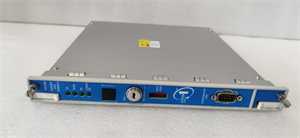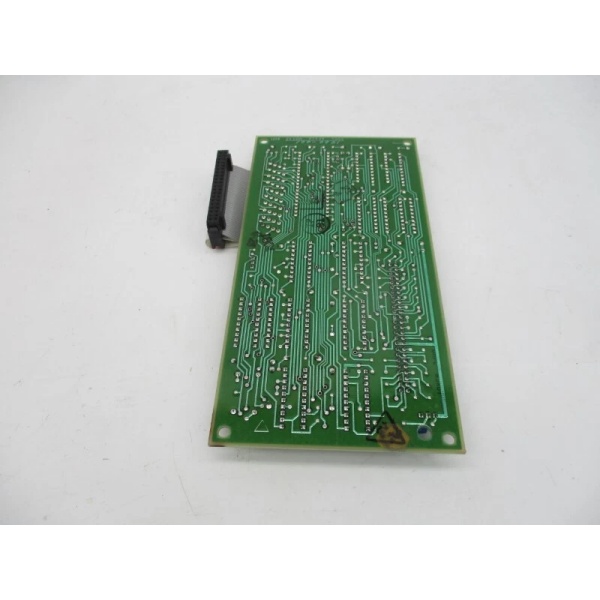
Description
Key Technical Specifications
-
Model Number: DS3800XDIC1A1A
-
Manufacturer: General Electric
-
Logic Voltage: +5 V ±5 % @ 1.3 A from rack back-plane
-
Display: 5-digit, 0.3″ VF tube, 2 × 20 character driver latches
-
Analog I/O: 2 differential ±10 V inputs (field volts & amps), 1 ±10 V output to SCR bridge
-
Digital Section: 4-bit comparator latch stores last fire-angle word from CPU
-
Isolation: 500 Vrms field-to-logic on analog signals, 1500 V on display supply
-
Connectors: 96-pin DIN to back-plane, two 20-position headers for display cable
-
Diagnostics: Green “LOGIC OK,” red “DISPLAY FLT” LEDs visible through bezel
-
Operating Temperature: 0 – 70 °C operational, –40 – 85 °C storage
-
Dimensions: 6.3 × 9.0 in (160 × 229 mm), single-slot 6U Euro-card

GE DS3800DMPC1F1E
Field Application & Problem Solved
A 1987 frame-5 peaker still expects a local 5-digit read-out of field current—no laptop, no HMI, just a bright vacuum-fluorescent display bolted to the cabinet door. The DS3800XDIC1A1A is the card that drives that display while closing the exciter loop. It sits in the exciter rack, reads scaled PT/CT signals, and spits out a ±10 V angle command to the SCR firing card. When the display fades—usually the filament supply resistor opens—the operator can’t see field amps and you trip on “EXCITER FAILURE”; swap the board, snap the ribbon back in, and the digits light up at exactly the same brightness they did in 1987. You’ll find this PCB in any plant that still runs the original swing-out door display: paper-mill back-pressure sets, refineries, and every frame-5/6 that never upgraded to a CRT HMI. Its value is eyeballs and repeatability: the scaling resistors are laser-trimmed, so the 5-digit read-out matches the old analog meter within 0.5 %—critical for keeping the operator confident the exciter is still alive.
A 1987 frame-5 peaker still expects a local 5-digit read-out of field current—no laptop, no HMI, just a bright vacuum-fluorescent display bolted to the cabinet door. The DS3800XDIC1A1A is the card that drives that display while closing the exciter loop. It sits in the exciter rack, reads scaled PT/CT signals, and spits out a ±10 V angle command to the SCR firing card. When the display fades—usually the filament supply resistor opens—the operator can’t see field amps and you trip on “EXCITER FAILURE”; swap the board, snap the ribbon back in, and the digits light up at exactly the same brightness they did in 1987. You’ll find this PCB in any plant that still runs the original swing-out door display: paper-mill back-pressure sets, refineries, and every frame-5/6 that never upgraded to a CRT HMI. Its value is eyeballs and repeatability: the scaling resistors are laser-trimmed, so the 5-digit read-out matches the old analog meter within 0.5 %—critical for keeping the operator confident the exciter is still alive.
Installation & Maintenance Pitfalls (Expert Tips)
Filament resistor open—display dead, exciter still works
The 5 V filament supply runs through a 22 Ω 1 W resistor; after 20 years the resistor opens and the display goes dark. Field current is still correct, but the operator panics and hits the trip. Check for 1.2 V across the tube filament—if it’s zero, swap the resistor or the whole card.
The 5 V filament supply runs through a 22 Ω 1 W resistor; after 20 years the resistor opens and the display goes dark. Field current is still correct, but the operator panics and hits the trip. Check for 1.2 V across the tube filament—if it’s zero, swap the resistor or the whole card.
Ribbon cable twist—segment drive shorts, digits garbled
The 20-pin flat cable is 1 mm pitch; twist it once and segment lines short. You’ll see “8.8.8.8.8” or random segments. Lay the cable in the hinge gutter before you swing the door shut—no sharp bends, no zip-ties on the bend.
The 20-pin flat cable is 1 mm pitch; twist it once and segment lines short. You’ll see “8.8.8.8.8” or random segments. Lay the cable in the hinge gutter before you swing the door shut—no sharp bends, no zip-ties on the bend.
Wrong keying—+10 V on filament pin cooks the tube
The display and analog headers are keyed alike but pin-outs differ. Land the analog cable on the display header and you stuff +10 V onto the 1.2 V filament—tube flashes white and dies. Match the white wire-stripe to the silk-screen triangle before you push the plug home.
The display and analog headers are keyed alike but pin-outs differ. Land the analog cable on the display header and you stuff +10 V onto the 1.2 V filament—tube flashes white and dies. Match the white wire-stripe to the silk-screen triangle before you push the plug home.
EPROM window uncovered—character set corrupts
A 2 kB EPROM holds the 7-segment lookup table. Leave the quartz window exposed and UV erases the font; next power-up the display shows Klingon. If operators complain about “funny digits,” peel the old foil sticker and slap on fresh HVAC tape—no re-burn needed.
A 2 kB EPROM holds the 7-segment lookup table. Leave the quartz window exposed and UV erases the font; next power-up the display shows Klingon. If operators complain about “funny digits,” peel the old foil sticker and slap on fresh HVAC tape—no re-burn needed.
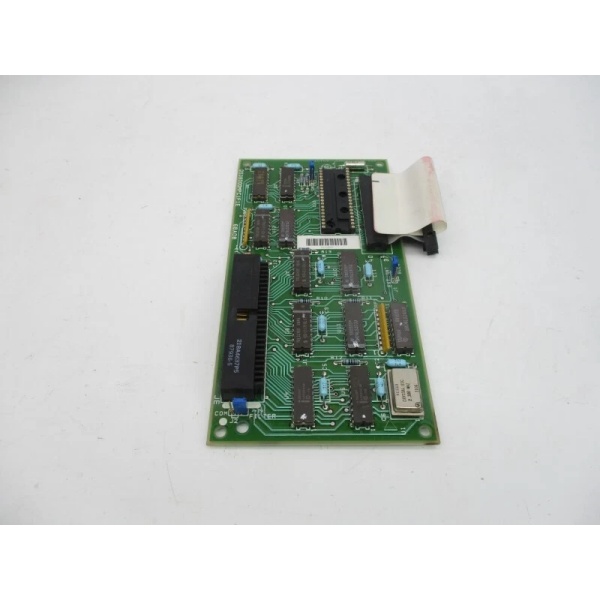
GE DS3800DMPC1F1E
Technical Deep Dive & Overview
DS3800XDIC1A1A is a hybrid display driver and low-level regulator on a 6U Euro-card. A 4-bit latch grabs the angle/fault data off the back-plane; a 7447 decoder drives the 5-digit VF tube; a 741 op-amp buffers the analog output to the SCR bridge. The filament supply is linear-regulated from +5 V through a 22 Ω resistor—no switcher noise, just steady 1.2 V so the digits glow the same orange they did the day the plant was commissioned. Because the card carries both logic and display power, you can swap it hot and the exciter never knows—just kill the 125 VDC field breaker first so you don’t arc-weld the gate leads. Think of it as a digital dashboard frozen in 1987 silicon; treat the filament resistor like a calibrated light-bulb and the operator will keep trusting what he sees for another thirty years
DS3800XDIC1A1A is a hybrid display driver and low-level regulator on a 6U Euro-card. A 4-bit latch grabs the angle/fault data off the back-plane; a 7447 decoder drives the 5-digit VF tube; a 741 op-amp buffers the analog output to the SCR bridge. The filament supply is linear-regulated from +5 V through a 22 Ω resistor—no switcher noise, just steady 1.2 V so the digits glow the same orange they did the day the plant was commissioned. Because the card carries both logic and display power, you can swap it hot and the exciter never knows—just kill the 125 VDC field breaker first so you don’t arc-weld the gate leads. Think of it as a digital dashboard frozen in 1987 silicon; treat the filament resistor like a calibrated light-bulb and the operator will keep trusting what he sees for another thirty years
.