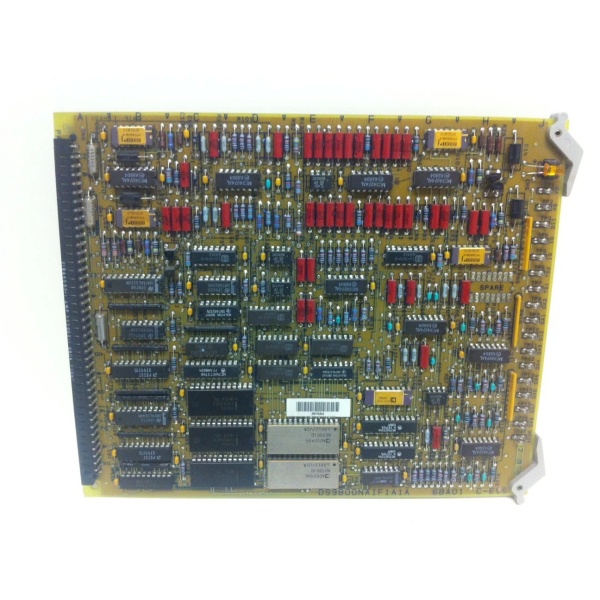
Description
Key Technical Specifications
-
Model Number: DS3800NAIF1A1A
-
Manufacturer: General Electric
-
Inputs: 3 PT channels 0-120 VAC, 3 CT channels 0-5 AAC, 50 Hz/60 Hz
-
Scaling Network: Precision 0.1 % metal-film dividers, 20 kΩ / 2 kΩ ratio for PT, 0.1 Ω / 20 kΩ for CT
-
Isolation: 1500 Vrms input-to-logic via 2 kV rated resistor dividers (no optos)
-
Output Range: ±10 V differential to downstream firing card (NMEC/NVRC)
-
Frequency Response: Flat ±0.5 dB 10 Hz – 1 kHz, –3 dB @ 3 kHz
-
Connectors: Three 12-position pluggable terminal blocks (PT1-3, CT1-3), 96-pin DIN to back-plane
-
Power: +5 V @ 400 mA, ±12 V @ 100 mA from rack; field power stays off-card
-
Protection: 2 A 150 V MOV on each input, 10 A 250 V ferrite fuse on CT return
-
Operating Temperature: –20 °C to +70 °C inside turbine cabinet
-
Dimensions: 6.3 × 9.0 in (160 × 229 mm), single-slot 6U Euro-card

GE DS3800NAIF1A1A
Field Application & Problem Solved
A 1987 frame-5 static exciter doesn’t want raw PT/CT wires flopping around the cabinet—it wants a clean ±10 V signal that represents actual generator volts and amps. The DS3800NAIF1A1A is the card that does the scaling. It sits two slots left of the SCR firing card, reads 120 VAC PT and 5 AAC CT inputs, drops them across precision dividers, and feeds a low-impedance differential voltage to the firing logic. When the card drifts—usually a divider resistor opens—you see 5 % low field volts and the VAR meter creeps high; swap the board, re-torque the CT screws, and the numbers snap back to the original calibration. You’ll find this PCB in any plant that still runs a three-phase SCR bridge: paper-mill back-pressure sets, refineries, and every frame-5/6 peaker that never upgraded to digital AVRs. Its core value is repeatability: the divider ratios are laser-trimmed, so you get the same volts-per-hertz slope the generator was commissioned with—critical for keeping old electromechanical distance relays inside their circle diagram.
A 1987 frame-5 static exciter doesn’t want raw PT/CT wires flopping around the cabinet—it wants a clean ±10 V signal that represents actual generator volts and amps. The DS3800NAIF1A1A is the card that does the scaling. It sits two slots left of the SCR firing card, reads 120 VAC PT and 5 AAC CT inputs, drops them across precision dividers, and feeds a low-impedance differential voltage to the firing logic. When the card drifts—usually a divider resistor opens—you see 5 % low field volts and the VAR meter creeps high; swap the board, re-torque the CT screws, and the numbers snap back to the original calibration. You’ll find this PCB in any plant that still runs a three-phase SCR bridge: paper-mill back-pressure sets, refineries, and every frame-5/6 peaker that never upgraded to digital AVRs. Its core value is repeatability: the divider ratios are laser-trimmed, so you get the same volts-per-hertz slope the generator was commissioned with—critical for keeping old electromechanical distance relays inside their circle diagram.
Installation & Maintenance Pitfalls (Expert Tips)
CT screws loose—burns the shunt resistor
The CT inputs use #8 brass screws. If you torque them under 12 in-lb the joint overheats, the 0.1 Ω shunt desolders itself, and field current collapses. Always use a calibrated screwdriver and re-torque after the first heat-cycle.
The CT inputs use #8 brass screws. If you torque them under 12 in-lb the joint overheats, the 0.1 Ω shunt desolders itself, and field current collapses. Always use a calibrated screwdriver and re-torque after the first heat-cycle.
PT fuse missing—120 V hits the divider, blows the trace
Each PT input has a 2 A 250 V ferrite fuse on the card edge. If someone jumpered it out and a surge arrives, the 2 kΩ divider burns open and you lose voltage feedback. Check the fuse first—if it’s blown, replace it, don’t jumper.
Each PT input has a 2 A 250 V ferrite fuse on the card edge. If someone jumpered it out and a surge arrives, the 2 kΩ divider burns open and you lose voltage feedback. Check the fuse first—if it’s blown, replace it, don’t jumper.
Wrong keying—CT lands on PT pin, 5 A through 2 kΩ
The PT and CT terminal blocks are keyed alike but pin-outs are mirror-image. Land the generator CT on the PT header and you stuff 5 A into a 2 kΩ divider—resistor becomes a toaster. Match the white wire-stripe to the silk-screen triangle before you push the plug home.
The PT and CT terminal blocks are keyed alike but pin-outs are mirror-image. Land the generator CT on the PT header and you stuff 5 A into a 2 kΩ divider—resistor becomes a toaster. Match the white wire-stripe to the silk-screen triangle before you push the plug home.
Missing nylon washer—card arcs to rack
The four corner holes are through-plated. Forget the fiber washers and the card edge sits 0.5 mm proud; 120 V PT finds the rack paint, arcs, and blows a hole in the ground plane. Use the original GE shoulder washers or add 2 mm nylon spacers—torque to 8 in-lb, no more.
The four corner holes are through-plated. Forget the fiber washers and the card edge sits 0.5 mm proud; 120 V PT finds the rack paint, arcs, and blows a hole in the ground plane. Use the original GE shoulder washers or add 2 mm nylon spacers—torque to 8 in-lb, no more.
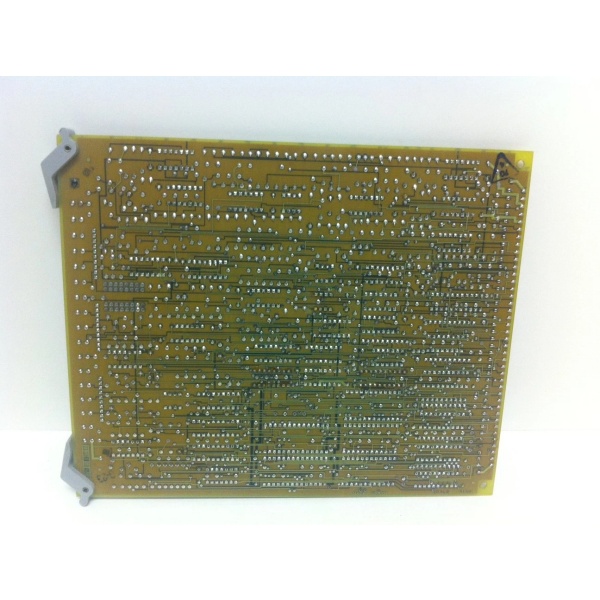
GE DS3800NAIF1A1A
Technical Deep Dive & Overview
DS3800NAIF1A1A is a passive analog front-end frozen in 1987 precision resistors. Three precision divider networks scale 120 VAC down to 4.096 VAC; three 0.1 Ω shunts convert 5 AAC to 500 mVAC. The resulting low-level signals are routed through twisted-pair on the card and sent differentially to the downstream firing card—no active amplifiers, no optos, just resistor accuracy good for 0.5 % over temperature. A 150 V MOV on each input clips surges, and a 10 A ferrite fuse protects the shunt. Because everything is passive you can swap the card hot and the exciter never knows—just make sure you kill the external PT/CT fuses first or you’ll arc-weld the terminal screws. Think of it as a ruggedized potential/current transformer that lives on a PCB; treat the divider network like a calibrated shunt and the VAR meter will stay inside the stable circle for another thirty years.
DS3800NAIF1A1A is a passive analog front-end frozen in 1987 precision resistors. Three precision divider networks scale 120 VAC down to 4.096 VAC; three 0.1 Ω shunts convert 5 AAC to 500 mVAC. The resulting low-level signals are routed through twisted-pair on the card and sent differentially to the downstream firing card—no active amplifiers, no optos, just resistor accuracy good for 0.5 % over temperature. A 150 V MOV on each input clips surges, and a 10 A ferrite fuse protects the shunt. Because everything is passive you can swap the card hot and the exciter never knows—just make sure you kill the external PT/CT fuses first or you’ll arc-weld the terminal screws. Think of it as a ruggedized potential/current transformer that lives on a PCB; treat the divider network like a calibrated shunt and the VAR meter will stay inside the stable circle for another thirty years.