Description
Key Technical Specifications
-
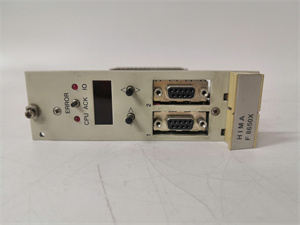
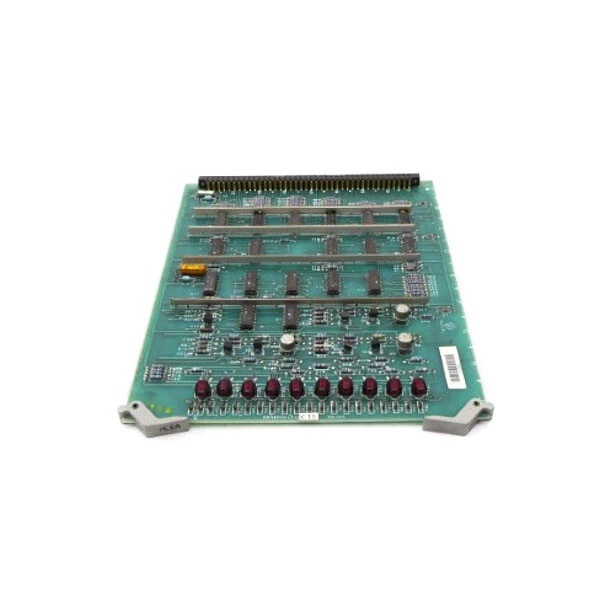
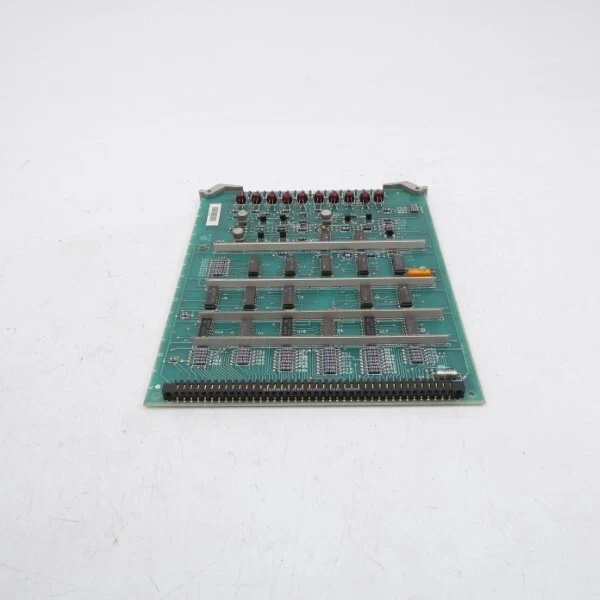
Model Number: DS3800HLEA1C1B
-
Manufacturer: General Electric
-
Logic Voltage: +5 V ±5 % @ 1 A from rack back-plane
-
Signal Levels: 5 V CMOS, 8 mA source/sink, short-circuit protected
-
Latches: Three 74LS374 octal D-types store last CPU command word
-
Buffers: Two 74LS244 octal tri-state for status return to CPU
-
Propagation Delay: 12 ns typical, guaranteed < 25 ns over temp
-
Connectors: 96-pin DIN to back-plane, two 16-position headers for local I/O
-
Isolation: 500 Vrms between field-side returns and Mark IV logic ground
-
Diagnostics: Green “LOGIC OK” LED, red “PARITY” latch visible through bezel
-
Operating Temperature: 0 – 70 °C operational, –40 – 85 °C storage
-
Dimensions: 6.3 × 9.0 in (160 × 229 mm), single-slot 6U Euro-card

GE DS3800HLEA1C1B
Field Application & Problem Solved
In a 1987 frame-5 peaker the CPU doesn’t drive I/O directly—it writes a byte to the back-plane and expects something to catch it before the next 40 ms scan. The DS3800HLEA1C1B is that catcher. It sits in the middle rack, latches the command word, buffers the return status, and keeps the timing tight enough that the turbine doesn’t know silicon from 1987 is doing the work. When the card dies the CPU throws “I/O TIMEOUT,” every discrete output drops out, and the unit coasts down—swap the board and you’re back online without a reboot. You’ll find this PCB in any Mark IV that still uses the original I/O scheme: paper-mill back-pressure sets, refineries, and every frame-5/6 that never got a Mark V retrofit. Its value is speed and repeatability: the latch propagation is fixed at 12 ns, so the I/O scan stays deterministic—critical when your overspeed bolt is still mechanical and expects the trip solenoid to drop inside 100 ms.
In a 1987 frame-5 peaker the CPU doesn’t drive I/O directly—it writes a byte to the back-plane and expects something to catch it before the next 40 ms scan. The DS3800HLEA1C1B is that catcher. It sits in the middle rack, latches the command word, buffers the return status, and keeps the timing tight enough that the turbine doesn’t know silicon from 1987 is doing the work. When the card dies the CPU throws “I/O TIMEOUT,” every discrete output drops out, and the unit coasts down—swap the board and you’re back online without a reboot. You’ll find this PCB in any Mark IV that still uses the original I/O scheme: paper-mill back-pressure sets, refineries, and every frame-5/6 that never got a Mark V retrofit. Its value is speed and repeatability: the latch propagation is fixed at 12 ns, so the I/O scan stays deterministic—critical when your overspeed bolt is still mechanical and expects the trip solenoid to drop inside 100 ms.
Installation & Maintenance Pitfalls (Expert Tips)
Bent back-plane pin—5 V short cooks the trace
The 96-pin DIN is soft brass. One folded pin on +5 V arcs as you seat the card and blows a buried trace you can’t jumper. Always flashlight-inspect the receptacle; if you see a shiny crescent, straighten it with a jeweler’s screwdriver before the card goes in.
The 96-pin DIN is soft brass. One folded pin on +5 V arcs as you seat the card and blows a buried trace you can’t jumper. Always flashlight-inspect the receptacle; if you see a shiny crescent, straighten it with a jeweler’s screwdriver before the card goes in.
Wrong suffix—timing skew trips I/O
HLEA1C1B runs 74LS374 latches; HLEA1B1B uses slower 74HC374. The Mark IV I/O scanner expects the faster LS propagation; swap revisions and your discrete outputs skew 15 ns, enough to miss a 25 ms overspeed pulse. Match the last six characters exactly.
HLEA1C1B runs 74LS374 latches; HLEA1B1B uses slower 74HC374. The Mark IV I/O scanner expects the faster LS propagation; swap revisions and your discrete outputs skew 15 ns, enough to miss a 25 ms overspeed pulse. Match the last six characters exactly.
Missing pull-up—floating inputs give false status
The 74LS244 buffers need a 4.7 k pull-up on every return line. If someone “field-modified” the card and clipped a resistor pack, the inputs float high and the CPU reads “contact closed” when it’s open. Meter each return line to +5 V—you should see 4.8 V, not 1.2 V.
The 74LS244 buffers need a 4.7 k pull-up on every return line. If someone “field-modified” the card and clipped a resistor pack, the inputs float high and the CPU reads “contact closed” when it’s open. Meter each return line to +5 V—you should see 4.8 V, not 1.2 V.
EPROM window uncovered—latch data fades
A 2 kB EPROM on earlier revs holds the I/O map. Leave the quartz window exposed and UV erases the lookup table; next startup the CPU maps the wrong bit to the wrong coil. If your “STARTER MOTOR” command fires the fuel-trip solenoid, reburn the EPROM and foil-tape the window.
A 2 kB EPROM on earlier revs holds the I/O map. Leave the quartz window exposed and UV erases the lookup table; next startup the CPU maps the wrong bit to the wrong coil. If your “STARTER MOTOR” command fires the fuel-trip solenoid, reburn the EPROM and foil-tape the window.
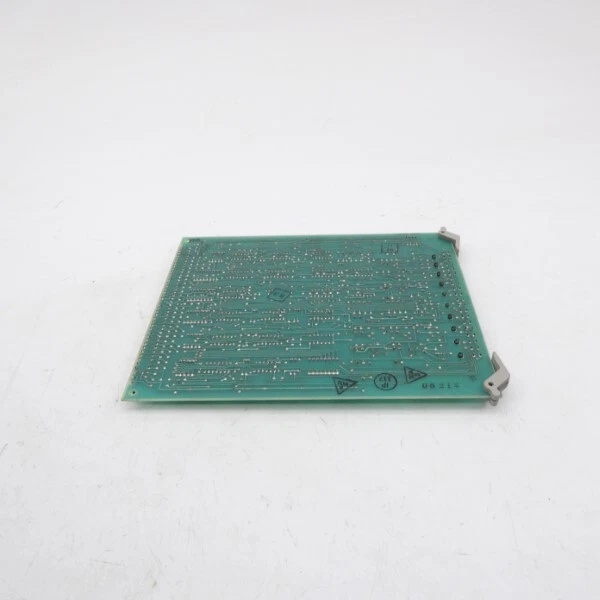
GE DS3800HLEA1C1B
Technical Deep Dive & Overview
DS3800HLEA1C1B is a pure hard-wired latch/buffer card—no micro, no firmware. The CPU drops a 16-bit word on the back-plane; on the rising edge of the I/O strobe the 74LS374s latch the lower byte and drive it out to field I/O cards via ribbon cable. Return status comes back through 74LS244 buffers, gets placed on the data bus, and the CPU reads it 200 ns later. A 1 MHz ceramic resonator clocks a 74LS123 one-shot that blanks the outputs for 50 ns during each transition to prevent race conditions. Because everything is combinatorial logic, you can swap the card hot and the turbine never knows—just make sure the new card has the same LS-family ICs or the scan timing drifts. Think of it as a 16-bit hardware mailbox frozen in 1987 TTL; treat the back-plane pins like gold and the I/O scan will stay deterministic for another thirty years.
DS3800HLEA1C1B is a pure hard-wired latch/buffer card—no micro, no firmware. The CPU drops a 16-bit word on the back-plane; on the rising edge of the I/O strobe the 74LS374s latch the lower byte and drive it out to field I/O cards via ribbon cable. Return status comes back through 74LS244 buffers, gets placed on the data bus, and the CPU reads it 200 ns later. A 1 MHz ceramic resonator clocks a 74LS123 one-shot that blanks the outputs for 50 ns during each transition to prevent race conditions. Because everything is combinatorial logic, you can swap the card hot and the turbine never knows—just make sure the new card has the same LS-family ICs or the scan timing drifts. Think of it as a 16-bit hardware mailbox frozen in 1987 TTL; treat the back-plane pins like gold and the I/O scan will stay deterministic for another thirty years.