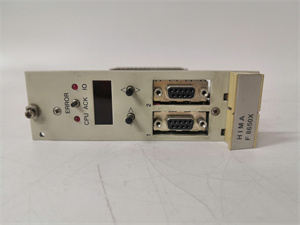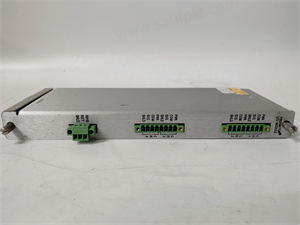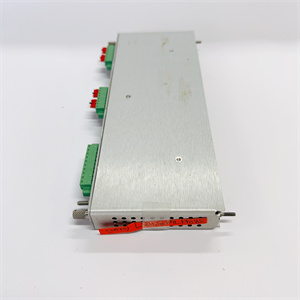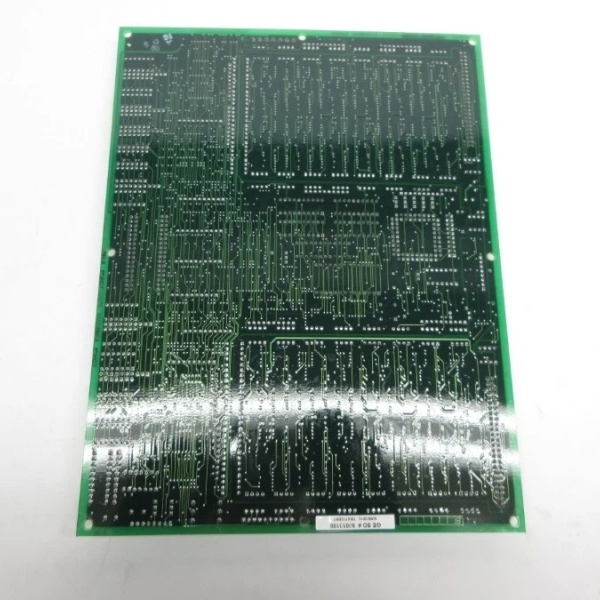
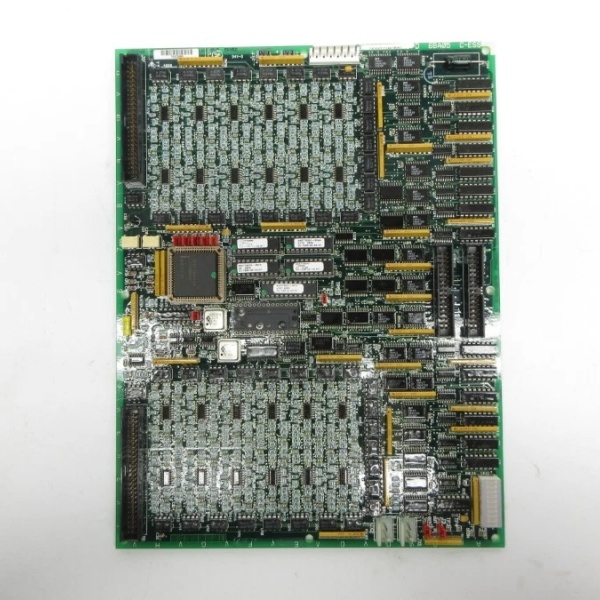
Description
Hard-Numbers: Technical Specifications
- Functional Acronym: TCAA (Terminal Card Analog Board)
- Board Variant: H1 variant with HD suffix (High-Density configuration)
- Group Number: G1 (Group 1 variant)
- Revision: B (Board Revision B)
- Core Function: High-density analog signal conditioning and processing
- Input/Output: Extended analog input and output channel capacity
- Signal Types: Supports mA, V, RTD, thermocouple signals (enhanced capacity)
- Signal Conditioning: Amplification, filtering, isolation for multiple analog channels
- Analog-to-Digital: Multi-channel A/D conversion for analog inputs
- Digital-to-Analog: Multi-channel D/A conversion for analog outputs
- Isolation: Electrical isolation between field devices and control processors
- Channel Density: Increased number of channels compared to standard TCAA boards
- Diagnostic Features: Enhanced status indicators for multiple channel monitoring and fault detection
- LED Indicators: Multiple LED indicators for channel status, power, faults (extended configuration)
- Power Requirements: Typically 24 V DC from control system power supply (may have higher current draw)
- Dimensions: Standard Mark V board form factor (typically 3″ H × 11.5″ W)
- PCB Coating: Normal coating (non-conformal)
- Manual: GEH-6215A (Terminal Card Analog Board Manual) – HD supplement

DS200TCDAH1BHD
The Real-World Problem It Solves
The Mark V control system in complex turbine applications often requires a higher density of analog signal conditioning capacity than standard TCAA boards provide. The DS200TCDAH1BHD (Terminal Card Analog Board – H1 High-Density Variant, Revision B) addresses this requirement by offering extended analog channel capacity in a single board, reducing the number of boards required and simplifying system architecture. Applications such as large combined cycle plants, multi-unit turbine installations, or turbine systems with extensive monitoring and control requirements often have numerous analog sensors and actuators that would require multiple standard TCAA boards to accommodate. The high-density configuration consolidates these channels into a single board, providing the same signal conditioning, amplification, filtering, isolation, and conversion capabilities as standard boards but with increased channel capacity. This reduces cabinet space requirements, simplifies wiring, and potentially improves system reliability by reducing the number of inter-board connections. Without high-density boards, systems with extensive analog I/O requirements would need multiple standard boards, increasing complexity, cost, and potential failure points.
Where you’ll typically find it:
- High-density analog signal conditioning racks in Mark V control cabinets
- Large-scale turbine control applications requiring extensive analog I/O
- Combined cycle power plants with multiple turbine units
- Multi-unit control systems with numerous analog sensors and actuators
- Complex process monitoring applications requiring many analog channels
- Space-constrained control cabinets requiring high-density I/O solutions
Bottom line: High-density analog signal conditioning board—providing extended channel capacity for complex turbine applications requiring multiple analog signal paths in a compact form factor.
Hardware Architecture & Under-the-Hood Logic
The DS200TCDAH1BHD (H1 High-Density Variant, Revision B) is the high-density version of the Terminal Card Analog Board for the Mark V control system, designed to accommodate a larger number of analog input and output channels than standard TCAA boards while maintaining the same signal conditioning and conversion capabilities. The HD suffix indicates a hardware configuration with increased channel density, achieved through compact circuit design, multi-channel conversion components, and optimized board layout. The board provides multiple extended analog input channels that receive signals from field devices such as 4-20 mA transmitters, 0-10 V sensors, RTDs, thermocouples, and position feedback devices in higher quantities than standard boards. Each input channel undergoes signal conditioning including amplification, filtering, and isolation before being converted to digital values by multi-channel analog-to-digital converters. The board also provides extended analog output channels that receive digital commands from control processors and convert them to analog signals through multi-channel digital-to-analog converters, with output conditioning including amplification, filtering, and isolation to drive field actuators. The isolation circuitry ensures that electrical disturbances from field devices do not propagate to control processors. The board includes enhanced status monitoring and diagnostic capabilities to detect signal faults, channel failures, out-of-range conditions, or board malfunctions across the extended channel set.
Signal flow:
- Multiple analog input signals from field devices enter TCAA-HD through terminal connectors (extended capacity)
- Input protection circuits limit voltage and current to protect board circuits for each channel
- Input conditioning circuits filter and amplify analog signals for extended channel set
- Isolation circuits provide electrical separation between field and control circuits
- Multi-channel analog-to-digital converters convert conditioned analog signals to digital values
- Digital values are formatted and transmitted to control processors through data buses
- Digital control commands from processors are received through communication interfaces
- Multi-channel digital-to-analog converters convert digital commands to analog output signals
- Output conditioning circuits filter and amplify analog output signals for extended channels
- Output isolation circuits provide electrical protection for field devices
- Conditioned analog outputs are routed to field actuators through terminal connectors
- Enhanced status monitoring circuits track health for extended channel set
- Extended LED indicator arrays display channel status, power state, and fault conditions
- Diagnostic functions detect faults across multiple channels (overrange, underrange, opens, shorts)
- Power conditioning ensures stable operation from 24 V DC supply with adequate current capacity
DS200TCDAH1BHD
Field Service Pitfalls: What Rookies Get Wrong
Confusing TCAA-HD with standard TCAA causes capacity planning errorsMixing up HD and standard boards. I’ve seen technicians replacing TCAA-HD with standard TCAA, losing channel capacity and causing I/O shortage.
- Field Rule: Clearly identify TCAA-HD vs. standard TCAA. TCAA-HD has extended channel capacity. Standard TCAA has fewer channels. Check board label for “HD” suffix. Never assume TCAA boards are identical—HD provides extended capacity.
Overlooking HD power requirements causes power supply issuesNot accounting for higher current draw. I’ve seen technicians installing TCAA-HD boards without checking power supply capacity, causing voltage drops or power supply overloads.
- Field Rule: Verify power supply capacity before HD board installation. TCAA-HD may draw more current due to extended channels. Calculate total power load with all channels operating. Check power supply rating for adequate margin. Never install HD board without verifying power—insufficient power causes erratic operation.
Assuming HD uses same configuration as standard causes errorsApplying standard TCAA configuration to HD boards. I’ve seen technicians using standard configuration parameters for HD boards, causing channel addressing or range errors.
- Field Rule: Use HD-specific configuration procedures. HD may have different channel addressing schemes. HD may require different parameter ranges or scaling. Consult HD supplement documentation for configuration details. Never assume HD uses standard configuration—verify HD-specific requirements.
Skipping channel-by-channel verification causes missed faultsNot testing all channels thoroughly. I’ve seen technicians testing only a few channels on HD boards, missing faults in untested channels.
- Field Rule: Test all channels on HD boards after installation. Verify each input channel reads correctly with known signals. Verify each output channel produces correct outputs. Document test results for every channel. Never assume untested channels work—test all channels before placing in service.
Forgetting to verify isolation integrity for all channels causes damageNot checking isolation circuits for extended channels. I’ve seen technicians verifying only a few isolation paths, allowing field transients to damage processors through untested channels.
- Field Rule: Verify isolation integrity for all HD channels. Use insulation resistance tester to check isolation between field and control circuits for each channel. Verify ground isolation is intact for all signal paths. Never assume isolation is good for all channels—verify each channel’s isolation.
Overheating due to high channel density causes intermittent operationNot considering thermal issues. I’ve seen technicians installing HD boards in hot cabinets without adequate cooling, causing intermittent operation or failures.
- Field Rule: Monitor temperature for HD boards. HD generates more heat due to extended channels. Verify cabinet cooling is adequate for thermal load. Check board temperature during full-channel operation. Never ignore thermal issues—overheating causes intermittent failures.
Improper termination causes cross-talk between channelsIncorrect wiring techniques. I’ve seen technicians improperly terminating HD boards, causing cross-talk between adjacent channels.
- Field Rule: Use proper termination techniques for HD boards. Follow Mark V wiring procedures for high-density connections. Avoid running signal cables in parallel without shielding. Verify shielding is properly grounded. Never rush HD board termination—improper wiring causes cross-talk.
Confusing HD channel numbering causes addressing errorsMisunderstanding channel addressing. I’ve seen technicians using wrong channel numbers for HD boards, causing addressing conflicts or missing channels.
- Field Rule: Learn HD channel addressing scheme. HD may use different channel numbering than standard boards. Verify channel addresses match system configuration. Document channel assignments. Never assume standard addressing applies—use HD-specific addressing.
Forgetting to calibrate all channels causes accuracy issuesNot calibrating extended channel set. I’ve seen technicians calibrating only a few channels, leaving others uncalibrated and causing accuracy variations.
- Field Rule: Calibrate all HD channels after replacement. Use Mark V calibration procedures for each input and output channel. Verify calibration accuracy across full channel set. Document calibration values for every channel. Never assume uncalibrated channels are accurate—calibrate all channels.
Neglecting LED interpretation for extended array causes missed faultsMisreading extended LED patterns. I’ve seen technicians misunderstanding HD LED arrays, missing fault information due to complex indication patterns.
- Field Rule: Learn HD LED indication patterns. HD may have more LEDs or different patterns. Understand what each LED indicates for extended channel set. Use LED information for fault diagnosis. Never ignore HD LED patterns—they provide comprehensive fault information.
Commercial Availability & Pricing Note
Please note: The listed price is for reference only and is not binding. Final pricing and terms are subject to negotiation based on current market conditions and availability. As a high-density specialized component, availability may be limited and lead times extended. HD boards may command premium pricing due to extended channel capacity.