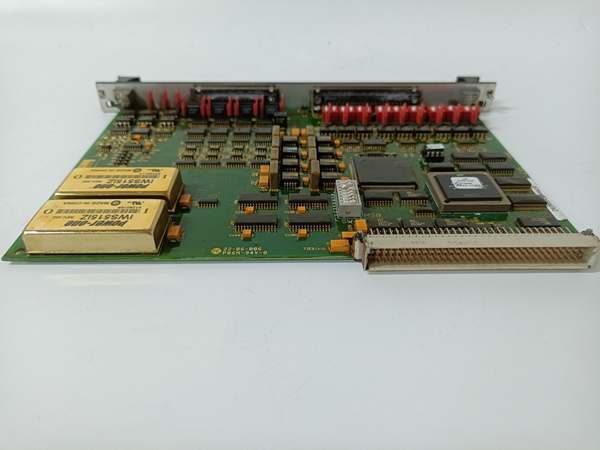
Description
Product Introduction
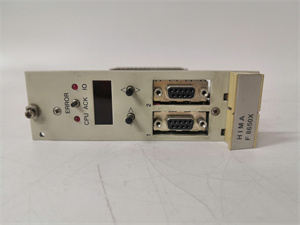
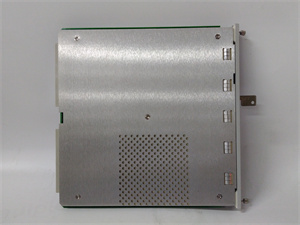
The is a Serial I/O board (SIOB) designed for the Mark V turbine control system, occupying a full slot in the VME I/O core (<R1>, <R2>, <R3>). Unlike the previously discussed DS200SIOBH1ABA(which focuses on signal conditioning like LVDTs), this “ACA” revision is specialized for data communication.
It features two independent serial ports (configurable as RS-232 or RS-485 via software/DIP switches), allowing the Mark V controller to talk to external systems like a DCS (Distributed Control System) via Modbus RTU, or to drive a local alarm printer. The “ACA” suffix indicates a specific hardware revision with conformal coating (C) for corrosion resistance and updated artwork (A/A) for improved noise immunity in electrically noisy turbine decks .
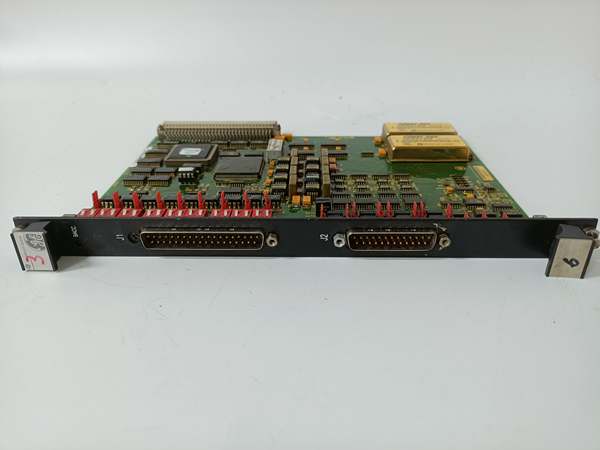
DS200SIOBH1ACA
Key Technical Specifications
- System Role: SIOB (Serial I/O Bridge)
- Bus Interface: VMEbus (P1 Connector, 96-pin)
- Serial Ports: 2 Independent Channels (Port 1 & Port 2)
- Physical Interfaces: Typically DB9 or Removable Terminal Blocks (Rev Dependent)
- Protocols: Modbus RTU (Slave/Master), GE Genius, ASCII
- Baud Rates: 300 bps to 115.2 kbps (Software Selectable)
- Configuration:
- 20 Jumpers (Signal termination, handshaking config)
- 3 Switch Blocks (18 DIP Switches for Addressing/Mode)
- Logic Power: 5 V DC (From VME Backplane)
- Isolation: Opto-Isolated Serial Lines (Typically 1500V – 2500V)
- Coating: Conformal Coated (ACA Revision)
- Temp Range: -20 °C to +70 °C (Operational)
Quality Control Process (Engineer’s Perspective)
- Incoming Verification: Match serial to manifest. Inspect 96-pin VME fingers (P1) for carbon arcs. Check DB9/Terminal ports for broken plastic or bent serial pins (very common during removal).
- Loopback Test: Rig in a VME test rack with 5V DC. Use a DB9 loopback plug (Short Pin 2-3). Initialize the port via Toolbox; the board must echo characters instantly without framing errors.
- Electrical Parameter Test: Back-probe the 5V rail. Ripple shouldn’t exceed 50mV p-p. Megger the serial port shields to chassis at 500V; leakage >10µA risks communication drops during turbine run-up.
- Config Cloning: Photograph all 18 DIP switches and 20 jumpers on the old board. The SIOB is useless without correct addressing (e.g., Unit ID for Modbus). Hardware config must match the
.tcfproject file. - Final QC & Packaging: Clean VME fingers with isopropanol. Bag in rigid ESD foam. Label “QC Passed – Serial Loopback OK” with the date.
Replacement Pitfall Guide
❗ SIOB vs SIOB (Function Conflict): While both DS200SIOBH1ABAand are “SIOB” family, they are often used for different purposes in the same rack.
- ABA= Often used as TCQA (Signal Conditioning for LVDTs/AI).
- ACA= Often used as COMM (Serial Gateway).
Do not swap them 1-for-1 unless the application logic in ToolboxST defines them identically. Putting an “ACA” (Comm) in a slot expecting “ABA” (Signals) results in “I/O Type Mismatch” and loss of LVDT data.
❗ DIP Switch Criticality (Addressing): The 18 DIP switches set the VME Address and Protocol Mode. If you clone Jumper positions but miss Switch Block 1 (Address), the VME bus will either ignore the card or cause an address conflict, crashing the <R>core.
❗ RS-485 Termination: If using the ports for RS-485 (Multi-drop), Jumper JP1/JP2 controls the 120Ω termination resistor. Forgetting to enable this on the last device in the chain causes signal reflection, resulting in “CRC Errors” and intermittent DCS link drops.
❗ Cable Gender: SIOB ports are often Male DB9. If your site cable is Male, you’ll need a Gender Changer (M-M). Forcing pins without a coupler bends the serial pins instantly.
❗ ESD to Fingers: The 96-pin P1 is dense. Discharge to the VME chassis before insertion—static in dry turbine halls (common in northern China winters) can fry the UART controller on this board.
Keep these in mind and you’ll cut 90% of rework time.
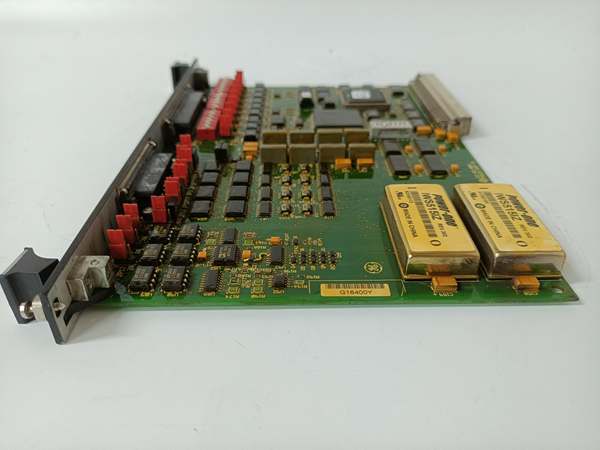
DS200SIOBH1ACA
Compatibility Matrix & Benchmarks
- → GE DS200SIOBH1ABA: Caution— Same form factor (VME), but typically different functional roles (Comm vs Signal Cond.). Check ToolboxST
<R>core configuration before swapping. - → Mark V I/O Core (R1/R2/R3): Direct— Slides into standard VME slots addressed for SIOB function.
- → Mark VIe (IS200 Series): Incompatible— Mark VIe uses Ethernet (IONet) for external comms; this VME board will not fit.
- Data Rate: 115.2 kbps (Max Serial Throughput)
- Isolation: 1500 Vrms (Port-to-Logic, typical)
- Latency: < 5 ms (VME Scan to Serial TX)