Description
Key Technical Specifications
-
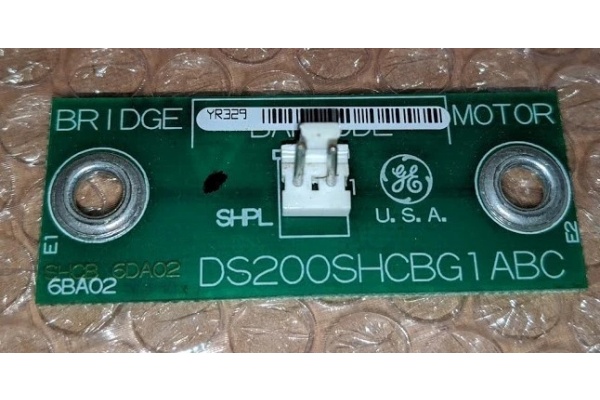
Model Number: DS200SHCBG1ABC
-
Manufacturer: General Electric
-
Current Rating: 65 A continuous
-
System Voltage: ≤ 600 Vdc (Group A scaling)
-
Connectors: J1–J4 40-pin to SDCI, P1–P6 high-current bayonet lugs, 190-wire screw field block
-
Fusing: On-board ferrule fuses sized per system (not user-serviceable)
-
Isolation: 1500 Vdc board-to-ground
-
Operating Temperature: 0 – 60 °C
-
Board Size: ≈ 11 × 8 in (279 × 203 mm)
-
Weight: ≈ 0.9 kg
-
Construction: Non-repairable epoxy-potted traces; replace complete board on failure

DS200SHCBG1ABC
Field Application & Problem Solved
In a DC2000 crane drive the armature loop pulls 65 A through a 500 Vdc bus. You can’t land that current on a dinky Euro-block—this card is the copper highway. It bolts into the power stack, carries the full load through bayonet lugs, and drops a calibrated shunt signal back to the SDCI so the Mark V knows exactly what the motor is drawing. When a shooter shorts, the on-board fuse blows, the SDCI throws “SHUNT FAIL,” and you swap the whole card in five minutes—no re-cal, no download. Bottom line: cheap sacrificial layer keeps expensive silicon alive.
In a DC2000 crane drive the armature loop pulls 65 A through a 500 Vdc bus. You can’t land that current on a dinky Euro-block—this card is the copper highway. It bolts into the power stack, carries the full load through bayonet lugs, and drops a calibrated shunt signal back to the SDCI so the Mark V knows exactly what the motor is drawing. When a shooter shorts, the on-board fuse blows, the SDCI throws “SHUNT FAIL,” and you swap the whole card in five minutes—no re-cal, no download. Bottom line: cheap sacrificial layer keeps expensive silicon alive.
Installation & Maintenance Pitfalls (Expert Tips)
Bayonet lugs must click twice
These carry 65 A at 500 V. A half-latch arcs, welds, and torches the bus bar. Twist until you feel the second detent, then tug-test.
Bayonet lugs must click twice
These carry 65 A at 500 V. A half-latch arcs, welds, and torches the bus bar. Twist until you feel the second detent, then tug-test.
Fuses are board-specific
Factory sizes the ferrule fuses for the motor HP. If you change the armature rating and forget to update the fuse, a fault will vaporize the copper trace inside the epoxy and you’re buying a whole new board. Verify the job drawing before you power up.
Factory sizes the ferrule fuses for the motor HP. If you change the armature rating and forget to update the fuse, a fault will vaporize the copper trace inside the epoxy and you’re buying a whole new board. Verify the job drawing before you power up.
Board is live at bus potential
The heat-spreader plate is tied to DC-minus. Bolt it to the cabinet while the bus is hot and you’ll strike an arc across the mounting hole. Always rack the breaker before you swap the card.
The heat-spreader plate is tied to DC-minus. Bolt it to the cabinet while the bus is hot and you’ll strike an arc across the mounting hole. Always rack the breaker before you swap the card.
Temperature limit is real
Spec is 0–60 °C. Run it inside a 70 °C cabinet and the epoxy softens; vibration works the copper loose and you’ll chase random “SHUNT OPEN” faults that clear when the door is open. Keep the cubicle fan running or add external airflow.
Spec is 0–60 °C. Run it inside a 70 °C cabinet and the epoxy softens; vibration works the copper loose and you’ll chase random “SHUNT OPEN” faults that clear when the door is open. Keep the cubicle fan running or add external airflow.
Technical Deep Dive & Overview
Internally the card is a pure copper bus-way with a precision manganin shunt resistor. The shunt drops 50 mV at 65 A; that millivolt signal is carried through twisted-pair to the SDCI A/D. Because there is no active electronics, you can hot-swap with the bridge powered—pull the old card, slam in the new, torque the lugs, and the SDCC re-acquires current feedback inside 50 ms. Non-repairable construction means when anything inside fails you replace the whole board—no field soldering, no cap kits, just bolt-in and go
Internally the card is a pure copper bus-way with a precision manganin shunt resistor. The shunt drops 50 mV at 65 A; that millivolt signal is carried through twisted-pair to the SDCI A/D. Because there is no active electronics, you can hot-swap with the bridge powered—pull the old card, slam in the new, torque the lugs, and the SDCC re-acquires current feedback inside 50 ms. Non-repairable construction means when anything inside fails you replace the whole board—no field soldering, no cap kits, just bolt-in and go
.