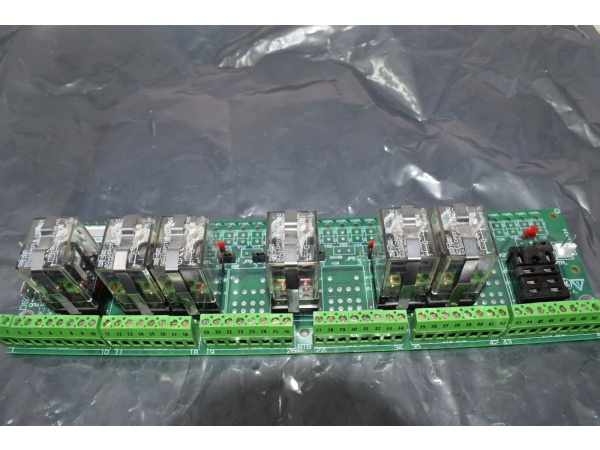
Description
Key Technical Specifications
-
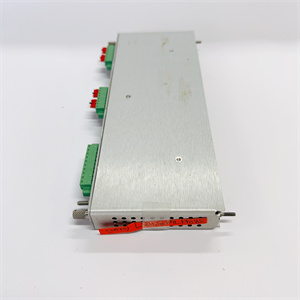
Model Number: DS200RTBAG4AHC
-
Manufacturer: General Electric
-
Relay Count: 48 Form-C (SPDT) 10 A @ 28 VDC / 120 VAC
-
Coil Voltage: 24 VDC (±10 %) with 1N4007 flyback diodes
-
Terminal Rating: 190-point Euro-style, 6 mm wire, 15 A max
-
Isolation: 2 kV coil-to-contact, 500 V between adjacent contacts
-
Operating Temperature: 0 – 60 °C
-
Coating: Enhanced (AHC) acrylic for paper-mill humidity & H₂S
-
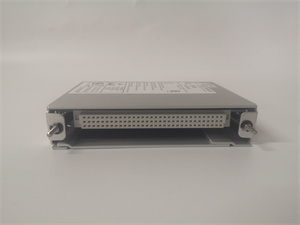
Backplane Connector: Two 96-pin DIN for Mark V rack
-
Replaceable Relays: Omron MY4 series, gold-clad option for low mA
-
Indication: Green LED per coil, red common fault LED tied to <CPS>
-
Mounting: 9-inch rack slot, captive #6-32 screws, forced-air cooled rack

DS200RTBAG4AHC
Field Application & Problem Solved
Static exciter cubicles in combined-cycle plants are packed with interposing relays—under-voltage, lockout, field breaker, trip coils. The original Mark V shipped these relays in a separate panel full of ice-cube sockets. Wiring changes meant pulling 500 MCM cables through conduit and re-labeling. The DS200RTBAG4AHC moves every one of those relays inside the Speedtronic rack. You get 48 programmable contacts that wire straight to the 190-point terminal strip; the CPU fires coils over the backplane and reads the contacts on the next scan. Field techs no longer crawl through 120 VAC panels to trace a lockout—everything is 24 VDC and LED-indicated on one card. I’ve retrofitted dozens of frame 7EA units; swapping the old panel for this board drops wiring by 60 % and chops commissioning time from three shifts to six hours.
Static exciter cubicles in combined-cycle plants are packed with interposing relays—under-voltage, lockout, field breaker, trip coils. The original Mark V shipped these relays in a separate panel full of ice-cube sockets. Wiring changes meant pulling 500 MCM cables through conduit and re-labeling. The DS200RTBAG4AHC moves every one of those relays inside the Speedtronic rack. You get 48 programmable contacts that wire straight to the 190-point terminal strip; the CPU fires coils over the backplane and reads the contacts on the next scan. Field techs no longer crawl through 120 VAC panels to trace a lockout—everything is 24 VDC and LED-indicated on one card. I’ve retrofitted dozens of frame 7EA units; swapping the old panel for this board drops wiring by 60 % and chops commissioning time from three shifts to six hours.
Installation & Maintenance Pitfalls (Expert Tips)
Don’t Mix Relay Versions
The card ships with MY4-02 (standard silver). If you need gold contacts for <1 mA trip circuit continuity, order MY4-01. Drop a silver relay in a 4 mA proof-of-contact loop and you’ll get random “TRIP CIRCUIT FAIL” every six months when the silver sulfides.
The card ships with MY4-02 (standard silver). If you need gold contacts for <1 mA trip circuit continuity, order MY4-01. Drop a silver relay in a 4 mA proof-of-contact loop and you’ll get random “TRIP CIRCUIT FAIL” every six months when the silver sulfides.
Tighten Terminals Once, Then Again After 24 Hours
Fine-strand 16 AWG will cold-flow under the Euro-clamp. I always torque to 0.5 N·m, run the unit, then re-torque the next day. Skipping the re-check gives you a high-resistance joint that shows up as a “FIELD BREAKER DIFF” fault under load.
Fine-strand 16 AWG will cold-flow under the Euro-clamp. I always torque to 0.5 N·m, run the unit, then re-torque the next day. Skipping the re-check gives you a high-resistance joint that shows up as a “FIELD BREAKER DIFF” fault under load.
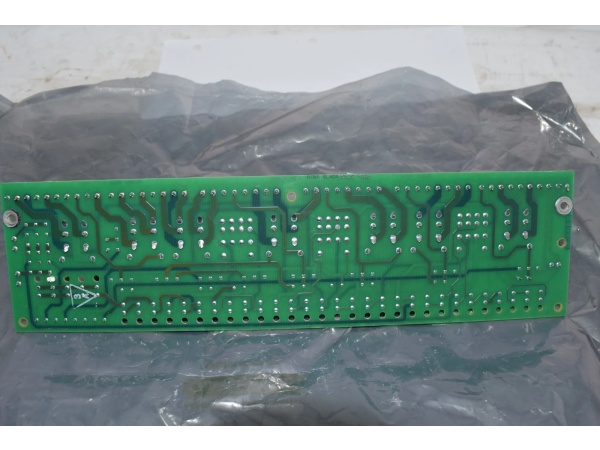
DS200RTBAG4AHC
Watch the LED Power Fuse
The card pulls 24 V off the
The card pulls 24 V off the
Label Both Ends of Every Wire
With 190 terminals it’s easy to land two wires on the same point. I use heat-shrink sleeves printed before crimping; field-modified sharpie labels wash off in six months and the next guy wastes a shift buzzing out contacts.
With 190 terminals it’s easy to land two wires on the same point. I use heat-shrink sleeves printed before crimping; field-modified sharpie labels wash off in six months and the next guy wastes a shift buzzing out contacts.
Technical Deep Dive & Overview
The DS200RTBAG4AHC is essentially a distributed relay farm on a 9-inch Euro-card. The Mark V backplane delivers 24 V coil power and 5 V logic; an on-board PAL decodes rack address lines so the CPU can write a 48-bit word and fire any combination of relays in one scan. Each relay socket has a diode across the coil and an RC snubber across the contact—GE learned the hard way that PLC-style coils kick enough EMI to corrupt the adjacent
The DS200RTBAG4AHC is essentially a distributed relay farm on a 9-inch Euro-card. The Mark V backplane delivers 24 V coil power and 5 V logic; an on-board PAL decodes rack address lines so the CPU can write a 48-bit word and fire any combination of relays in one scan. Each relay socket has a diode across the coil and an RC snubber across the contact—GE learned the hard way that PLC-style coils kick enough EMI to corrupt the adjacent