Description
Key Technical Specifications
-
Model Number: DS200PCCAG9ACB
-
Manufacturer: General Electric
-
System Voltage: ≤ 600 V AC / 800 V DC (Group 9 scaling)
-
Group: G9 – regenerative power-conversion class
-
Snubbers: AC & DC RC networks, 0.1 µF / 100 Ω, 1 kW pulse rating
-
Fuses: On-board ferrule fuses for armature & field bridges (values selected by system)
-
Reactors: Bus-tie reactors embedded in copper path
-
Isolation: 1500 V card-to-ground
-
Connectors: J1–J4 40-pin to SDCI, P1–P6 HV bayonet, armature & field screw lugs
-
Weight: 9 oz (0.26 kg)
-
Dimensions: Approx. 11 × 8.5 in (279 × 216 mm)
-
Repairability: None – epoxy-potted, sealed; replace entire board on failure

DS200PCCAG9ACB
Field Application & Problem Solved
In a 600 Vdc crane drive you’re running regenerative braking back into the line. Every time the SCRs commutate you get a 600 V/µs spike that will walk straight through the gate leads and blow the SDCI card. This board sits in the power stack, clamps the spike with its RC snubber, and gives the fuses a place to blow without torching the copper bus. Because it’s Group 9 you also get the higher-voltage dividers and bigger reactors needed for four-quadrant operation—forget to install it and you’ll split SCRs inside a week. Swap time is five minutes; outage cost drops from days to hours.
In a 600 Vdc crane drive you’re running regenerative braking back into the line. Every time the SCRs commutate you get a 600 V/µs spike that will walk straight through the gate leads and blow the SDCI card. This board sits in the power stack, clamps the spike with its RC snubber, and gives the fuses a place to blow without torching the copper bus. Because it’s Group 9 you also get the higher-voltage dividers and bigger reactors needed for four-quadrant operation—forget to install it and you’ll split SCRs inside a week. Swap time is five minutes; outage cost drops from days to hours.
Installation & Maintenance Pitfalls (Expert Tips)
Group number is NOT cosmetic
G9 uses 1.5 kV dividers and 8 A fuses. Drop a G7 card in the same slot and the divider ratio is wrong—SDCC sees half the voltage and will over-fire the bridge. Read the label before you bolt it down.
Group number is NOT cosmetic
G9 uses 1.5 kV dividers and 8 A fuses. Drop a G7 card in the same slot and the divider ratio is wrong—SDCC sees half the voltage and will over-fire the bridge. Read the label before you bolt it down.
Fuses are board-specific
Factory ships the card with fuses sized for the frame (C or G). If you change motor HP, verify fuse rating against the job drawing—wrong fuse lets a shooter blow the copper trace and you’re buying a whole new board.
Factory ships the card with fuses sized for the frame (C or G). If you change motor HP, verify fuse rating against the job drawing—wrong fuse lets a shooter blow the copper trace and you’re buying a whole new board.
Snubber resistors run 150 °C—let it cool
The 50 W ceramic blocks are epoxy-potted and live at bus potential. Swap the card hot and you’ll grab 600 V through the wrist-strap. Power down, wait five minutes, then pull the latches.
The 50 W ceramic blocks are epoxy-potted and live at bus potential. Swap the card hot and you’ll grab 600 V through the wrist-strap. Power down, wait five minutes, then pull the latches.
Bayonet HV connectors must click twice
These carry 600 Vdc. A half-latch arcs, carbon-tracks the insulator, and you chase “PCCA OVER-V” trips that clear when the door is open. Twist until you feel the second detent, then tug-test.
These carry 600 Vdc. A half-latch arcs, carbon-tracks the insulator, and you chase “PCCA OVER-V” trips that clear when the door is open. Twist until you feel the second detent, then tug-test.
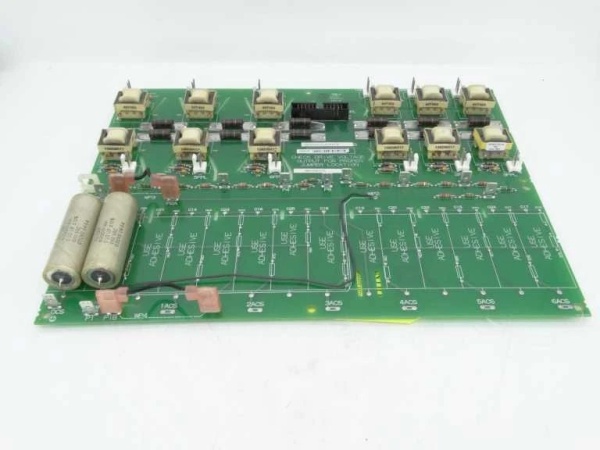
DS200PCCAG9ACB
Technical Deep Dive & Overview
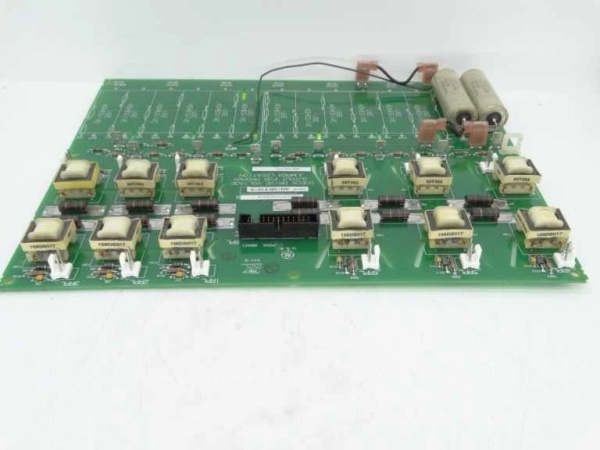
Internally the board is a passive highway—no processor, no firmware. Copper planes carry armature and field current through fuses and embedded reactors; RC networks clamp dv/dt to <500 V/µs. High-voltage feedback is scaled through precision dividers and delivered differentially to the SDCI A/D. Because everything is hardware you can hot-swap with the bridge powered: pull the old card, move wires one-for-one, snap the 40-pin connector, and the Mark V acknowledges “PCCA OK” without a download. Non-repairable construction means when anything inside fails you replace the whole card—no field soldering, no cap kits, just bolt-in and go
Internally the board is a passive highway—no processor, no firmware. Copper planes carry armature and field current through fuses and embedded reactors; RC networks clamp dv/dt to <500 V/µs. High-voltage feedback is scaled through precision dividers and delivered differentially to the SDCI A/D. Because everything is hardware you can hot-swap with the bridge powered: pull the old card, move wires one-for-one, snap the 40-pin connector, and the Mark V acknowledges “PCCA OK” without a download. Non-repairable construction means when anything inside fails you replace the whole card—no field soldering, no cap kits, just bolt-in and go
.