Description
Key Technical Specifications
-
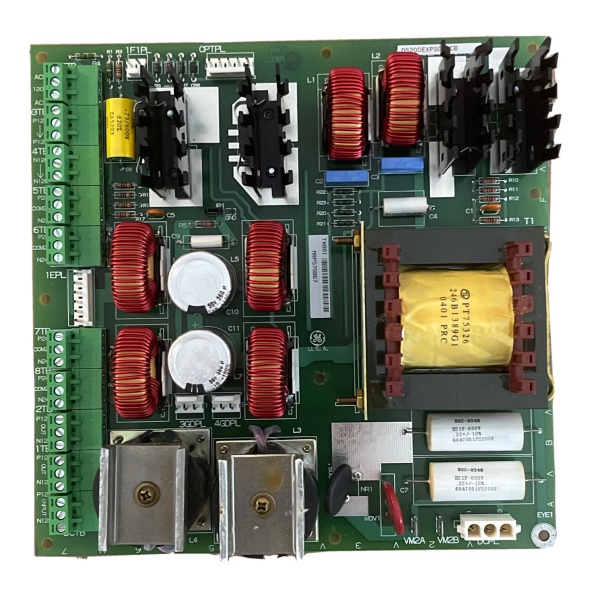
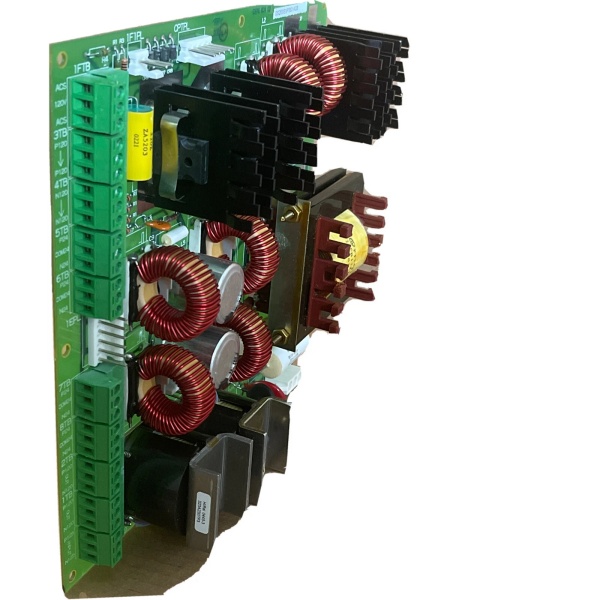
Model Number: DS200NATOG1ABB
-
Manufacturer: General Electric (GE)
-
Voltage Inputs: 1200 V, 2200 V, 3300 V, 4200 V, 6900 V AC/DC (jumper-selected string)
-
Output Range: 0-10 V DC (attenuated) per string
-
Resistor Strings: 5 identical, series-connected precision strings (one per phase + DC+ / DC–)
-
Connectors: 15 stab-on terminals (3 per string)
-
Protection: Metal-oxide varistors (MOVs) on each output to clamp transients
-
Isolation: 2 kV basic input-to-logic; transformer-coupled to back-plane
-
Test Points: 5 factory low-voltage test points for calibration
-
Operating Temperature: –40 °C…+70 °C
-
Dimensions / Weight: 159 × 178 mm, 0.7 kg typical
-
Standards: UL, EC, CSA listed for safety & transient control

GE DS200NATOG1ABB
Field Application & Problem Solved
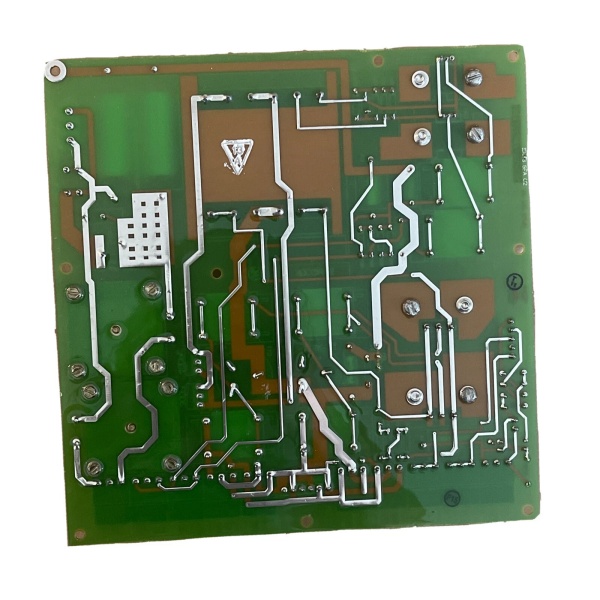
In an LCI or EX2100 exciter the biggest headache is getting a clean, low-voltage replica of a 6900 V bus without running copper cables that pick up noise or create ground loops. The board solves that by living at bridge potential—each resistor string drops the bus down to 0-10 V, the MOVs clamp any spike, and the opto-isolated output feeds the DSP a rock-steady signal. You’ll typically find one card per six-pulse bridge on Frame-7/9 peakers—swap time is five minutes with the unit on turning gear. Core value: it collapses five high-voltage dividers, surge suppressors, and isolation amps into one plug-in card you can swap without pulling the bus
In an LCI or EX2100 exciter the biggest headache is getting a clean, low-voltage replica of a 6900 V bus without running copper cables that pick up noise or create ground loops. The board solves that by living at bridge potential—each resistor string drops the bus down to 0-10 V, the MOVs clamp any spike, and the opto-isolated output feeds the DSP a rock-steady signal. You’ll typically find one card per six-pulse bridge on Frame-7/9 peakers—swap time is five minutes with the unit on turning gear. Core value: it collapses five high-voltage dividers, surge suppressors, and isolation amps into one plug-in card you can swap without pulling the bus
.
GE DS200NATOG1ABB
Installation & Maintenance Pitfalls (Expert Tips)
Stab-On Terminals Loosen with Heat
The 15 Fast-on tabs are brass—after a year at 70 °C they relax and you’ll see 5 % drift in feedback. Tug-test every stab during the major outage; if it pulls off by hand, crimp a new 1/4-inch female and re-land.
The 15 Fast-on tabs are brass—after a year at 70 °C they relax and you’ll see 5 % drift in feedback. Tug-test every stab during the major outage; if it pulls off by hand, crimp a new 1/4-inch female and re-land.
MOV Clamps Wear Out—Meter Them
Each output has a 20 mm MOV; after a few spikes the varistor starts leaking and the offset climbs. If you read > 0.5 V on the “zero” string, replace the MOV or you’ll chase phantom over-voltage trips.
Each output has a 20 mm MOV; after a few spikes the varistor starts leaking and the offset climbs. If you read > 0.5 V on the “zero” string, replace the MOV or you’ll chase phantom over-voltage trips.
String Jumper Sets Voltage Class—Photo Before You Pull
Two wire jumpers per string select 1200/2200/3300 V etc. If you mirror the board the jumpers land on the wrong pads and the DSP sees 200 % scale. Cell-phone the old jumper map before you swap.
Two wire jumpers per string select 1200/2200/3300 V etc. If you mirror the board the jumpers land on the wrong pads and the DSP sees 200 % scale. Cell-phone the old jumper map before you swap.
Board Floats at Bridge Potential—Short the Bus First
The whole card sits at 690 V. If you pull it before the DC link bleeds you’ll arc-weld the 96-pin connector. Wait for bus < 50 V or use the external discharge resistor.
The whole card sits at 690 V. If you pull it before the DC link bleeds you’ll arc-weld the 96-pin connector. Wait for bus < 50 V or use the external discharge resistor.
Technical Deep Dive & Overview
Internally the card is five precision resistor ladders bolted to a 2 kV isolation barrier. Each ladder is factory-trimmed to 0.1 % tolerance; the output is transformer-coupled to the DSP so the high-voltage bus never touches the back-plane. No firmware—pure hardware—so you can swap it without reloading parameters; just remember to torque the stab-ons or the divider will drift on the first heat-cycle
Internally the card is five precision resistor ladders bolted to a 2 kV isolation barrier. Each ladder is factory-trimmed to 0.1 % tolerance; the output is transformer-coupled to the DSP so the high-voltage bus never touches the back-plane. No firmware—pure hardware—so you can swap it without reloading parameters; just remember to torque the stab-ons or the divider will drift on the first heat-cycle
.