Description
Key Technical Specifications
-
Model Number: DS200IQXSG1A
-
Manufacturer: General Electric (GE) – Boards & Turbine Control
-
Function: Dual-role card—snubs IGBT turn-off transients and buffers analog feedback signals
-
Snubber Current: 100-400 A continuous (family rating)
-
Working Voltage: 24 VDC logic supply; inverter bridge up to 1500 VDC system class
-
Isolation: 3750 V basic insulation (channel-to-ground)
-
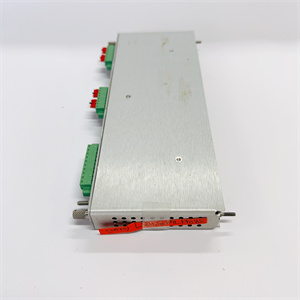
Connectors: 8 screw-terminal blocks (E1-E8) plus one 8-pin header for control interface
-
Capacitors: Film-type snubber caps, 0.47-2 µF per phase, low ESR for < 50 ns dv/dt clamping
-
Temperature Range: –40 °C…+70 °C operational; IP30 front when panel-mounted
-
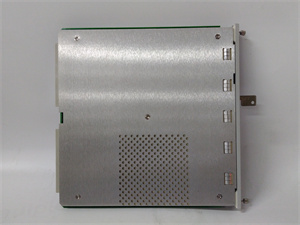
Dimensions / Weight: 6.25 × 5 in (159 × 127 mm), 2 kg; four-corner screw mount

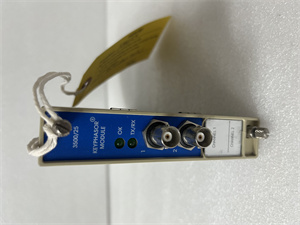
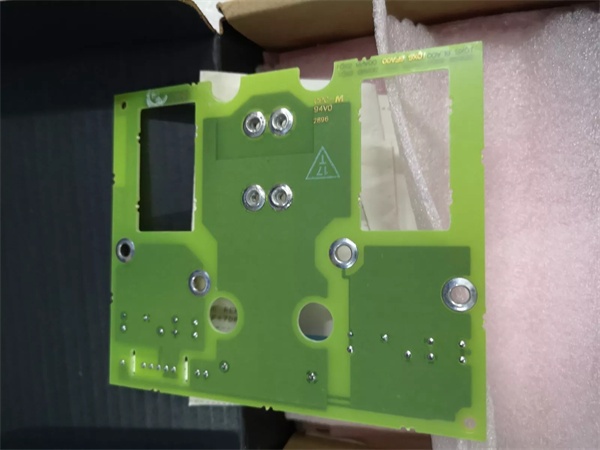
GE DS200IQXSG1A
Field Application & Problem Solved
EX2000 inverter bridges in 9E/9F gas-turbine packages switch 600 A IGBTs at 2 kHz. When the gate drive turns off, the collector voltage tries to rise in < 100 ns—enough to avalanche the device. Slide the DS200IQXSG1A across the DC bus and the on-board film caps absorb the transient while the resistor network damps the ringing. The same board buffers the bridge-current signal (±10 V shunt) and feeds it to the Mark V DSP via connector E3; no external snubber bricks or twisted-pair harness cluttering the cabinet. I’ve used these on 50 Hz Frame-9 units in Kuwait—one card per bridge, hot-swappable while the unit is on turning gear, and you still meet IEC 61800-5-1 isolation without extra hardware. Value: it collapses snubber network, analog isolator, and current feedback into one 2 kg card you can swap with the rack live.
EX2000 inverter bridges in 9E/9F gas-turbine packages switch 600 A IGBTs at 2 kHz. When the gate drive turns off, the collector voltage tries to rise in < 100 ns—enough to avalanche the device. Slide the DS200IQXSG1A across the DC bus and the on-board film caps absorb the transient while the resistor network damps the ringing. The same board buffers the bridge-current signal (±10 V shunt) and feeds it to the Mark V DSP via connector E3; no external snubber bricks or twisted-pair harness cluttering the cabinet. I’ve used these on 50 Hz Frame-9 units in Kuwait—one card per bridge, hot-swappable while the unit is on turning gear, and you still meet IEC 61800-5-1 isolation without extra hardware. Value: it collapses snubber network, analog isolator, and current feedback into one 2 kg card you can swap with the rack live.
Installation & Maintenance Pitfalls (Expert Tips)
Snubber caps hold charge after DC bus is down – The 2 µF film bank sits at bridge potential; if you pull the card before the bus bleeds you’ll arc-weld the connector pins. Wait for the DC link < 50 V or use the external discharge resistor.
E3 connector reversed = negative current scale – The shunt input is polarized. Flip the plug and the DSP sees –8 V at full load, thinks the bridge is motoring, and trips on “Reverse Power”. Check polarity with a DMM before you latch the handle.
Film caps dry out at 70 °C – After 5 years at 65 °C the capacitance drops 15 % and the snubber overshoot climbs 50 V. Log run-hours and replace the card at the 4-year major or you’ll discover the weakness during a load-rejection test.
IP30 means no wash-down – The front plate is open. If the auxiliary cooling fan ingests salt mist the cap terminals corrode and you’ll get partial-discharge noise on the current feedback. Mount the card behind a filtered door or bag it during offshore maintenance.
Snubber caps hold charge after DC bus is down – The 2 µF film bank sits at bridge potential; if you pull the card before the bus bleeds you’ll arc-weld the connector pins. Wait for the DC link < 50 V or use the external discharge resistor.
E3 connector reversed = negative current scale – The shunt input is polarized. Flip the plug and the DSP sees –8 V at full load, thinks the bridge is motoring, and trips on “Reverse Power”. Check polarity with a DMM before you latch the handle.
Film caps dry out at 70 °C – After 5 years at 65 °C the capacitance drops 15 % and the snubber overshoot climbs 50 V. Log run-hours and replace the card at the 4-year major or you’ll discover the weakness during a load-rejection test.
IP30 means no wash-down – The front plate is open. If the auxiliary cooling fan ingests salt mist the cap terminals corrode and you’ll get partial-discharge noise on the current feedback. Mount the card behind a filtered door or bag it during offshore maintenance.
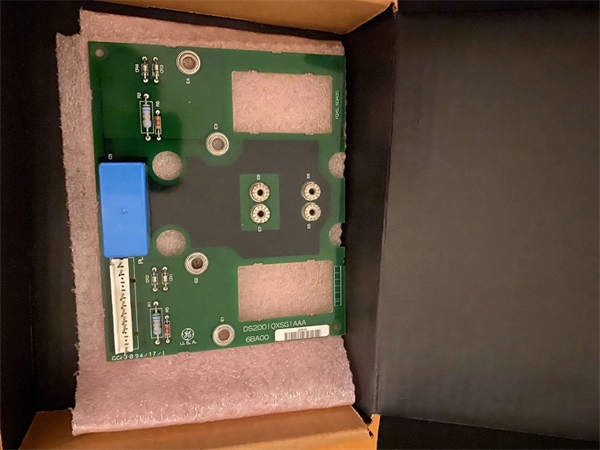
GE DS200IQXSG1A
Technical Deep Dive & Overview
Internally the DS200IQXSG1A is a passive snubber network bolted to an analog buffer. The snubber side uses low-inductance film caps and non-inductive resistors to clamp dv/dt to < 500 V/µs; the buffer side uses 0.1 % precision resistors and isolation amps to give the DSP a ±10 V replica of bridge current with < 1 µs delay. No firmware—pure analog—so you can swap it without reloading the controller. The 8 screw terminals accept ring-lugs up to 6 mm² and the 8-pin header carries power and signal to the back-plane; lose any connector and the DSP throws “Snubber Fail” within 50 ms.
Internally the DS200IQXSG1A is a passive snubber network bolted to an analog buffer. The snubber side uses low-inductance film caps and non-inductive resistors to clamp dv/dt to < 500 V/µs; the buffer side uses 0.1 % precision resistors and isolation amps to give the DSP a ±10 V replica of bridge current with < 1 µs delay. No firmware—pure analog—so you can swap it without reloading the controller. The 8 screw terminals accept ring-lugs up to 6 mm² and the 8-pin header carries power and signal to the back-plane; lose any connector and the DSP throws “Snubber Fail” within 50 ms.