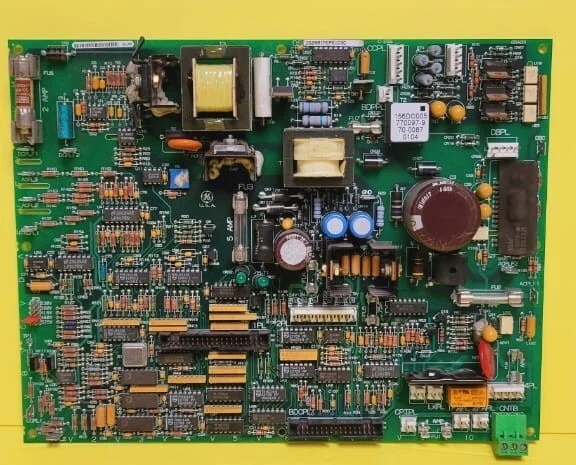
Description
Key Technical Specifications
-
Model Number: DS200IMCPG1C
-
Manufacturer: General Electric
-
Input Voltage: 24 Vdc ±10 %
-
Power Consumption: 10 W typical
-
On-Board Fuses: 8 × 5 × 20 mm (arm, field, gate, logic rails)
-
Gate Drive Outputs: ±15 V isolated, 2 A peak per IGBT leg
-
Communication: Modbus TCP/IP via RJ-45 on face-plate
-
Connectors: 1PL to SDCC (40-pin), 2 × 3-pin Mate-N-Lock for 24 V in/out, 6-pin gate header
-
Isolation: 1500 Vdc input-to-output
-
Operating Temperature: –40 °C to +70 °C
-
Mounting: 4-hole chassis mount (112 mm × 75 mm pattern)
-
Weight: 0.47 kg (1 lb)
-
Conformance: Normal assembly, domestic GE build, C revision firmware

DS200IMCPG1C
Field Application & Problem Solved
A DC2000 crane drive in a steel mill keeps eating IGBT modules because the gate supply drifts with temperature. You drop in a fresh DS200IMCPG1C and the problem disappears. This board is the electrical “junction box” between the SDCC brain and the power stack: it takes the dirty 24 Vdc from the battery charger, filters it, splits out ±15 V for gate drives, and routes armature & field feedback back to the SDCC. Eight fuses protect every rail—when a shooter shorts, only the fuse blows, not the whole SDCC. The face-plate RJ-45 gives you Modbus TCP/IP so you can pull real-time volts, amps, and fuse status into the plant DCS without extra gateways. Bottom line: no IMCP, no gate power; no gate power, no IGBTs; no IGBTs, no steel.
A DC2000 crane drive in a steel mill keeps eating IGBT modules because the gate supply drifts with temperature. You drop in a fresh DS200IMCPG1C and the problem disappears. This board is the electrical “junction box” between the SDCC brain and the power stack: it takes the dirty 24 Vdc from the battery charger, filters it, splits out ±15 V for gate drives, and routes armature & field feedback back to the SDCC. Eight fuses protect every rail—when a shooter shorts, only the fuse blows, not the whole SDCC. The face-plate RJ-45 gives you Modbus TCP/IP so you can pull real-time volts, amps, and fuse status into the plant DCS without extra gateways. Bottom line: no IMCP, no gate power; no gate power, no IGBTs; no IGBTs, no steel.
Installation & Maintenance Pitfalls (Expert Tips)
Fuse match is non-negotiable
Only use the same 5 × 20 mm, 250 V, 2 A fast-blow ceramic. A 3 A glass fuse will survive long enough to cook the copper trace—then you’re buying a new board.
Fuse match is non-negotiable
Only use the same 5 × 20 mm, 250 V, 2 A fast-blow ceramic. A 3 A glass fuse will survive long enough to cook the copper trace—then you’re buying a new board.
Gate-header index key is soft plastic
Reverse the 6-pin plug and you dump +15 V on the –15 V pin, blowing every IGBT in the stack. Line up the triangle mark with the board silk-screen; tug-test before power-on.
Reverse the 6-pin plug and you dump +15 V on the –15 V pin, blowing every IGBT in the stack. Line up the triangle mark with the board silk-screen; tug-test before power-on.
Ribbon cable 1PL loves to back out
Vibration walks the 40-pin connector out 0.5 mm—enough to drop gate pulses and give you “PHASE LOSS” faults. Push until you hear the second click, then hot-glue the latch.
Vibration walks the 40-pin connector out 0.5 mm—enough to drop gate pulses and give you “PHASE LOSS” faults. Push until you hear the second click, then hot-glue the latch.
24 V ripple kills the DC-DC
Battery chargers riding a genset can push 3 Vpp ripple. The on-board converter runs hot, folds back, and you get intermittent “GATE UNDER-V.” Add an external 10 000 µF, 50 V cap across the 24 V input if ripple >1 %.
Battery chargers riding a genset can push 3 Vpp ripple. The on-board converter runs hot, folds back, and you get intermittent “GATE UNDER-V.” Add an external 10 000 µF, 50 V cap across the 24 V input if ripple >1 %.
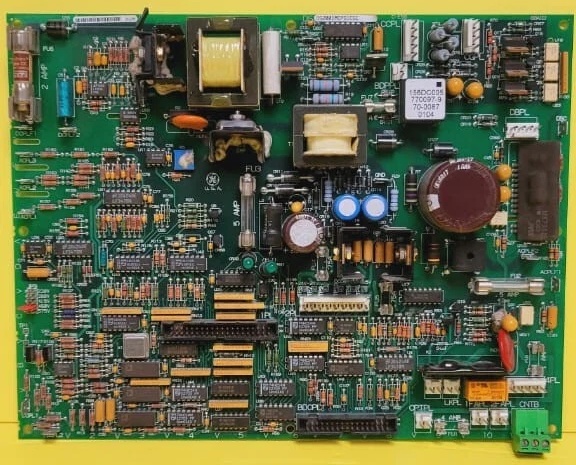
DS200IMCPG1C
Technical Deep Dive & Overview
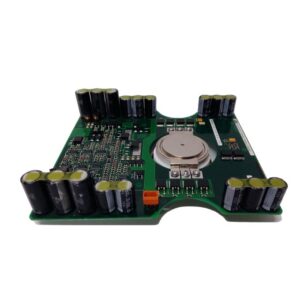
Internally the board is a triple-output DC-DC plus fuse matrix. A forward converter takes 24 Vdc and creates +15 V, –15 V, and 5 V rails. Each rail feeds its own fuse and then exits through Mate-N-Lock or the gate header. Status LEDs on every fuse give you instant eyes; if the LED is dark the fuse is blown—no meter needed. A tiny PHY chip converts TTL-level Modbus from the SDCC into 10/100 Ethernet on the face-plate RJ-45, letting you poll fuse state, rail voltages, and board temperature over TCP. No processor on the power path—just comparators—so you can hot-swap with the drive idling; the SDCC re-acquires gate feedback inside 100 ms.
Internally the board is a triple-output DC-DC plus fuse matrix. A forward converter takes 24 Vdc and creates +15 V, –15 V, and 5 V rails. Each rail feeds its own fuse and then exits through Mate-N-Lock or the gate header. Status LEDs on every fuse give you instant eyes; if the LED is dark the fuse is blown—no meter needed. A tiny PHY chip converts TTL-level Modbus from the SDCC into 10/100 Ethernet on the face-plate RJ-45, letting you poll fuse state, rail voltages, and board temperature over TCP. No processor on the power path—just comparators—so you can hot-swap with the drive idling; the SDCC re-acquires gate feedback inside 100 ms.