Description
Key Technical Specifications
-
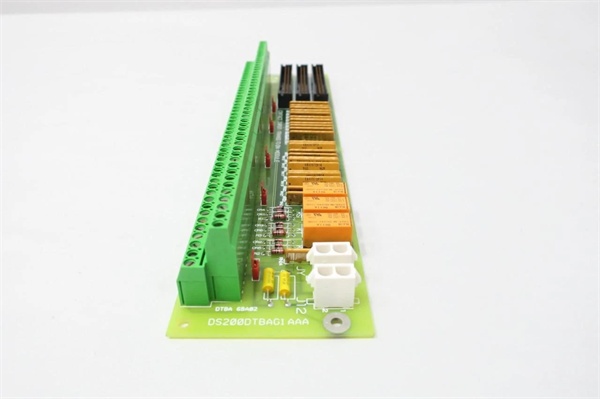
Model Number: DS200DTBAG1AAA
-
Manufacturer: General Electric (GE)
-
Function: Contact input termination – brings field contacts into Mark V rack
-
Input Voltage Range: 24-125 VDC contact wetting
-
Wire Capacity: 190 wires max (95 per terminal block)
-
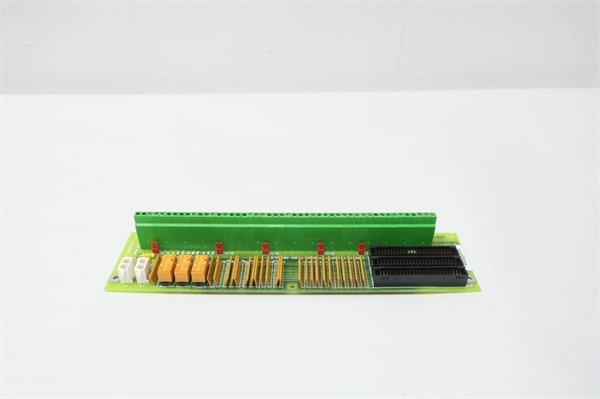
Connectors: J12, JQR, JQS/T, JY plus two 2-pin plugs
-
Jumpers: 5 berg jumpers for input filtering / pull-up selection
-
Isolation: 500 V channel-to-ground (basic)
-
Operating Temperature: –40 °C…+70 °C
-
Dimensions: 6.25 × 5 in (159 × 127 mm), 1 lb (0.45 kg)
-
Mounting: Rack mount (Mark V card-file) or panel stand-offs
-
Protection Degree: IP30 front when door closed

Field Application & Problem Solved
Mark V turbine panels need a clean way to land dozens of field contacts—oil-pressure switches, temperature stats, limit switches—without cluttering the rack with individual terminals. Slide the DS200DTBAG1AAA into the card-file: each screw terminal accepts 24-125 VDC wetting voltage, the berg jumpers let you enable pull-ups or filters, and the pre-wired J-plugs snap straight onto the DSP board. I’ve used these on 7EA peakers—one board terminates 48 contacts, saves 2 h of wiring, and you still meet UL spacing without extra DIN rails. Value: it collapses a 3-row terminal block, pull-up resistors, and noise filters into one plug-in card you can swap with the turbine on turning gear.
Mark V turbine panels need a clean way to land dozens of field contacts—oil-pressure switches, temperature stats, limit switches—without cluttering the rack with individual terminals. Slide the DS200DTBAG1AAA into the card-file: each screw terminal accepts 24-125 VDC wetting voltage, the berg jumpers let you enable pull-ups or filters, and the pre-wired J-plugs snap straight onto the DSP board. I’ve used these on 7EA peakers—one board terminates 48 contacts, saves 2 h of wiring, and you still meet UL spacing without extra DIN rails. Value: it collapses a 3-row terminal block, pull-up resistors, and noise filters into one plug-in card you can swap with the turbine on turning gear.
Installation & Maintenance Pitfalls (Expert Tips)
Jumpers backwards = no pull-up – The silk-screen is read from the component side; if you install berg jumpers on the reverse side the inputs float and you’ll chase “contact open” faults that aren’t there. Match the jumper map in GEI-100161 before you insert the card.
Terminal torque 0.8 Nm only – Over-tighten and the screw posts crack; under-tighten and vibration walks the wire out. Use a calibrated screwdriver and stop when the washer flattens.
IP30 means no wash-down – The front is open; if the cooling fan ingests salt mist the screw posts corrode and you’ll get intermittent “contact bounce”. Mount behind a filtered door or bag the card during offshore maintenance.
Wire dress counts – 190 wires in a 6 in slot is tight; if you leave the harness proud of the card the door won’t close and you’ll pinch a wire against the sheet-metal, giving you a ground fault that trips the whole Mark V. Lace the bundle flat and strap it to the card stand-offs.
Jumpers backwards = no pull-up – The silk-screen is read from the component side; if you install berg jumpers on the reverse side the inputs float and you’ll chase “contact open” faults that aren’t there. Match the jumper map in GEI-100161 before you insert the card.
Terminal torque 0.8 Nm only – Over-tighten and the screw posts crack; under-tighten and vibration walks the wire out. Use a calibrated screwdriver and stop when the washer flattens.
IP30 means no wash-down – The front is open; if the cooling fan ingests salt mist the screw posts corrode and you’ll get intermittent “contact bounce”. Mount behind a filtered door or bag the card during offshore maintenance.
Wire dress counts – 190 wires in a 6 in slot is tight; if you leave the harness proud of the card the door won’t close and you’ll pinch a wire against the sheet-metal, giving you a ground fault that trips the whole Mark V. Lace the bundle flat and strap it to the card stand-offs.
Technical Deep Dive & Overview
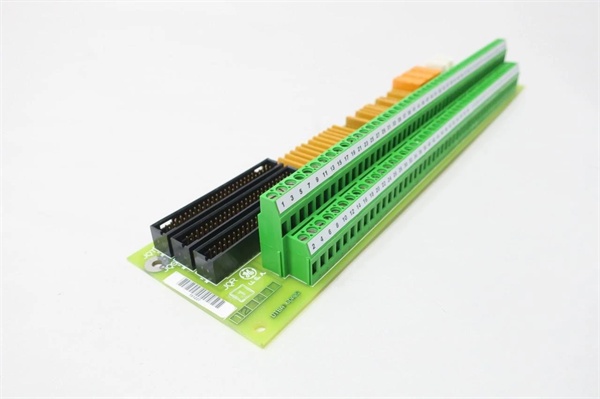
Internally the DS200DTBAG1AAA is a passive termination array. Each input line has a 10 kΩ pull-up to +24 V, an RC noise filter (1 ms time-constant), and a 500 V opto-coupler that feeds the DSP a clean TTL signal. The 96-pin DIN 41612 connector carries all 48 channels plus power; lose any pin and the DSP throws “Contact Loss” within 50 ms. No firmware—pure hardware—so you can swap it without reloading the controller.
Internally the DS200DTBAG1AAA is a passive termination array. Each input line has a 10 kΩ pull-up to +24 V, an RC noise filter (1 ms time-constant), and a 500 V opto-coupler that feeds the DSP a clean TTL signal. The 96-pin DIN 41612 connector carries all 48 channels plus power; lose any pin and the DSP throws “Contact Loss” within 50 ms. No firmware—pure hardware—so you can swap it without reloading the controller.