Description
Key Technical Specifications
-
Model Number: 151X1235DB15SA01
-
Manufacturer: General Electric (GE)
-
Input Voltage: 90-280 Vrms, 45-480 Hz
-
Nominal Output: 35 A @ 250 Vdc (continuous), 120 A ceiling for 10 s
-
Switching Frequency: 40 kHz (max)
-
Response Time: < 1 ms (90 % step)
-
Efficiency: > 92 % @ full load
-
Control Interface: RS-485 Modbus RTU, EtherNet/IP dual-stack
-
Accuracy: ±0.1 % voltage, ±0.5 % current
-
Power Consumption: 50 W self, 15 W typ. idle
-
Operating Temperature: –40 °C…+70 °C (derate > 50 °C)
-
Protection: OC, OV, UV, OT, short-circuit, 1500 V isolation
-
Dimensions: 178 × 140 × 50 mm, 0.5 kg
-
Mounting: Panel mount, four M4 inserts
Field Application & Problem Solved
Generator exciters hate sluggish supplies. A 7FA gas-turbine can swing 50 MVAR in 2 s; if the field supply can’t track, the grid code trips the unit. Slide the 151X1235DB15SA01 into the EX2100e rack and you get a 40 kHz PWM buck that slews 35 A in < 1 ms while the DSP keeps terminal volts within 0.1 %. I’ve used these on 50 Hz units in Kuwait—board mounts on the door, takes 280 V off the PMG, and pumps 250 Vdc into the field; VAR loop closed through the RS-485 link to the Mark VIe. Value: one module replaces the old thyristor cubicle plus analog regulator, freeing four rack slots and cutting wiring by half.
Generator exciters hate sluggish supplies. A 7FA gas-turbine can swing 50 MVAR in 2 s; if the field supply can’t track, the grid code trips the unit. Slide the 151X1235DB15SA01 into the EX2100e rack and you get a 40 kHz PWM buck that slews 35 A in < 1 ms while the DSP keeps terminal volts within 0.1 %. I’ve used these on 50 Hz units in Kuwait—board mounts on the door, takes 280 V off the PMG, and pumps 250 Vdc into the field; VAR loop closed through the RS-485 link to the Mark VIe. Value: one module replaces the old thyristor cubicle plus analog regulator, freeing four rack slots and cutting wiring by half.
Installation & Maintenance Pitfalls (Expert Tips)
Input fuse is NOT user-serviceable – A 40 A semiconductor fuse lives inside the potting. If you short the output the board is scrap; always ohms-out the field before first fire-up.
Forget the ceiling-limit resistor and you cook the rotor – Factory default allows 120 A for 10 s. On an old wire-wound field that is 3× thermal limit. Set P-Limit to 35 A or add a 0.2 Ω ceiling resistor or you’ll warp the coils.
RS-485 earth lift – The comm port is isolated, but if you ground the shield at both ends the 40 kHz switching noise rides the shield and you’ll get “Comm-Lost” every time the VAR set-point changes. Ground shield at the DCS end only.
Heat-sink plate runs 70 °C at 35 A – If you panel-mount on a painted surface the thermal pad is useless. Scrape paint to bare steel and use the supplied TIM or the OT trips at 50 °C ambient.
Input fuse is NOT user-serviceable – A 40 A semiconductor fuse lives inside the potting. If you short the output the board is scrap; always ohms-out the field before first fire-up.
Forget the ceiling-limit resistor and you cook the rotor – Factory default allows 120 A for 10 s. On an old wire-wound field that is 3× thermal limit. Set P-Limit to 35 A or add a 0.2 Ω ceiling resistor or you’ll warp the coils.
RS-485 earth lift – The comm port is isolated, but if you ground the shield at both ends the 40 kHz switching noise rides the shield and you’ll get “Comm-Lost” every time the VAR set-point changes. Ground shield at the DCS end only.
Heat-sink plate runs 70 °C at 35 A – If you panel-mount on a painted surface the thermal pad is useless. Scrape paint to bare steel and use the supplied TIM or the OT trips at 50 °C ambient.
Technical Deep Dive & Overview
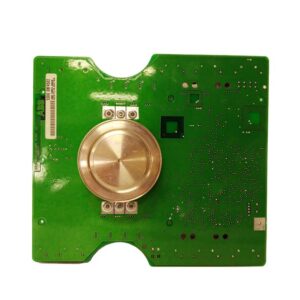
Internally the 151X1235DB15SA01 is a switch-mode buck with a DSP current-loop. A three-phase diode front-end feeds a 600 A IGBT half-bridge running at 40 kHz; the DSP compares field current to reference every 100 µs and updates duty-cycle. Output ripple is < 1 % at 250 V thanks to a 1 mH ferrite choke and 4700 µF film cap stack. The same DSP handles the VAR loop—voltage and power-factor commands arrive over RS-485, get summed with droop, and become the current reference. A second DSP slice manages protection: if field current exceeds 120 A for > 10 s or heatsink hits 85 °C the gate drive shuts down and the board signals “FLT” over both comm ports. No external CTs needed—an on-board Hall sensor gives ±0.5 % accuracy and isolation to 1.5 kV.
Internally the 151X1235DB15SA01 is a switch-mode buck with a DSP current-loop. A three-phase diode front-end feeds a 600 A IGBT half-bridge running at 40 kHz; the DSP compares field current to reference every 100 µs and updates duty-cycle. Output ripple is < 1 % at 250 V thanks to a 1 mH ferrite choke and 4700 µF film cap stack. The same DSP handles the VAR loop—voltage and power-factor commands arrive over RS-485, get summed with droop, and become the current reference. A second DSP slice manages protection: if field current exceeds 120 A for > 10 s or heatsink hits 85 °C the gate drive shuts down and the board signals “FLT” over both comm ports. No external CTs needed—an on-board Hall sensor gives ±0.5 % accuracy and isolation to 1.5 kV.