Description
Hard-Numbers: Technical Specifications
- Series: I/A Series Fieldbus
- Input Channels: 8 (group-isolated channels)
- HART Protocol Version: HART Protocol v6
- Interface Type: 8 group-isolated channels
- Communication Mode: Point-to-point, master/slave, asynchronous, half-duplex
- Baud Rate: 1200 baud
- Message Speed: 2 messages per second per channel
- Fastest Allowed ECB Block Period: 500 ms
- Maximum Distance (FBM216 to Field Device): Up to 3030 m (10,000 ft) per HART FSK physical layer specification HCF_SPEC-54, Revision 8.1
- Compliance Voltage: 18 V DC minimum at 20.5 mA
- Sense Resistor: 61.9 Ω nominal
- Total Input Resistance: 280 Ω minimum
- Analog Accuracy (Includes Nonlinearity): ±0.075% of full scale
- Temperature Coefficient: 50 PPM/°C
- Resolution: 15 bits
- Update Rate: 100 ms
- Integration Time: 500 ms
- Common Mode Rejection: >100 dB at 50 or 60 Hz
- Normal Mode Rejection: >35 dB at 50 or 60 Hz
- Dimensions – Module:
- Height: 102 mm (4 in), 114 mm (4.5 in) including mounting lugs
- Width: 45 mm (1.75 in)
- Depth: 104 mm (4.11 in)
- Mass:
- Module: 284 g (10 oz) approximate
- Termination Assembly (Compression): 181 g (0.40 lb) approximate
- Termination Assembly (Ring Lug): 249 g (0.55 lb) approximate
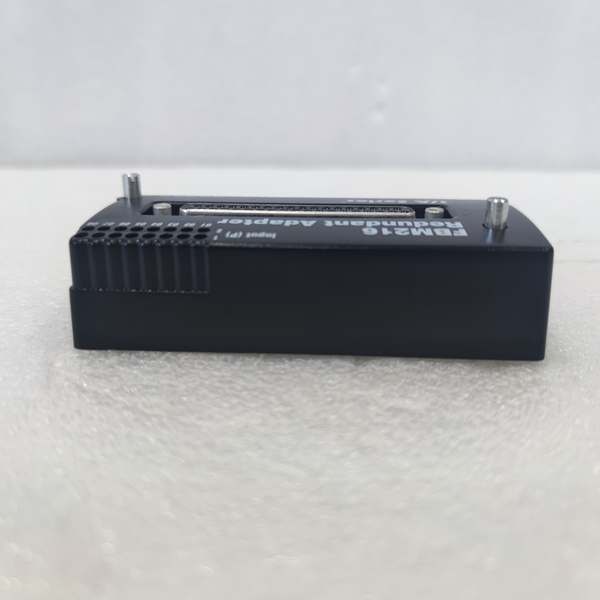
Foxboro P0917XQ
The Real-World Problem It Solves
Traditional analog input modules only measure the 4-20 mA current signal from field instruments, losing access to the rich digital diagnostic and configuration data available through HART communication. Smart instruments can provide extended range measurements, device health status, calibration records, and multiple process variables—all inaccessible without a HART-enabled input interface. The FBM216 enables full-duplex HART communication while simultaneously measuring the analog signal, providing both primary process variables and secondary digital data from smart instruments without requiring separate HART modems or gateways.
Where you’ll typically find it:
- Refinery and petrochemical plant temperature and pressure transmitter networks
- Chemical reactor process monitoring with smart Coriolis flowmeters
- Power plant boiler feedwater and steam system instrumentation
- Pharmaceutical and food & beverage process validation requiring smart device diagnostics
Bottom line: It provides simultaneous analog measurement and HART digital communication for smart field instruments with group isolation for reliable operation in industrial environments.
Hardware Architecture & Under-the-Hood Logic
This HART input interface module contains isolated signal conditioning circuits, HART FSK modem circuitry, and a microprocessor for data acquisition and communication. Each channel group provides electrical isolation to prevent ground loops and cross-channel interference. The module communicates over the Foxboro Fieldbus to the I/A Series control system.
- 4-20 mA analog signals from smart field instruments enter through the termination assembly and pass through sense resistors.
- The module measures voltage across the sense resistor to determine analog current value (61.9 Ω nominal).
- HART FSK (Frequency Shift Keying) signals superimposed on the 4-20 mA loop are extracted by the HART modem circuitry.
- Isolated signal conditioning and A/D converters digitize analog values with 15-bit resolution and 100 ms update rate.
- The microprocessor processes HART digital messages at 1200 baud, extracting extended device data and diagnostics.
- Group isolation barriers prevent ground potential differences between channels from affecting measurements.
- Processed analog values and HART digital data are transmitted over the Fieldbus to the I/A Series controller.
- Diagnostics monitor loop integrity, HART communication health, and device status per channel.
- Error checking includes parity on each byte and CRC check bytes for data integrity verification.
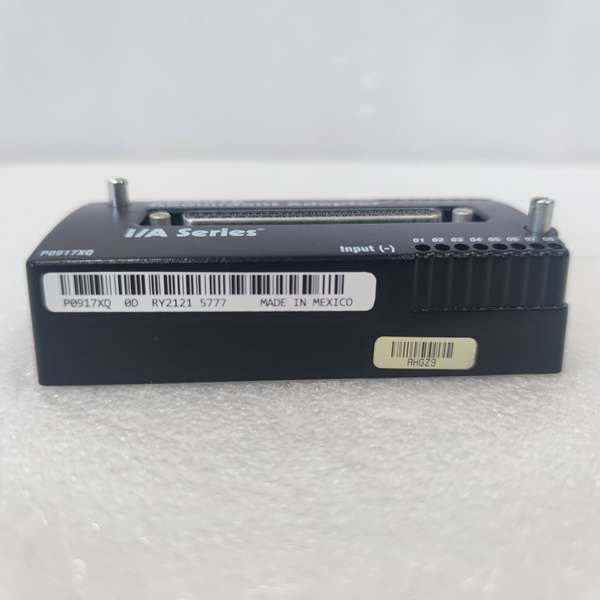
Foxboro P0917XQ
Field Service Pitfalls: What Rookies Get Wrong
Incorrect Loop Wiring PolarityRookies wire the 4-20 mA loop with reversed polarity to the FBM216 termination. The analog measurement may appear as negative or near zero, and HART communication fails completely because the FSK signals require correct current flow direction.
- Field Rule: Verify loop polarity at the termination assembly before powering the instrument. Smart transmitters require proper polarity for both analog and HART communication. Use a multimeter to confirm current flow direction.
Exceeding Maximum Loop ResistanceNew engineers add too many devices in series or use undersized field wiring, causing total loop resistance to exceed the 18 V DC minimum compliance voltage requirement at 20.5 mA. Instruments drop into voltage starvation mode, causing erratic readings and HART communication failures.
- Quick Fix: Calculate total loop resistance including transmitter resistance, wiring resistance, and FBM216 input resistance (minimum 280 Ω). Ensure power supply voltage provides sufficient headroom: V_supply ≥ 18 V + (I_loop × R_total). For 24 V systems, keep total resistance under 300 Ω.
Mixing Instrument Types on Group-Isolated ChannelsTechnicians connect field devices from different ground reference areas to channels within the same isolation group without considering ground potential differences. Ground loops form through the shared isolation barrier, introducing noise and measurement errors.
- Field Rule: Verify ground references of connected instruments. When devices from different ground potential areas are connected, distribute them across different isolation groups within the module. Never assume group isolation eliminates all ground loop issues when ground potentials exceed 30 V difference.
Ignoring HART Communication Timing RequirementsRookies configure too many HART variables or poll devices too frequently, exceeding the 2 messages per second per channel speed limit. The module falls behind on HART communication, causing missed data and device timeout alarms.
- Field Rule: Configure HART polling based on application requirements. For most applications, polling primary variable and device status every 500-1000 ms is sufficient. Reserve faster polling for critical diagnostics only. Remember the ECB block period minimum is 500 ms.
Using Non-HART Compatible InstrumentsInstallers connect standard 4-20 mA analog transmitters without HART capability to the FBM216. The analog measurement works, but HART communication attempts generate continuous timeout errors and fill alarm logs with unnecessary messages.
- Quick Fix: Verify transmitter compatibility before installation. Only instruments with registered HART capabilities should be connected to the FBM216. For pure analog applications, use standard FBM201 or FBM202 analog input modules instead.
Please note: The listed price is for reference only and is not binding. Final pricing and terms are subject to negotiation based on current market conditions and availability.