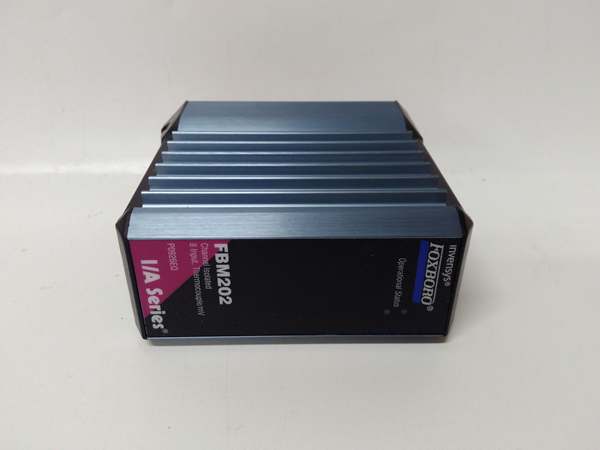
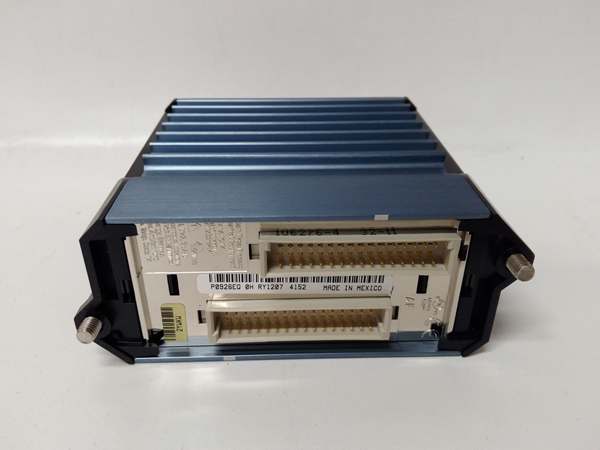
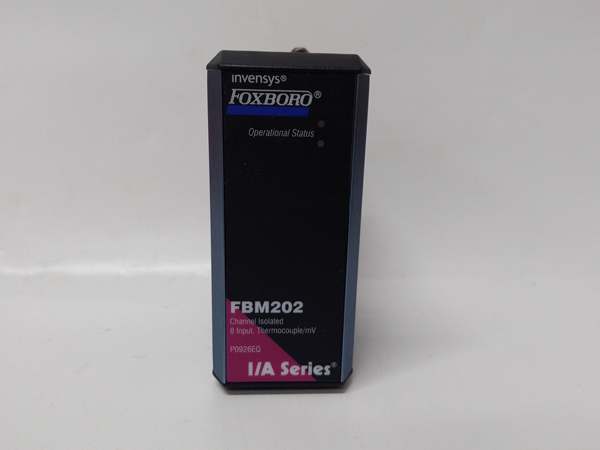
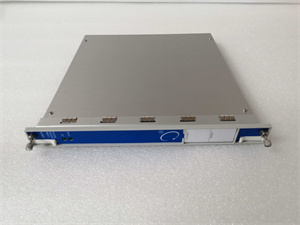
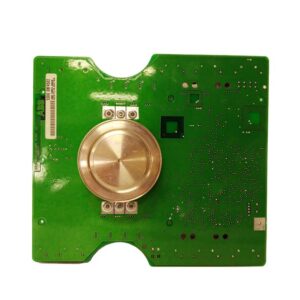
Manufacturer: Modules Part number: FBM202
Our extensive Modules catalogue, including
: FBM202
, is available now for dispatch to the worldwide.
Brand: FOXBORO
The listed price is not final; the actual selling price is negotiable based on current market conditions.
Isolation Rating: 600 VAC channel-to-channel and channel-to-ground
Operating Temperature: 0 °C to +60 °C
Power Draw: 3 W maximum, 24 VDC backplane powered
Resolution: 16-bit analog-to-digital conversion
Accuracy: ±0.03% of range (±27 μV) at 25 °C
CJC Accuracy: ±0.50 °C (internal 3-wire PT100 RTD)
Update Rate: 20 ms per channel
Status Indicators: RUN green LED, FAULT red LED, 8 channel LEDs
The Real-World Problem It Solves
Weak thermocouple signals degrade over long cable runs. Generic modules struggle with noise and drift, causing inaccurate temperature readings that ruin batch runs or trip interlocks.
Where you’ll typically find it:
Furnace and boiler temperature monitoring in thermal power plants
Reactor and distillation column temperature control in refineries
Cryogenic and high-temperature process loops in chemical plants
This module’s high-impedance, isolated design rejects common-mode noise and delivers stable, repeatable mV/TC measurements.
Hardware Architecture & Under-the-Hood Logic
This is a dedicated analog input slave card with no local CPU. It uses precision op-amps and opto-isolators to condition and protect weak field signals.
Each channel buffers low-level mV/TC signals via high-impedance differential amplifiers.
Internal PT100 RTD measures terminal temperature for cold-junction compensation.
Signal passes through 600VAC opto-isolators to break ground loops.
16-bit ADC converts analog to digital; filtered for 20ms update.
Digital data sent to FCP over backplane; LEDs reflect channel/module health.
FBM202
Field Service Pitfalls: What Rookies Get Wrong
Mixing Up (TC/mV) with FBM201 (4-20mA)
Techs often swap and FBM201. has high impedance; FBM201 is 250Ω. Swapping causes signal loss or burnout.
Field Rule: Verify P/N before insertion. = TC/mV; FBM201 = 4-20mA. Never cross-wire termination assemblies.
Ignoring Cold-Junction Compensation Wiring
CJC uses a 3-wire RTD in the termination head. Using 2-wire or loose connections introduces ±2–5°C drift.
Quick Fix: Torque CJC terminals to 0.8 Nm. Use dedicated 3-wire cable; avoid splices.
Running TC Cables Parallel to Power Wires
Thermocouple wires act as antennas. Running them next to 480VAC cables induces 50/60Hz noise, causing erratic readings.
Field Rule: Separate TC/mV cables from power by ≥30cm. Use shielded twisted pair; ground shield only at the cabinet end.
Commercial Availability & Pricing Note
Please note: The listed price is for reference only and is not binding. Final pricing and terms are subject to negotiation based on current market conditions and availability.