Description
Key Technical Specifications
-
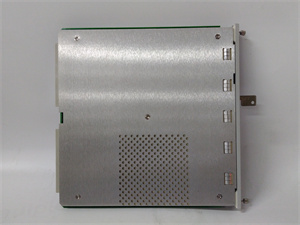
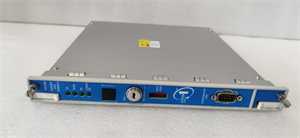
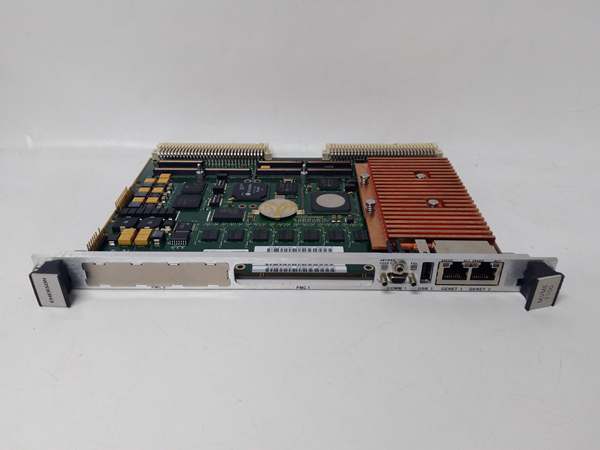
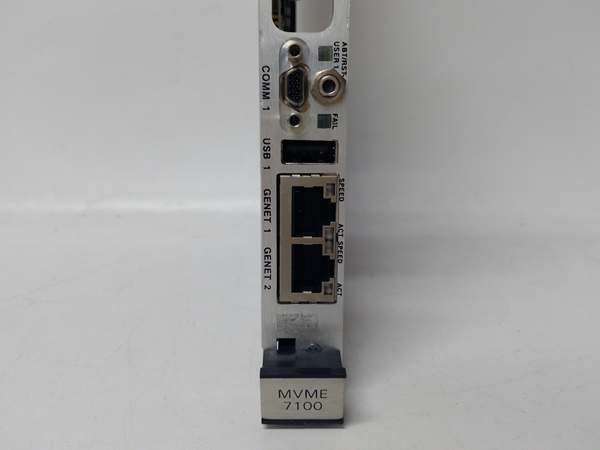
Model Number: MVME7100
-
Manufacturer: Emerson Automation Solutions
-
Processor: Freescale PowerPC G4 (1.0GHz or 1.2GHz)
-
Memory: 2GB to 8GB DDR2 SDRAM (ECC protected)
-
Storage: 512MB Flash memory; 2.5” SATA HDD/SSD support
-
Bus Interface: VME64x (32/64-bit, up to 160MB/s throughput)
-
I/O Ports: 2x Gigabit Ethernet, 4x USB 2.0, 2x RS-232/422/485, 1x VGA
-
Operating Temperature: -40°C to 70°C (-40°F to 158°F)
-
Power Consumption: 15W typical, 25W maximum
-
Environmental Rating: 5-95% RH (non-condensing); 15g shock (11ms); 2g vibration (10-2000Hz)
-
Software Support: VxWorks, Linux, Emerson DeltaV O/S
-
Mounting: VMEbus rack-mount (6U form factor)

EMERSON MVME7100
Field Application & Problem Solved
In legacy power plants and refineries, outdated embedded computers are a ticking time bomb. I was called to a California refinery in 2022 where a 1990s-era SBC failed, taking down the crude distillation unit’s control system—9 hours of downtime, $1.2M in lost production. The problem? The old board couldn’t handle modern control logic updates and lacked ECC memory, leading to data corruption. The MVME7100 solves this: it’s a drop-in VMEbus replacement that runs legacy software while supporting new control algorithms, bridging the gap between old infrastructure and modern demands.
You’ll find this SBC in VMEbus-based control racks: power plant turbine governors, refinery FCC unit controllers, and chemical plant batch systems. At a Midwest coal-fired power plant, we replaced three obsolete SBCs with MVME7100s to run their boiler control logic. The ECC memory eliminated the “random” control glitches they’d endured for years, and the 1.2GHz G4 processor cut loop execution time by 40%—letting them add emissions monitoring logic without slowing down core controls. Unlike generic SBCs, it’s certified for DeltaV DCS, so there was no software rework—we just loaded the existing code and went live.
Its core value is “legacy continuity with modern reliability.” Plants can’t afford to rip out entire VMEbus racks, but they need computers that won’t fail or hold back upgrades. The MVME7100’s VME64x interface fits old racks, while its ECC memory and rugged design fix the flaws of 1990s and 2000s-era boards. For engineers, it’s the ultimate “plug-and-play” solution—no rewiring, no software overhauls, just a reliable SBC that keeps critical processes running. It’s not about being cutting-edge; it’s about being the stable backbone that lets plants extend the life of expensive control hardware.
Installation & Maintenance Pitfalls (Expert Tips)
VMEbus Termination: Don’t Skip the End-of-Bus Resistor
Rookies install the MVME7100 without checking VMEbus termination, causing data collisions. A Texas petrochemical plant did this— the SBC would freeze every 4-6 hours because the bus signal reflected back. The MVME7100 has a built-in termination jumper, but it only works if it’s the last module in the rack. If it’s in the middle, install a 132-ohm resistor at the rack’s end. Test with a VMEbus analyzer: signal rise time should be <5ns, with no overshoot. If you see glitches, recheck termination—this fixes 70% of post-install freezes.
Flash Memory: Avoid Writing to Flash in Continuous Loops
Programmers often log data directly to the MVME7100’s flash memory, burning it out in 6-12 months. A Florida water treatment plant had this issue— their MVME7100 failed after 8 months because the SCADA system wrote 100+ data points/sec to flash. Use the SBC’s SATA interface to connect an industrial SSD for logging—flash should only store the OS and control software. If you must use flash, enable wear leveling in the OS and limit writes to <1000/day. Check flash health monthly with Emerson’s Flash Monitor tool—replace the module if bad blocks exceed 5%.
Power Supply: Match Voltage to the Module’s Jumpers
The MVME7100 supports 5V and 12V VMEbus power, but wrong jumper settings fry the processor. A Wyoming power plant destroyed two modules by running 12V to a 5V-jumpered SBC. Before installation, check the J1 jumper bank: pins 1-2 closed for 5V, 3-4 closed for 12V. Verify the rack’s power supply with a multimeter—legacy VME racks often have both voltages, so pick the one matching the jumper. If you’re unsure, use the auto-voltage mode (jumpers open) for 5-12V compatibility. Never hot-swap the module—VMEbus power spikes during insertion can damage the RAM.
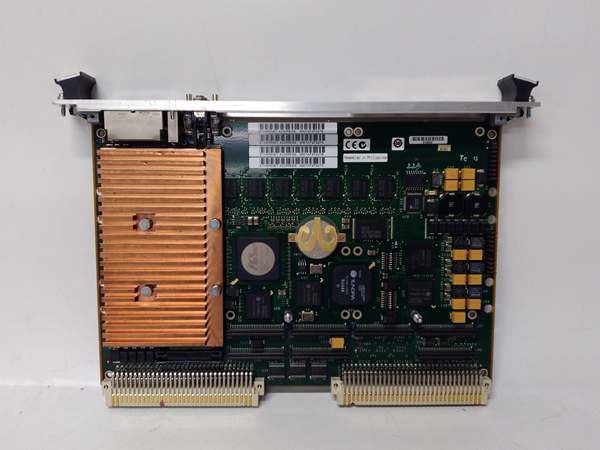
EMERSON MVME7100
Technical Deep Dive & Overview
The MVME7100 is a ruggedized embedded SBC designed for the harsh electrical and physical conditions of industrial plants. At its core is a Freescale PowerPC G4 processor, optimized for real-time control—unlike x86 chips, it excels at deterministic task execution, critical for control loops that need to run every 10ms without variation. The ECC DDR2 RAM is non-negotiable for industrial use: it corrects single-bit errors and detects multi-bit errors, preventing the data corruption that crashes legacy SBCs.
Its VME64x interface is the key to legacy compatibility. It plugs into 3U and 6U VMEbus racks, communicating with old I/O modules via the 64-bit bus at up to 160MB/s—fast enough for modern data acquisition without abandoning existing hardware. The on-board Gigabit Ethernet lets it connect to plant networks, while the USB ports simplify configuration with laptops. The flash memory uses industrial-grade chips rated for 100,000 write cycles, and the SATA interface supports SSDs for high-volume data logging.
What sets it apart from generic SBCs is Emerson’s industrial hardening: the circuit board uses conformal coating to resist dust and moisture, and the components are rated for extended temperatures (-40°C to 70°C) that would kill consumer-grade hardware. It integrates with Emerson’s AMS software, so you can monitor CPU load, memory usage, and flash health remotely—no more climbing into tight rack rooms to check status lights. It’s the bridge between the past and present of industrial control, letting plants keep working while planning for future upgrades.