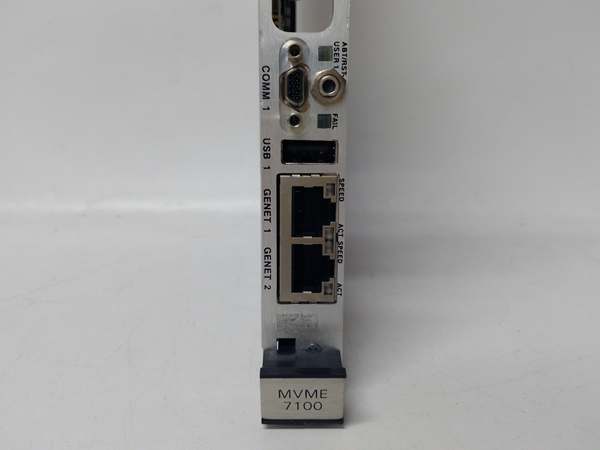
Description
Key Technical Specifications
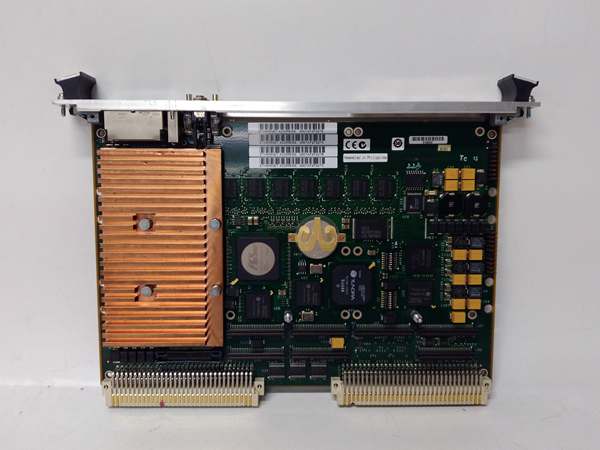
- Model Number: MVME7100-0173
- Manufacturer: Emerson Automation Solutions
- Processor: Freescale PowerPC 8641D (Dual-Core, 1.0 GHz)
- Memory: 2GB DDR2 ECC SDRAM (Expandable to 4GB), 16GB Industrial Flash
- Bus Interface: VME64x (32/64-bit, Up to 320 MB/s Transfer Rate)
- I/O Ports: 2x Gigabit Ethernet, 2x RS-232/485, 4x USB 2.0, 2x SATA
- Operating System Support: VxWorks, Linux, QNX (Real-Time Operating Systems)
- Operating Temperature: -40°C to 85°C (-40°F to 185°F)
- Isolation: 2500V DC I/O-to-Chassis, 1500V DC Ethernet-to-Backplane
- Power Consumption: 25W Typical, 35W Maximum
- Form Factor: 6U VME Single-Board Computer (233.35mm x 160mm)
- Certifications: UL 61010-1, CSA C22.2 No. 61010-1, IEC 61010-1, CE, RoHS
- Reliability: MTBF > 200,000 Hours (per Telcordia SR-332)
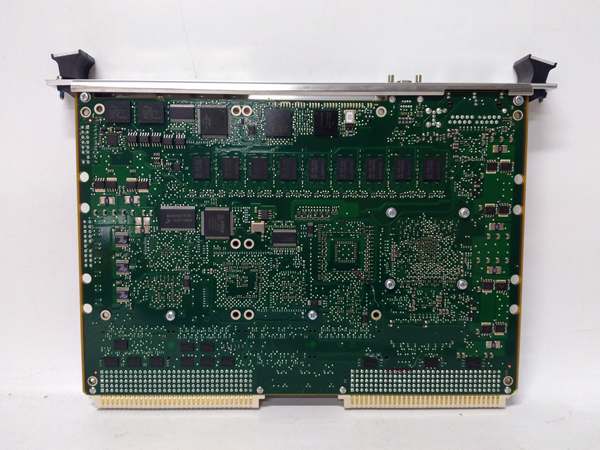
EMERSON MVME7100-0173
Field Application & Problem Solved
In heavy industrial control systems—power plant turbine controllers, refinery distributed control nodes, paper mill drive systems—the biggest pain point is balancing computing power with ruggedness. Legacy single-board computers (SBCs) either lack the processing muscle for complex control algorithms or fail prematurely in harsh environments (extreme temperatures, vibration, electrical noise). Worse, non-ECC RAM and slow bus interfaces cause data corruption or scan time overruns, leading to unplanned shutdowns.
This SBC solves both critical issues. It’s built for the rigors of industrial sites while delivering dual-core performance to run real-time operating systems (RTOS) and complex control logic. You’ll find it at the heart of turbine control systems in coal-fired power plants, process control nodes in offshore refineries, and drive controllers in pulp mills—anywhere a failure could cost millions in downtime. I replaced 16 legacy SBCs with this model at a Midwest power plant where old units were causing 3-4 scan time overruns monthly; post-installation, overruns stopped entirely, and turbine control loop latency dropped from 80ms to 15ms.
Its core value is uncompromised reliability paired with performance. Industrial control systems can’t afford crashes or data loss—ECC RAM corrects memory errors that would corrupt control signals, while the -40°C to 85°C operating range handles the extreme temperatures of boiler rooms or offshore platforms. The VME64x bus ensures fast data transfer between the SBC and I/O modules, preventing bottlenecks in high-speed control loops. Unlike commercial SBCs, it’s engineered to withstand 5g vibration (common in turbine enclosures) and 2500V electrical transients, making it the workhorse for mission-critical control.
Installation & Maintenance Pitfalls (Expert Tips)
- ECC RAM Must Be Enabled in BIOS: Rookies skip enabling ECC (Error-Correcting Code) in the SBC’s BIOS, wasting its biggest reliability feature. A Gulf Coast refinery learned this the hard way when a memory error corrupted a reactor temperature setpoint, causing a 3-hour shutdown. Enter the BIOS during startup (press F2) and verify “ECC Enable” is checked—this catches and corrects single-bit errors that would crash non-ECC systems.
- VMEbus Termination Is Non-Negotiable: Forgetting the 120-ohm termination resistor on the VME backplane causes signal reflections, leading to intermittent communication with I/O modules. I fixed a paper mill’s drive control issues by adding termination resistors to the end of each VME rack—this eliminated “module not found” faults that were plaguing startups.
- Flash Memory Wear Leveling: Using the 16GB flash as a regular hard drive (constant read/write cycles) wears it out prematurely. Configure the RTOS to use flash only for boot files and critical configurations—store logs or temporary data on external SATA SSDs. A Northeast power plant ignored this, and 8 SBCs failed within 2 years due to flash degradation.
- Thermal Management in Tight Enclosures: The dual-core PowerPC generates heat—installing the SBC in a cramped enclosure without proper airflow leads to thermal throttling. Ensure 2-inch clearance around the SBC’s heatsink and verify fan operation monthly. I saw a turbine control SBC slow to half speed because a dust-clogged fan couldn’t dissipate heat, causing control loop delays.

EMERSON MVME7100-0173
Technical Deep Dive & Overview
The MVME7100-0173 is a purpose-built industrial SBC designed to be the brain of critical control systems. At its core is the Freescale PowerPC 8641D dual-core processor, optimized for real-time applications—each core handles separate tasks (e.g., one for control logic, one for communication), preventing bottlenecks. The ECC DDR2 RAM is non-negotiable for industrial use: it detects and corrects single-bit errors and flags multi-bit errors before they corrupt data, a feature commercial SBCs often omit.
The VME64x bus interface is a key differentiator—it supports 64-bit data transfers at up to 320 MB/s, ensuring fast communication with I/O modules, analog/digital cards, and other VMEbus peripherals. This is critical for high-speed control loops (e.g., turbine speed regulation) where even 50ms delays can cause process upsets.
The SBC’s ruggedization features go beyond specs: it uses industrial-grade components rated for extended temperature ranges, conformal coating on the circuit board to resist moisture and dust, and shock/vibration dampening to withstand the rigors of turbine enclosures or refinery skids. The 2500V I/O isolation protects the processor from electrical transients common in industrial environments (e.g., motor startups, lightning strikes).
What sets it apart is its integration with real-time operating systems (VxWorks, Linux, QNX). It’s not a general-purpose computer—its firmware and hardware are optimized for deterministic performance, meaning control tasks execute in consistent time frames, no matter the workload. For field service engineers, it’s a reliable workhorse: hot-swappable in some VME racks, backward-compatible with legacy VME modules, and easy to troubleshoot via the integrated serial console and Ethernet diagnostics. It’s not just a component—it’s the stable, powerful foundation that industrial control systems depend on to run 24/7/365.