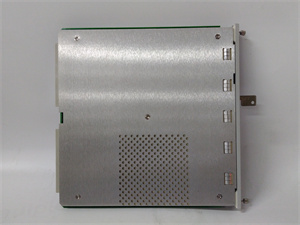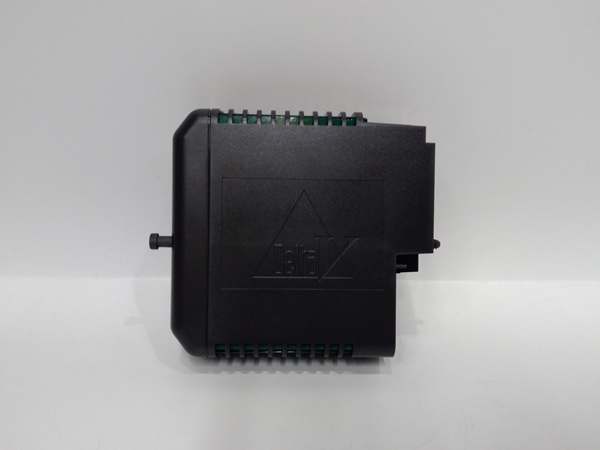

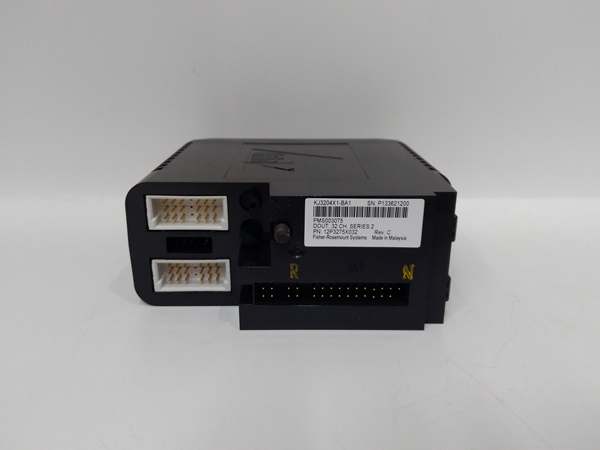
Description
Key Technical Specifications
- Model Number: KJ4001X1-CJ1
- Manufacturer: Emerson Automation Solutions
- Terminal Count: 40 Spring-Terminal Points (20 Differential Pairs)
- Wire Compatibility: 22-14 AWG Stranded/Solid, 0.2-2.5 mm² (Ferruled or Bare Wire)
- Terminal Type: Nickel-Plated Copper Spring Clamps (Tool-Less)
- Operating Temperature: -40°C to 70°C (-40°F to 158°F)
- Humidity Range: 5-95% Non-Condensing
- Voltage Rating: 30V DC Max per Terminal
- Current Rating: 1A Max per Terminal, 10A Max per 10-Terminal Bank
- Mounting: DeltaV I/O Chassis-Mounted (Dedicated Terminal Slot), Keyed Alignment
- Compatibility: DeltaV S-Series/I-Series I/O Modules (AI/AO/DI/DO), DeltaV I/O Chassis
- Labeling: Laser-Engraved Terminal Numbers, Module Pinout Alignment Markings
- Certifications: UL 61010-1, CSA C22.2 No. 61010-1, CE, RoHS
- Physical Dimensions: 5.5” (L) x 4.5” (W) x 1.5” (H), 230g (0.51 lbs)
- Wiring Time: ~10 Seconds per Terminal (Tool-Less Operation)

EMERSON KJ4001X1-CJ1
Field Application & Problem Solved
In DeltaV DCS installations—chemical batch reactor I/O racks, refinery distillation column control skids, power plant auxiliary systems—the biggest inefficiencies with legacy termination are slow wiring and vibration-induced failures. Old screw-terminal blocks require tools, taking 30+ seconds per wire and leading to inconsistent torque (either loose or over-tightened). In high-vibration environments (e.g., pump skids, turbine enclosures), these screws back out over time, causing intermittent signal loss that triggers false alarms or process upsets. Plants also waste hours troubleshooting miswired terminals, as generic blocks don’t align with DeltaV’s pinout, forcing cross-wiring.
This spring-terminal block fixes both critical pain points. Its tool-less design cuts wiring time by 67% (10 seconds per terminal vs. 30 with screws), and the spring clamps maintain consistent pressure—eliminating vibration-related loose connections. You’ll find it terminating field signals for every DeltaV I/O type: thermocouple temperature readings (AI), control valve outputs (AO), pump status switches (DI), and emergency shutdown relays (DO). I installed 96 of these at a Midwest chemical plant where screw-terminal blocks were causing 5-6 vibration-related outages yearly; post-installation, the plant went 2 years without a single wiring-related fault, and commissioning time for new I/O racks dropped from 3 days to 1 day.
Its core value is fast, reliable DeltaV-specific termination. Industrial plants can’t afford downtime from loose wires or slow installations—this block’s spring terminals ensure consistent, vibration-resistant connections, while its DeltaV-aligned pinout eliminates cross-wiring and mislabeling. Unlike generic spring terminals, it’s engineered to fit DeltaV chassis and modules seamlessly, no adapters needed. For electricians, it cuts installation time; for maintenance teams, it eliminates loose-terminal troubleshooting; for plant managers, it reduces commissioning delays and unplanned downtime. It’s not just a terminal block—it’s a productivity tool that streamlines DeltaV wiring from installation to maintenance.
Installation & Maintenance Pitfalls (Expert Tips)
- Wire Preparation Prevents Connection Failures: Rookies use unferruled stranded wire, leading to frayed strands that slip out of spring clamps. A Gulf Coast refinery had 8 AI signal drops because of this. For stranded wire, crimp on 0.2-2.5 mm² ferrules (EMerson-recommended P/N 9199-00159) to keep strands intact. For solid wire, trim to 4-6mm stripped length—no longer, to avoid exposed conductors shorting adjacent terminals.
- Overloading Terminal Banks Causes Overheating: Each 10-terminal bank has a 10A max current limit—rookies load 10 channels with 1A devices (10A) without leaving margin, leading to thermal buildup. A Texas power plant did this, causing terminal plastic to warp. Stay under 8A (80% of rating) per bank by spreading high-current devices (e.g., 1A DO actuators) across multiple banks. Use a clamp meter to verify total bank current after wiring.
- Incorrect Wire Insertion Damages Spring Clamps: Forcing wires into terminals at an angle bends the spring mechanism, reducing clamping force. A chemical plant technician did this, ruining 3 terminals that required block replacement. Insert wires straight into the terminal opening—you’ll feel a distinct “click” when the spring locks the wire in place. To remove, press the release tab with a small screwdriver (included with the block) and pull the wire straight out.
- Ignoring Terminal Labeling Leads to Troubleshooting Nightmares: Relying solely on factory terminal numbers doesn’t link wires to field devices. A Northeast refinery didn’t add device tags (e.g., “T-201 Thermocouple”) to terminals, leading to a 4-hour shutdown when a wire came loose. Use DeltaV’s wiring diagram to label each terminal with the device tag and I/O channel (e.g., “AI-12: T-201”)—use adhesive labels or a laser label printer for durability in harsh environments.
EMERSON KJ4001X1-CJ1
Technical Deep Dive & Overview
The KJ4001X1-CJ1 is a DeltaV-optimized tool-less termination block engineered to solve the two biggest pain points of industrial wiring: speed and reliability. At its core is a nickel-plated copper spring clamp design that replaces traditional screw terminals—each clamp exerts consistent pressure (10-15N) on the wire, ensuring vibration-resistant connections that outperform screws in high-shock environments. The spring material is heat-treated to maintain tension over the block’s entire operating temperature range (-40°C to 70°C), preventing relaxation that causes loose connections.
The block’s 40-terminal layout is precision-machined to align with DeltaV I/O module pinouts (AI/AO/DI/DO), creating a one-to-one mapping between field wires and module channels. This eliminates cross-wiring and adapter harnesses, reducing installation time and human error. The keyed mounting design ensures the block slides only into dedicated DeltaV chassis slots, preventing reverse installation that would damage modules or wires.
Laser-engraved terminal numbers and module compatibility markings (e.g., “DeltaV AI Module Pins 1-40”) are resistant to fading and smudging, even in chemical-rich or humid environments. The block’s housing is made of flame-retardant polyamide (UL 94 V-0) with ribbed reinforcement, protecting terminals from physical damage and electrical arcing. The terminal openings are shielded to prevent accidental contact with adjacent terminals, reducing short-circuit risks during wiring.
What sets it apart is its seamless integration with DeltaV systems. Unlike generic tool-less terminals, it’s designed to work natively with DeltaV’s I/O modules and chassis, leveraging the system’s pinout and mounting standards. The tool-less design doesn’t just save time—it reduces repetitive motion injuries for technicians and ensures consistent connections across all terminals. For field service engineers, it’s a reliability workhorse: spring clamps eliminate loose wires, DeltaV alignment cuts miswiring, and tool-less operation speeds up maintenance. It’s not just a passive termination device—it’s an integrated component that improves the entire lifecycle of DeltaV I/O wiring.