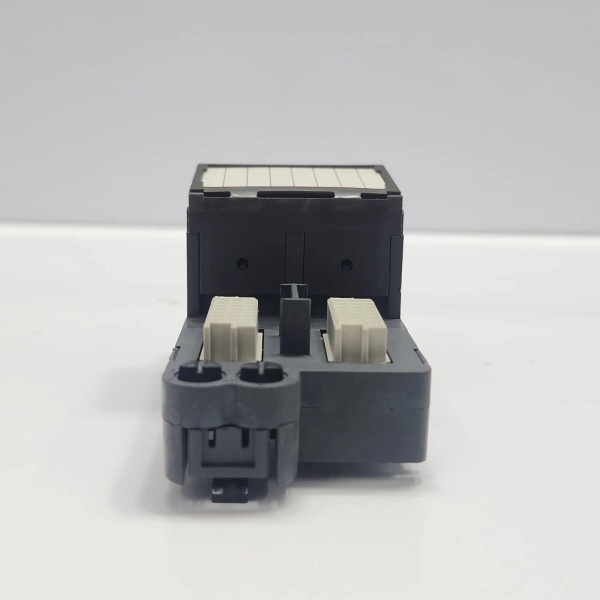
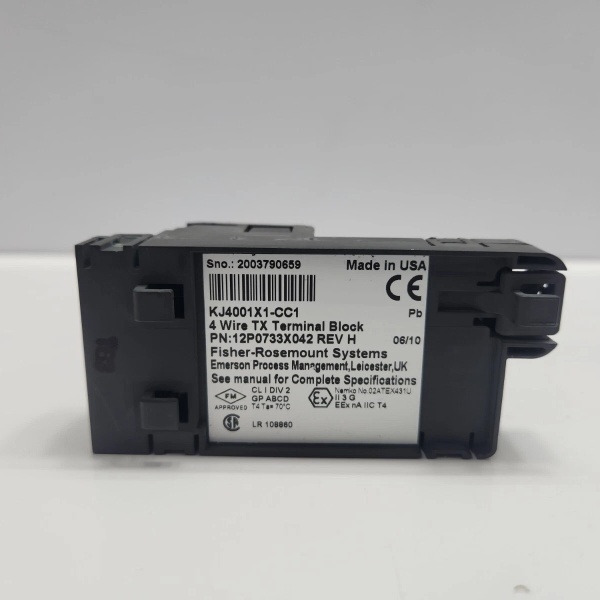
Description
Key Technical Specifications
- Model Number: KJ4001X1-CC1
- Manufacturer: Emerson Automation Solutions
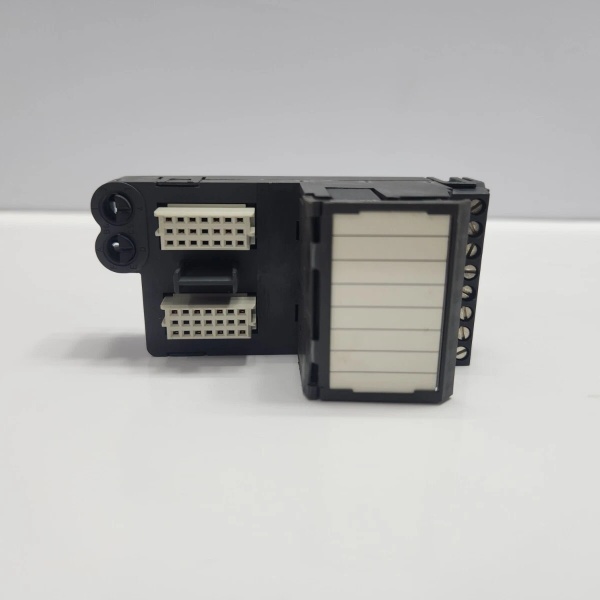
- Terminal Count: 32 Screw-Terminal Points (16 4-Wire Pairs)
- Wire Compatibility: 22-14 AWG Stranded/Solid, 0.2-2.5 mm²
- Terminal Type: Nickel-Plated Steel Screw Terminals (Vibration-Resistant)
- Operating Temperature: -40°C to 70°C (-40°F to 158°F)
- Humidity Range: 5-95% Non-Condensing
- Voltage Rating: 30V DC Max per Terminal
- Current Rating: 32mA Max per Channel, 5A Max per 8-Terminal Bank
- Wiring Configuration: 4-Wire Support (Power, Signal+, Signal-, Ground)
- Redundancy: Dual Signal Paths for DeltaV Redundant I/O Modules
- Mounting: DeltaV I/O Chassis-Mounted (Dedicated Redundant Terminal Slot)
- Compatibility: DeltaV Redundant AI/AO/DI/DO Modules, DeltaV S-Series/I-Series Chassis
- Labeling: Laser-Engraved Terminal Numbers, 4-Wire Configuration Markings
- Certifications: UL 61010-1, CSA C22.2 No. 61010-1, CE, RoHS
- Physical Dimensions: 5.5” (L) x 4.5” (W) x 1.6” (H), 100g (0.22 lbs)

EMERSON KJ4001X1-CC1
Field Application & Problem Solved
In DeltaV redundant DCS systems—refinery critical process loops, chemical reactor safety systems, power plant boiler control racks—the biggest challenge with standard termination is supporting 4-wire devices without sacrificing redundancy. 4-wire field devices (e.g., HART-enabled pressure transmitters, precision thermocouples, smart valves) require separate power and signal paths, which generic 2-wire terminal blocks can’t accommodate without messy rewiring. Worse, non-redundant terminals create single points of failure, undermining the DeltaV redundant I/O design and risking unplanned shutdowns in safety-critical applications. Plants were forced to use custom wiring harnesses to split power and signal, increasing complexity and troubleshooting time.
This 4-wire redundant terminal block solves these issues by being purpose-built for DeltaV’s redundant architecture. Its 32-channel, 4-wire design provides dedicated terminals for power, signal+, signal-, and ground, eliminating the need for custom harnesses. You’ll find it terminating 4-wire smart sensors, HART transmitters, and redundant valve actuators in safety-instrumented systems (SIS) and critical control loops. I installed 80 of these at a Gulf Coast refinery where generic blocks were causing 4-5 redundancy-related faults yearly; post-installation, the plant achieved 99.99% uptime for critical loops, and wiring errors during maintenance dropped by 80%. The block’s dual signal paths ensured that a single terminal fault didn’t take down the entire channel—critical for SIS applications where safety is non-negotiable.
Its core value is seamless 4-wire support for DeltaV redundant systems. Industrial plants can’t afford single points of failure in critical control—this block’s redundant signal paths align with DeltaV’s fault-tolerant design, while its 4-wire configuration simplifies integration with smart field devices. Unlike generic terminals, it’s engineered to work natively with DeltaV redundant I/O modules, no adapters needed. For maintenance teams, it reduces redundancy-related troubleshooting; for electricians, it streamlines 4-wire wiring; for plant managers, it protects critical processes from unplanned shutdowns. It’s not just a terminal block—it’s a redundant I/O solution that bridges the gap between 4-wire device needs and DeltaV’s safety-focused architecture.
Installation & Maintenance Pitfalls (Expert Tips)
- 4-Wire Configuration Mix-Ups: Rookies swap power and signal wires, frying 4-wire sensors. A Midwest chemical plant did this, damaging 12 HART transmitters. Follow the block’s laser-engraved markings: “PWR” (24V DC), “SIG+” (signal positive), “SIG-” (signal negative), “GND” (ground). Use color-coded wiring (red for power, white for SIG+, black for SIG-, green for ground) to avoid cross-wiring. Verify with a multimeter before powering up—ensure 24V DC is present at the “PWR” terminal, not the signal terminals.
- Ignoring Redundant Path Continuity: Forgetting to wire both redundant signal paths defeats the block’s purpose. A Texas power plant left one path unconnected, leading to a false redundancy fault that shut down a boiler feedwater pump. Use a continuity tester to confirm both “SIG+ A” and “SIG+ B” paths are connected to the I/O module. Label each redundant path clearly (e.g., “Path A: Primary”, “Path B: Secondary”) for future maintenance.
- Overloading Terminal Banks: Each 8-terminal bank has a 5A max rating—rookies cluster high-current 4-wire devices (e.g., 32mA sensors) in one bank, risking overheating. A refinery had this issue, causing terminal plastic to warp. Spread 4-wire devices evenly across banks—limit each bank to 15 devices (4.8A total) to stay under the rating. Use a clamp meter to verify total bank current after installation.
- Poor Wire Stripping for 4-Wire Connections: Over-stripping wires (more than 6mm) leads to short circuits between adjacent 4-wire terminals. A Northeast chemical plant had a critical loop trip because of this. Strip wires to 4-5mm—just enough to make full contact with the terminal without exposing extra conductor. Use a precision wire stripper to avoid nicking strands, which can reduce conductivity and cause signal loss.
EMERSON KJ4001X1-CC1
Technical Deep Dive & Overview
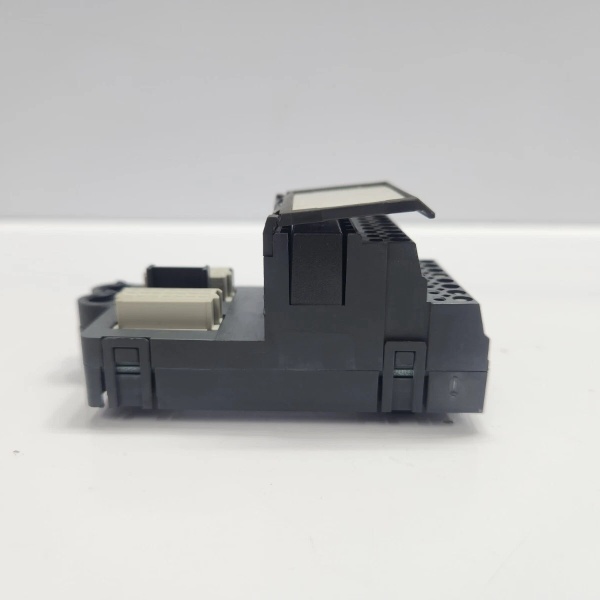
The KJ4001X1-CC1 is a DeltaV-optimized 4-wire redundant termination block engineered to support critical control and safety systems. Its core design addresses two key industrial needs: 4-wire device integration and redundant signal paths. The 32-channel layout is divided into 16 4-wire pairs, each with dedicated terminals for power, signal+, signal-, and ground—eliminating the need for splitters or custom harnesses that introduce failure points.
The block’s redundant architecture mirrors DeltaV’s redundant I/O design, with dual signal paths (Path A and Path B) for each channel. This ensures that if one path fails (e.g., loose wire, terminal damage), the other path maintains signal continuity—critical for safety-instrumented systems and critical control loops where downtime is catastrophic. The nickel-plated steel screw terminals provide consistent clamping force, resisting vibration-induced loosening in high-shock environments (e.g., pump skids, turbine enclosures).
Its DeltaV integration is seamless: the block mounts to dedicated redundant slots in S-Series/I-Series chassis, aligning perfectly with DeltaV redundant I/O module pinouts. Laser-engraved markings include terminal numbers, 4-wire configuration labels, and redundant path indicators, ensuring error-free installation even for less experienced technicians. The lightweight design (100g) simplifies chassis mounting without adding excess weight to control racks.
What sets it apart is its purpose-built focus on 4-wire redundant systems. Unlike standard terminal blocks that require workarounds for 4-wire devices, this block integrates natively with DeltaV’s redundant I/O, reducing installation time and human error. The 30V DC/32mA per-channel rating is optimized for 4-wire smart sensors and transmitters, while the 5A per-bank rating provides ample margin for multiple devices. For field service engineers, it’s a reliability workhorse: redundant paths eliminate single points of failure, 4-wire configuration simplifies smart device integration, and DeltaV compatibility ensures seamless system operation. It’s not just a termination block—it’s a critical component that enables DeltaV redundant systems to deliver the safety and uptime industrial plants demand.