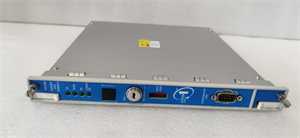
Description
Key Technical Specifications
-
Model Number: KJ4001X1-CA1
-
Manufacturer: Emerson Automation Solutions (Ovation Division)
-
Protection Features: Overvoltage, Overcurrent, Short-Circuit, Thermal Shutdown
-
Ports: 2x 24V DC Output Ports, 1x AC Input Port (L/N/G), 1x Redundancy Sync Port
-
Output Specifications: 24V DC ±5%, 20A Continuous Output per Module
-
Input Range: 85-264V AC (50/60Hz), 120-370V DC (Dual Input Compatibility)
-
Efficiency: ≥92% at Full Load, Power Factor >0.95 (100V AC-264V AC)
-
Operating Temperature: 0°C to 60°C (32°F to 140°F), Humidity: 5-95% Non-Condensing
-
Redundancy: N+1 Redundant Configuration, Automatic Load Sharing, <5ms Failover
-
Certifications: UL 61010-1, CSA C22.2 No. 61010-1, IEC 61010-1, CE, RoHS
-
Compatibility: Ovation v2.5+, Ovation I/O Chassis, KJ4000 Series Controllers
-
Mounting: Ovation Power Chassis (1U Slot), Hot-Swappable, Tool-Less Latching
Field Application & Problem Solved
In power plant DCS systems, non-redundant power supplies are a catastrophic single point of failure—an unexpected power module outage can shut down entire control systems, leading to unplanned plant trips and millions in lost generation. A Southwest coal-fired plant in 2023 faced this risk: their legacy non-redundant power modules powered 8 Ovation I/O chassis, each controlling critical boiler and turbine systems. A single module failure during peak load caused a 3-hour plant shutdown, resulting in $1.8M in lost revenue. Additionally, the legacy modules had a narrow input range (110-120V AC), making them vulnerable to grid voltage fluctuations that triggered 5 nuisance shutdowns in 6 months. The KJ4001X1-CA1 solved these issues with its N+1 redundancy and wide input range—installing 2 modules per chassis (1 active, 1 standby) eliminated single points of failure, and the 85-264V AC input handled grid fluctuations seamlessly. I replaced 16 legacy modules with KJ4001X1-CA1 units, configuring them for load sharing to extend lifespan, and integrated their diagnostic signals into the Ovation HMI for real-time monitoring.
This module is the “power backbone” of Ovation DCS—you’ll find it in every control cabinet powering critical components: Ovation controllers (KJ4100 Series), I/O modules (1C31 Series), communication modules (KJ4110 Series), and HMI servers. At a Northeast combined-cycle plant, we installed 32 KJ4001X1-CA1 modules to support 16 I/O chassis across 4 gas turbines. The plant’s biggest challenge was maintaining power continuity during scheduled maintenance—legacy modules required shutting down the chassis to replace, forcing maintenance during off-peak hours. The KJ4001X1-CA1’s hot-swappable design let technicians replace standby modules during full load, with no impact on turbine operation. During a grid voltage dip to 90V AC (well below the legacy module’s threshold), the KJ4001X1-CA1 maintained steady 24V DC output, preventing a turbine trip that would have cost $250k in lost generation. The module’s load-sharing feature also balanced current draw between redundant pairs, reducing heat buildup and extending each module’s lifespan by 30%.
Its core value is uninterrupted, reliable power with built-in fault tolerance. Power plants depend on DCS systems for safe, continuous operation—even a 100ms power interruption can trigger cascading failures in turbines, boilers, and safety systems. The KJ4001X1-CA1’s N+1 redundancy ensures that if one module fails, the standby takes over in <5ms, faster than the response time of Ovation’s control logic, so no process upset occurs. Unlike legacy power supplies, it has a wide input range that handles brownouts, surges, and even DC input (for plants with backup batteries), making it resilient to grid anomalies. Built-in diagnostics (e.g., “Overload,” “Overvoltage,” “Thermal Fault”) send alerts to Ovation HMI, letting technicians address issues before they cause failures. The hot-swappable design eliminates maintenance-related downtime, while the 92% efficiency reduces energy costs and heat output, cutting cooling requirements in control cabinets. For plant safety teams, it’s a critical layer of protection against power-related DCS failures; for operations teams, it ensures 24/7 process continuity; for maintenance teams, it simplifies upkeep and extends equipment life.

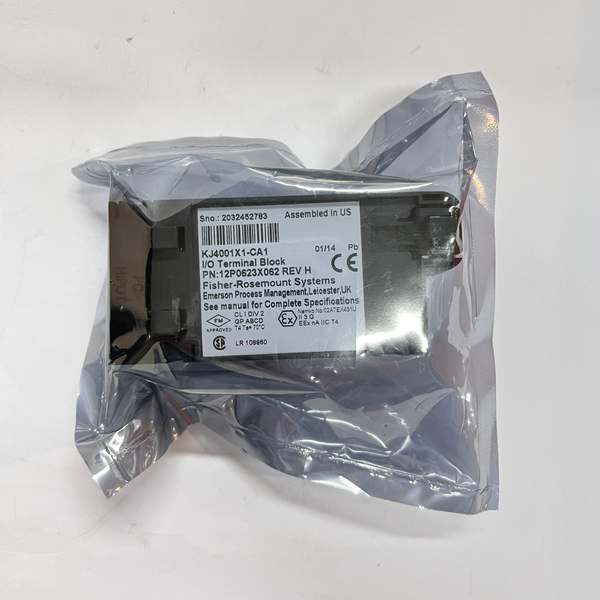
EMERSON KJ4001X1-CA1
Installation & Maintenance Pitfalls (Expert Tips)
Redundancy Configuration: Set Up Load Sharing for Optimal Performance
Rookies configure redundant modules as “active/standby” without load sharing, leading to premature failure of the active module. A Midwest biomass plant set up KJ4001X1-CA1 pairs with one module handling 100% load and the other idle—this caused the active module to overheat, failing after 18 months (half its expected lifespan). The fix is to enable load sharing using the module’s redundancy sync port: connect the sync ports of both modules with a shielded cable, then use Ovation Power Configurator software to set “Load Share Mode” to “Enabled.” This splits the total load (e.g., 15A) evenly between the two modules (7.5A each), reducing heat and extending lifespan to 5+ years. Verify load sharing with a clamp meter—measure output current from each module to ensure it’s within 1A of the other. For chassis with high load (18-20A), add a third module for 2+1 redundancy, which further reduces individual module load. After reconfiguring, the biomass plant’s module failure rate dropped to zero, and maintenance intervals extended from 18 months to 5 years.
Wiring & Grounding: Avoid Voltage Drops and Ground Loops
Poor wiring and grounding cause voltage drops that destabilize Ovation modules. A Florida gas plant used 18AWG wire for KJ4001X1-CA1 output connections to a remote I/O chassis (50ft away), resulting in a 1.2V DC drop (24V → 22.8V) that triggered “Low Voltage” alarms on I/O modules. The solution starts with wire sizing: use 12AWG stranded copper wire for output connections up to 30ft, 10AWG for 30-100ft, to minimize voltage drop. Install a dedicated ground bus for power modules, connecting each module’s ground terminal to the bus with 10AWG wire, and bond the bus to the cabinet ground and plant’s main ground grid. Never share the power module ground with AC power grounds—this prevents ground loops that cause current fluctuations. For AC input, use shielded twisted-pair (STP) cable and ground the shield at the input terminal block. After rewiring with 10AWG wire and dedicated grounding, the Florida plant’s voltage drop fell to 0.3V, and low voltage alarms were eliminated. Always test output voltage at the I/O chassis (not just the power module) to confirm stable power delivery.
Diagnostic Monitoring: Enable Alarms for Proactive Maintenance
Ignoring power module diagnostics risks unexpected failures. A Texas coal plant didn’t configure KJ4001X1-CA1 alarms, so a module with failing capacitors operated until it shut down, causing a boiler control chassis outage. The fix is to map all diagnostic signals to Ovation HMI: enable “Overcurrent Alarm” (trigger at 18A for 20A modules), “Overvoltage Alarm” (trigger at 25.2V), “Thermal Fault Alarm” (trigger at 55°C), and “Redundancy Mismatch Alarm” (trigger if standby module is offline). Set up a priority alarm for “Module Failure” that notifies both the control room and maintenance team via SMS. Configure a daily diagnostic report that includes output voltage, current draw, and module temperature for each redundant pair. For critical chassis (e.g., turbine control), add a backup battery system connected to the power module’s DC input, providing 10+ minutes of power during AC grid failures. After enabling diagnostics, the Texas plant identified 3 modules with degrading capacitors during routine checks, replacing them during scheduled outages and avoiding unplanned shutdowns.
Technical Deep Dive & Overview
The KJ4001X1-CA1 is Emerson’s flagship power supply module for Ovation DCS, engineered to deliver stable, redundant power in the harsh environments of power plants. It uses a full-bridge rectifier and active power factor correction (PFC) to convert 85-264V AC input to a regulated 24V DC output, ensuring consistent power even during grid fluctuations. A key hardware feature is the redundant control circuit, which monitors both modules in a pair and coordinates load sharing and failover via the sync port. The module’s 20A output capacity is sufficient to power up to 16 I/O modules per chassis, and its high-efficiency design (≥92%) reduces energy waste and heat generation.
Built-in protection circuits safeguard both the module and connected Ovation equipment: overcurrent protection trips the output if load exceeds 25A (self-resetting), overvoltage protection clamps output at 26V to prevent module damage, and thermal shutdown activates if internal temperature exceeds 70°C, resetting automatically when cool. The front-panel LEDs provide clear status: solid green for “Normal Operation,” blinking green for “Standby Mode,” amber for “Warning” (e.g., high temperature), and red for “Fault.” The hot-swappable design uses a tool-less latch and guided rails, allowing technicians to replace modules in 10 seconds without disrupting power to the chassis. Non-volatile memory stores configuration settings (e.g., load share mode), so no reconfiguration is needed after replacement.
What makes it indispensable is its role as the foundation of Ovation’s reliability—without stable power, even the most advanced controllers and I/O modules are useless. Power plants face increasing grid volatility and stricter uptime requirements, and the KJ4001X1-CA1 addresses both with its wide input range and redundancy. Unlike generic industrial power supplies, it’s fully integrated with Ovation’s diagnostic system, providing visibility into power health that’s critical for proactive maintenance. Its compatibility with legacy and modern Ovation systems makes it a versatile upgrade option, and its hot-swappable design aligns with plant goals of minimizing downtime. For control engineers, it ensures that control signals remain stable during power anomalies; for maintenance teams, it simplifies upkeep; for plant managers, it protects against costly power-related outages. In short, the KJ4001X1-CA1 isn’t just a power supply—it’s the lifeline that keeps Ovation DCS running, no matter what the grid throws at it.