Description
Key Technical Specifications
-
Model Number: KJ221X1-BA1
-
Manufacturer: Emerson Automation Solutions
-
Communication Ports: 2 independent RS-485 ports (half-duplex)
-
Supported Protocols: Modbus RTU, DeltaV Serial Protocol (DSP), ASCII
-
Data Rate: 300 bps to 115.2 kbps (software configurable)
-
Isolation Rating: 1500V AC (port to backplane, port to port)
-
Driver Capacity: Up to 32 devices per RS-485 port (max 1200m cable length)
-
Operating Temperature: 0°C to 60°C (32°F to 140°F); -40°C to 70°C for KJ221X1-BA2
-
Power Consumption: 1.8W typical, 3W maximum
-
EMC Compliance: IEC 61000-4-2 (ESD ±15kV air), IEC 61000-4-4 (EFT ±2kV)
-
Backplane Interface: DeltaV S Series I/O backplane (compatible with S9000 racks)
-
Status Indicators: Module OK (green), Port Active (green) per port, Fault (red)
-
Mounting: 1U rack-mount, DeltaV S Series I/O chassis compatible

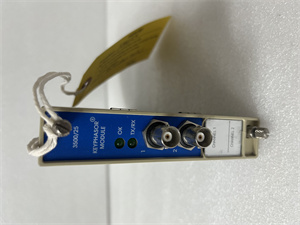
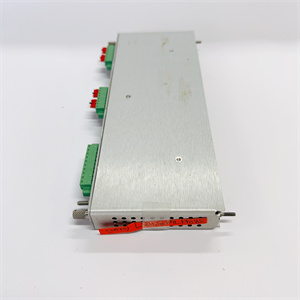
EMERSON KJ221X1-BA1
Field Application & Problem Solved
In industrial plants undergoing DCS upgrades, the biggest headache is integrating legacy serial devices—think 1990s-era flow meters, pressure transmitters, and motor controllers—with modern DeltaV systems. I was called to a Ohio steel mill in 2023 where they’d installed a new DeltaV DCS but couldn’t connect 12 Modbus RTU flow meters to it. Using generic serial-to-Ethernet converters caused data timeouts and corruption, leading to inconsistent batch processing. The KJ221X1-BA1 solves this: it’s a DeltaV-native module that speaks both the DCS’s language and legacy serial protocols, eliminating translation errors and ensuring reliable data flow between old devices and new controls.
You’ll find this module in DeltaV I/O racks across industries: steel mill rolling mill controls, refinery tank farm monitoring, chemical plant batch systems, and power plant auxiliary equipment (like pump controllers). At a Michigan chemical plant, we used 8 KJ221X1-BA1 modules to connect 96 legacy pH transmitters to their DeltaV DCS. Each module’s two RS-485 ports let us daisy-chain 12 transmitters per port, cutting wiring costs by 60% compared to running individual cables to the DCS. During a plant-wide power surge, the module’s isolation protected the DeltaV controller from damage—something generic converters couldn’t do, as we’d learned from a previous shutdown.
Its core value is “seamless integration.” Plants can’t afford to replace every legacy device when upgrading DCS—many of these devices are still reliable and cost $10k+ each to replace. The KJ221X1-BA1 lets them keep the old hardware while getting the benefits of DeltaV’s centralized monitoring and control. For operators, it means seeing all data—new and old—in one HMI, no more switching between systems. For maintenance teams, it eliminates the “black box” of generic converters: DeltaV’s diagnostics show exactly which port or device is causing a communication fault, cutting troubleshooting time from hours to minutes. It’s not just a communication module; it’s the bridge between a plant’s past and its modern control system.
Installation & Maintenance Pitfalls (Expert Tips)
Termination Resistors: Mandatory for Long RS-485 Runs
Rookies skip termination resistors on RS-485 networks, causing signal reflections and data corruption. A North Carolina pulp mill had this issue— their KJ221X1-BA1 lost communication with 8 temperature controllers every few hours. RS-485 networks need a 120-ohm resistor at the far end of the daisy chain (not at the module). The KJ221X1-BA1 has a built-in 120-ohm jumper for each port, but use it only if the module is the last device in the chain. For long runs (over 500m), use a precision metal-film resistor instead of the jumper— it’s more stable in temperature swings. Test the network with an oscilloscope: a clean RS-485 signal should have sharp edges, no rounding or overshoot.
Addressing: Avoid Duplicate Slave IDs on the Same Port
Duplicate Modbus slave IDs are the #1 cause of KJ221X1-BA1 communication faults. A Louisiana refinery had two flow meters set to ID 5 on the same RS-485 port— the module received garbled data, and the DCS showed “bad” values. Before wiring, create a master list of all devices on each port with their slave IDs (1-247, no duplicates). Use the DeltaV Explorer to map each ID to a unique tag in the DCS. If you inherit a network with duplicate IDs, use the KJ221X1-BA1’s “ID remapping” feature— it lets you assign a unique virtual ID to the DCS while the device keeps its original ID. Test each device individually by sending a Modbus read command from the module’s diagnostic menu.
Grounding: Daisy-Chain Shields, Don’t Star-Ground
Star-grounding RS-485 shield wires creates ground loops, frying the KJ221X1-BA1’s isolation circuit. A Arizona power plant learned this the hard way— they grounded each device’s shield to a local ground bar, causing a 2V potential difference that damaged three modules. Instead, daisy-chain the shield wires along the RS-485 cable and ground only at the KJ221X1-BA1’s shield terminal (use the module’s dedicated ground screw, not the chassis ground). Use twisted-pair shielded wire with 100% coverage—unshielded wire picks up noise from VFDs and motor starters. After wiring, measure the shield-to-ground voltage with a multimeter— it should be less than 0.1V. If it’s higher, install a ground loop isolator inline.
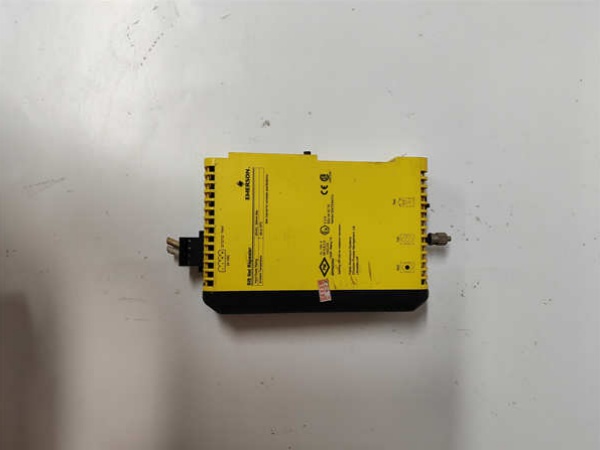
EMERSON KJ221X1-BA1
Technical Deep Dive & Overview
The KJ221X1-BA1 is a DeltaV-native communication gateway that translates between serial protocols and the DCS’s backplane. At its core is a dedicated microcontroller running Emerson’s proprietary communication stack—this ensures deterministic data transfer, unlike generic converters that use off-the-shelf firmware with variable latency. Each RS-485 port has its own signal conditioner and isolation transformer, so a fault on one port (like a short circuit) doesn’t affect the other or the DeltaV controller.
When a DeltaV controller sends a command to a legacy device, the KJ221X1-BA1 receives the digital command via the backplane, converts it to the appropriate serial protocol (e.g., Modbus RTU), and transmits it over the RS-485 port. For incoming data, it reads the serial signal from the device, validates the checksum (to catch corruption), converts it to DeltaV’s internal format, and sends it to the controller. The 1500V isolation is critical—RS-485 networks often span long distances, exposing the module to ground loops and voltage transients. The module also buffers data during peak traffic, preventing lost messages when multiple devices respond at once.
What makes it indispensable is its DeltaV integration. Unlike generic converters, it’s recognized by the DCS’s asset management system—you can monitor port status, data throughput, and error rates from the DeltaV HMI. It supports firmware updates via the backplane, so you don’t have to physically access the module. The hot-swappable design lets you replace a faulty module without shutting down the I/O rack—critical for 24/7 processes like refineries. It’s built to last in harsh industrial environments, with conformal coating on the circuit board to resist dust and moisture. For plants stuck between legacy hardware and modern controls, the KJ221X1-BA1 isn’t just a module—it’s a cost-saving lifeline.