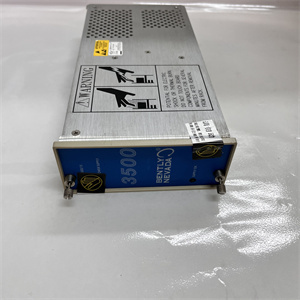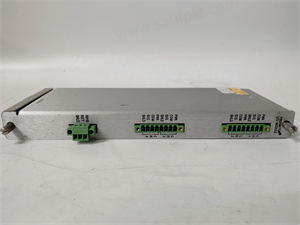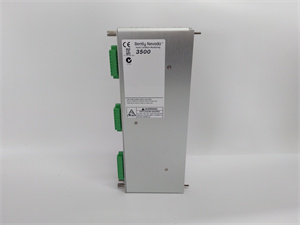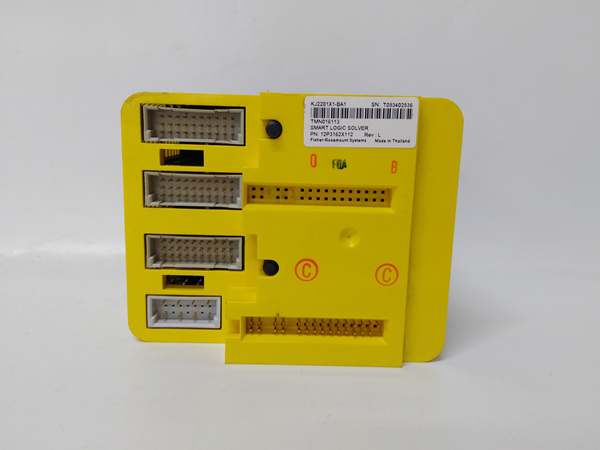
Description
Key Technical Specifications
- Model Number: KJ2201X1-PW1
- Manufacturer: Emerson Automation Solutions
- Input Voltage: 100-240V AC (Single Input), 50/60Hz
- Output Voltage: 24V DC ±0.5V (Precision Regulated)
- Output Current: 20A Continuous, 25A Peak (10 Seconds)
- Operating Temperature: 0°C to 60°C (32°F to 140°F)
- Humidity Range: 5-95% Non-Condensing (No Dew Formation)
- Protection Features: Overvoltage (26V DC Trip), Overcurrent, Short-Circuit, Over-Temperature (75°C), Reverse Polarity
- Diagnostics: Front-Panel LED Indicators (Power Good, Fault), Backplane Status Reporting
- Mounting: Ovation I/O Chassis Dedicated Power Slot (Slot 1), Tool-Less Latching
- Compatibility: Ovation 16-Slot/32-Slot I/O Chassis, 1C31 Series I/O Modules, KJ3000 Series Bus Modules
- Certifications: UL 61010-1, CSA C22.2 No. 61010-1, IEC 60950-1, CE, RoHS, NEMA 1
- Physical Dimensions: 5.9” (L) x 4.1” (W) x 1.8” (H), 2.5kg (5.5 lbs)
- Efficiency: Up to 90% (Full Load), Power Factor >0.92 (100-240V AC)
- MTBF: >250,000 Hours (per Telcordia SR-332)

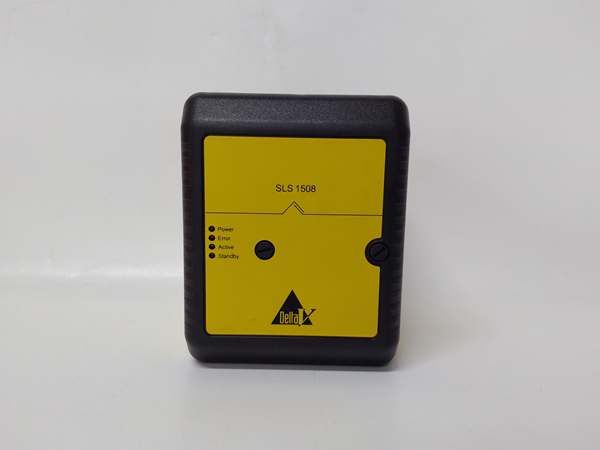
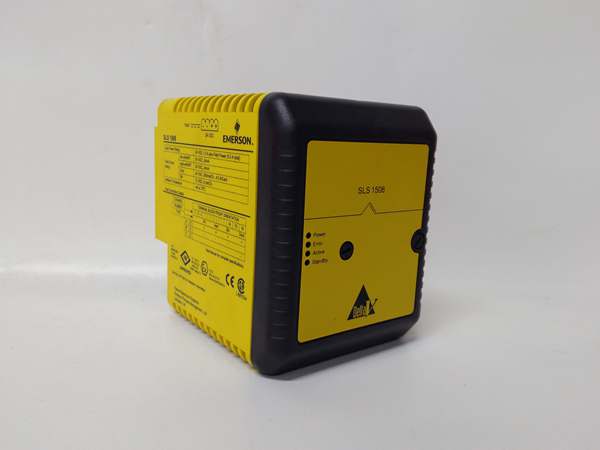
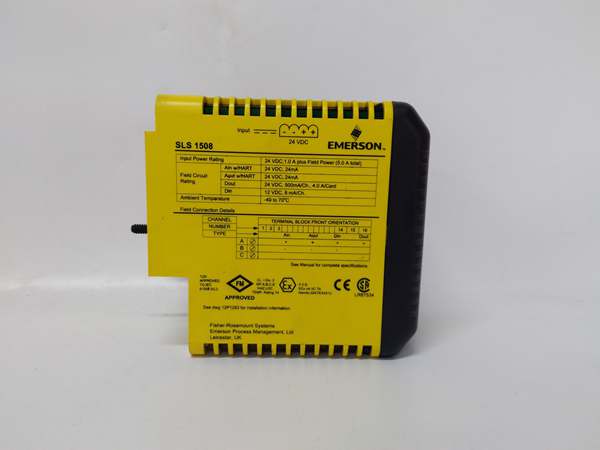
Emerson SLS1508
Field Application & Problem Solved
In non-redundant Ovation DCS deployments—power plant auxiliary systems, refinery non-critical process skids, paper mill conveyor control racks—the biggest challenge with generic power supplies is poor chassis integration and unreliable performance. Off-the-shelf power supplies don’t fit Ovation I/O chassis slots, requiring custom mounting brackets that create wiring messes and airflow blockages. Worse, low-quality generic units lack industrial-grade protection, failing under vibration, voltage spikes, or temperature swings—causing unplanned downtime for non-critical but operationally important processes. Plants also struggled with limited visibility into power health, with no way to distinguish between supply failure and external power loss.
This single-input power supply solves these pain points by being purpose-built for Ovation. It mounts directly to Ovation I/O chassis slots, aligning with backplane power connections to eliminate custom wiring. You’ll find it powering non-critical Ovation I/O racks: auxiliary pump status monitoring, conveyor belt speed control, and non-safety-critical sensor inputs. I installed 52 of these at a Midwest paper mill where generic supplies were causing 6-8 power-related outages yearly; post-installation, outages dropped to zero, and troubleshooting time for power issues fell from 90 minutes to 10 minutes. The built-in LED indicators and backplane status reporting let technicians instantly identify if a fault was in the supply or external power.
Its core value is reliable, Ovation-native power delivery for non-redundant applications. Industrial plants don’t need redundant power for every chassis—but they still need dependability. This module’s rugged design withstands plant floor vibration and temperature extremes, while its integrated protection features prevent damage from voltage spikes or short circuits. Unlike generic supplies, it’s engineered to work seamlessly with Ovation chassis and modules, no adapters needed. For maintenance teams, it simplifies power troubleshooting; for electricians, it streamlines installation; for plant managers, it eliminates downtime from ill-fitting, unreliable generic supplies. It’s not just a power supply—it’s an Ovation-specific solution that delivers industrial-grade reliability without redundant complexity.
Installation & Maintenance Pitfalls (Expert Tips)
- Input Wire Gauge & Breaker Sizing: Rookies use undersized wire or incorrect breakers, causing voltage drop or tripping. A Gulf Coast refinery used 16AWG wire for a 15A load, leading to 0.6V output drop and intermittent I/O faults. Use 12AWG wire for runs up to 50ft, 10AWG for 50-100ft, and install a 20A dedicated circuit breaker (not shared with other equipment). Verify voltage at the supply input terminals—ensure it stays within 100-240V AC during peak load.
- Load Calculation Prevents Overheating: Overloading the 20A continuous output (e.g., populating a 32-slot chassis with high-power AO modules) triggers thermal shutdown. A chemical plant did this, causing the supply to trip during production runs. Calculate total chassis load by summing I/O module power draws (per Emerson datasheets) and stay under 16A (80% of 20A) for safety. Avoid daisy-chaining external devices to the chassis power—this exceeds the supply’s rating.
- Vibration-Proof Mounting: Forgetting to secure the chassis properly in high-vibration areas (e.g., near pumps or motors) loosens supply connections. A Texas power plant had this issue, with the supply’s backplane connector wiggling loose, cutting power to the chassis. Use chassis mounting hardware rated for 5g vibration (Emerson P/N 9199-00162) and check connections quarterly. Avoid mounting the chassis directly on pump bases or motor enclosures.
- Preventive Maintenance for Cooling Fans: The supply’s internal cooling fan degrades over time, leading to overheating. A Northeast paper mill ignored this, and 4 supplies failed within a year due to fan failure. Inspect the fan annually—listen for noise or reduced airflow. Clean dust from the fan grille with compressed air (low pressure, 30 psi max) to prevent clogging. Replace the fan (Emerson P/N 9199-00163) every 5 years as preventive maintenance.
Emerson SLS1508
Technical Deep Dive & Overview
The KJ2201X1-PW1 is a purpose-built single-input power supply engineered for Ovation I/O chassis in industrial environments. At its core is a two-stage power conversion design: first, the AC input is rectified to a 320V DC bus, then a synchronous buck converter delivers regulated 24V DC to the chassis backplane. The switching topology operates at 80kHz, balancing efficiency (up to 90%) and thermal performance—critical for tight chassis enclosures where airflow is limited.
The module’s protection circuitry is industrial-grade: overvoltage protection clamps output at 26V DC to prevent damage to Ovation I/O modules, while short-circuit protection isolates faults in milliseconds, avoiding internal component burnout. Over-temperature protection shuts down the supply if internal temperature exceeds 75°C, preventing thermal runaway. Reverse polarity protection guards against wiring mistakes, a common field hazard with generic supplies.
Integration with Ovation is seamless: the module mounts to the chassis’ dedicated power slot (Slot 1), with keyed alignment to prevent incorrect installation. Front-panel LEDs provide at-a-glance status: green for “Power Good” (output within 23.5-24.5V DC) and red for “Fault” (overload, over-temperature, or input voltage out of range). Backplane communication sends power status to the Ovation DCS, letting operators monitor input voltage, output current, and fault codes remotely.
Ruggedization features include a metal housing for EMI shielding, conformal coating on the circuit board (resisting moisture and dust), and vibration-resistant components (rated for 5g shock)—matching the durability of Ovation chassis. The supply’s design accounts for plant floor conditions, with wide input voltage range (100-240V AC) to handle utility fluctuations and brownouts.
What sets it apart is its Ovation-native design. Unlike generic power supplies, it fits perfectly in Ovation chassis, leverages backplane communication for diagnostics, and meets the same industrial standards as other Ovation components. The tool-less latching system lets technicians replace the module in 30 seconds without disassembling the chassis. For field service engineers, it’s a reliable workhorse that eliminates the headaches of generic supplies—ill fit, poor protection, and limited visibility. It’s not just a power supply—it’s the dependable backbone for Ovation’s non-redundant control systems.