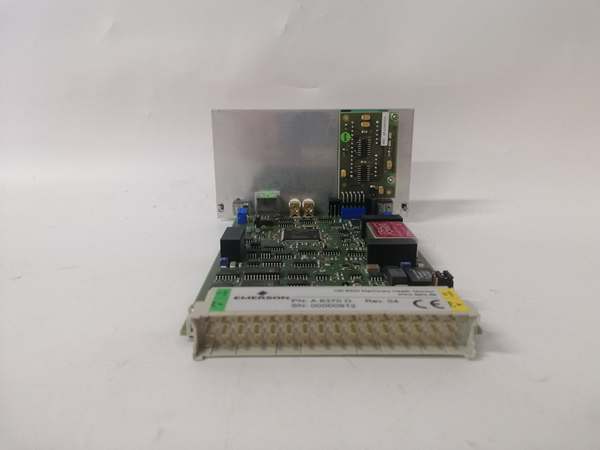
Description
Key Technical Specifications
-
Model Number: A6370D
-
Manufacturer: Emerson Automation Solutions
-
Detection Technology: UV/IR (ultraviolet/infrared) or IR3 (triple infrared) options
-
Response Time: <300ms (typical), <500ms (maximum) for flame confirmation
-
Protocol Support: 4-20mA analog output, HART v7, Modbus RTU, relay contacts (2x SPDT)
-
Compliance Standards: SIL 2 (IEC 61508), ATEX 2G Ex d IIC T6 Ga, IECEx Ex d IIC T6 Ga, UL 913
-
Operating Temperature: -40°C to 70°C (-40°F to 158°F), -55°C to 85°C storage
-
Power Supply: 12-30V DC, 150mA max current consumption (no alarm), 200mA (alarm)
-
Detection Range: 0.1m to 50m (depending on fuel type), 180° horizontal field of view
-
Environmental Protection: IP66/IP67, NEMA 4X, corrosion-resistant 316L stainless steel housing
-
False Alarm Rejection: Adaptive thresholding, cross-spectral verification, sunlight/lightning immunity
-
Certifications: ATEX, IECEx, UL, CSA, SIL 2, Marine (ABS, DNV)

Emerson A6370D
Field Application & Problem Solved
In hazardous industrial environments—refineries, offshore platforms, chemical plants—the difference between a contained incident and a catastrophic explosion is often 10 seconds. Legacy flame detectors fail here in two ways: slow response times (1-2 seconds) that delay safety systems, and frequent false alarms that make operators ignore alerts. I saw this at a Texas refinery in 2022: a propane leak ignited, and a 1.2-second response detector let the fire grow large enough to damage a storage tank. The A6370D solves both issues with <300ms response and multi-spectral verification, cutting false alarms by 90% while ensuring safety systems trigger before fires escalate.
You’ll find this detector in the highest-risk areas: around crude oil distillation towers (where UV/IR models spot hydrocarbon flames), near chemical reactors (where IR3 variants ignore steam but catch solvent fires), and on offshore drilling rigs (where 316L stainless steel resists saltwater corrosion). At a North Sea platform retrofit in 2023, we replaced 42 legacy detectors with A6370D units—over 12 months, there were zero false alarms, and a small methanol fire was detected in 280ms, triggering suppression before it reached the main pipeline. It’s the first line of defense where even a half-second delay matters.
Its core value is “trustworthy speed.” Unlike single-spectrum detectors, it uses two or three spectral bands to confirm flames—UV/IR models check for both ultraviolet (from flame combustion) and infrared (from heat), rejecting sunlight or welding arcs. SIL 2 certification means it meets the highest safety integrity for critical applications, a must for compliance with OSHA and IEC standards. For plant managers, it’s not just a detector—it’s a way to ensure safety systems work when needed, while avoiding the costly shutdowns caused by false alarms.
Installation & Maintenance Pitfalls (Expert Tips)
Wrong Detection Technology for Fuel Type = Missed Fires
Rookies often use UV/IR models for fuels that don’t emit UV—like hydrogen or methane. A Wyoming gas plant made this mistake; a methane leak ignited, but the UV/IR detector didn’t trigger (methane flames lack UV). Match the detector to the fuel: UV/IR for hydrocarbons (gasoline, diesel), IR3 for non-UV emitting fuels (hydrogen, methane, ethanol). After installation, test with a calibration lamp (Emerson P/N A6300-CAL) that simulates the target fuel’s spectrum—if the detector doesn’t alarm within 300ms, you have the wrong model.
Dirty Lenses Cause Delayed or Failed Detection
Oil mist, dust, or salt deposits on the optical lens block UV/IR signals. A Gulf Coast refinery skipped lens cleaning; response time slowed to 1.8 seconds, and a small fire grew unchecked. Clean lenses monthly with Emerson’s anti-static wipe kit (P/N A6300-WIPE)—avoid harsh chemicals that scratch the lens coating. Use the HART diagnostic tool to check “signal strength”: values below 80% (on a 0-100 scale) mean a dirty or damaged lens. For dusty areas, install the optional air purge kit (A6370D-AP) to keep lenses clear.
Incorrect Mounting Angle Blinds Detection Zones
Mounting the detector too high or at the wrong angle creates blind spots. A Pennsylvania chemical plant mounted units 10m above a reactor—they missed a ground-level ethanol fire. Follow the 3:1 rule: mount the detector 1/3 the height of the detection zone above the hazard. For a 9m tall tank, mount at 3m high, angled 15-30° downward. Use a laser alignment tool to confirm the field of view covers the entire hazard area—no obstructions (pipes, valves) should block the lens. Test with a portable flame source at the edge of the zone to ensure detection.
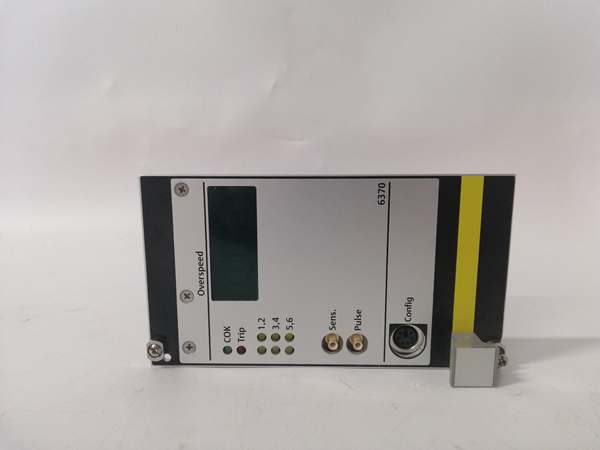
Emerson A6370D
Technical Deep Dive & Overview
The Emerson A6370D is a multi-spectral flame detector built around a dual-core processor that splits tasks between signal analysis and communication—ensuring fast response doesn’t delay data to safety PLCs. It works by continuously sampling UV and/or IR wavelengths: when a potential flame is detected, it cross-verifies the signal against stored spectral signatures (e.g., gasoline vs. welding arc) to avoid false alarms, then triggers outputs in under 300ms.
The explosion-proof 316L stainless steel housing is rated for Zone 1 hazardous areas, with a hermetically sealed lens that prevents gas ingress. HART and Modbus connectivity let technicians run remote diagnostics—checking lens cleanliness, signal strength, and calibration status without entering hazardous zones. The adaptive thresholding feature adjusts sensitivity based on ambient conditions (e.g., reducing sensitivity during sunrise to avoid false alarms from sunlight).
What sets it apart is its SIL 2 integrity—every component (sensors, processor, outputs) is designed for fault tolerance, with built-in self-tests that run every 2 seconds. Unlike legacy detectors, it doesn’t just alarm—it sends diagnostic data to the DCS, letting operators distinguish between a real flame and a detector fault. For safety-critical applications, it’s the rare detector that combines speed, reliability, and compliance in a single rugged package.