Description
Key Technical Specifications
-
Model Number: A6370D
-
Manufacturer: Emerson Automation Solutions
-
Port Configuration: 24x 10/100/1000BASE-T (PoE++) + 6x 1/10GBASE-X (SFP+) uplink ports + 4x dedicated ring ports
-
PoE Support: PoE++ (IEEE 802.3af/at/bt), 60W per port, 740W total power budget (4 independent power rails)
-
Switching Capacity: 128 Gbps
-
Forwarding Rate: 95.2 Mpps
-
Redundancy Protocols: Dual MRP, HSR, PRP, STP/RSTP/MSTP (support for 2 independent rings simultaneously)
-
Operating Temperature: -40°C to 85°C (-40°F to 185°F) (extended range vs. standard models)
-
Power Supply: Quad redundant 24V DC / 48V DC / 110V AC / 220V AC inputs with load balancing
-
Protection Rating: IP30 (rack-mount), IP67 (with ruggedized enclosure)
-
Management: Web GUI, CLI, SNMP v3, Emerson AMS Device Manager, NetFlow v9, sFlow, 5G/4G LTE integration
-
EMC Compliance: IEC 61000-4-2 (ESD ±25kV), IEC 61000-4-4 (EFT ±4kV), IEC 61000-4-5 (Surge ±6kV)
-
Mounting: 1U rack-mount, DIN-rail compatible (with heavy-duty adapter)

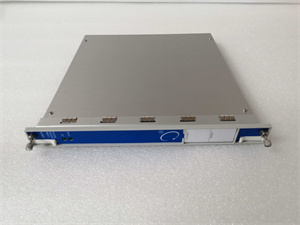
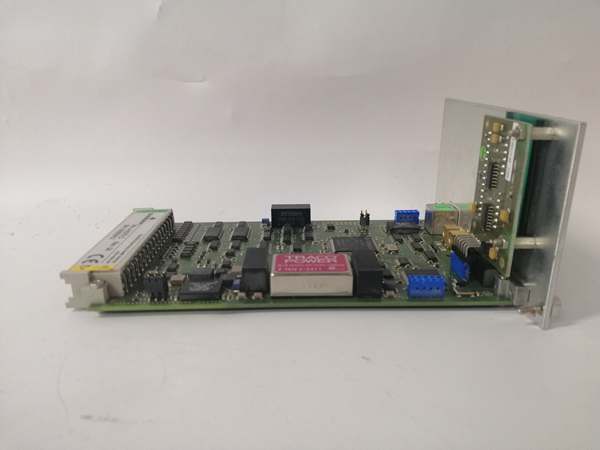
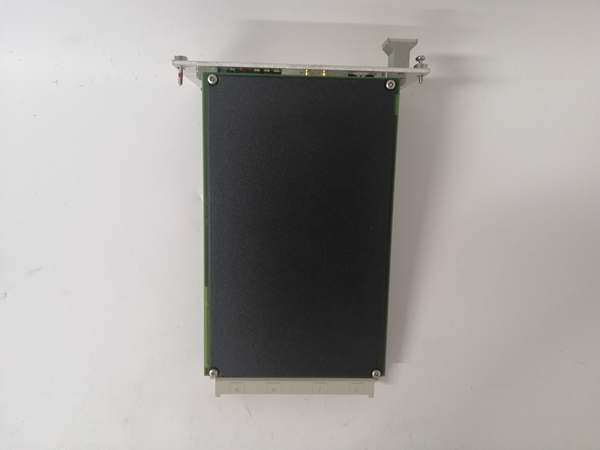
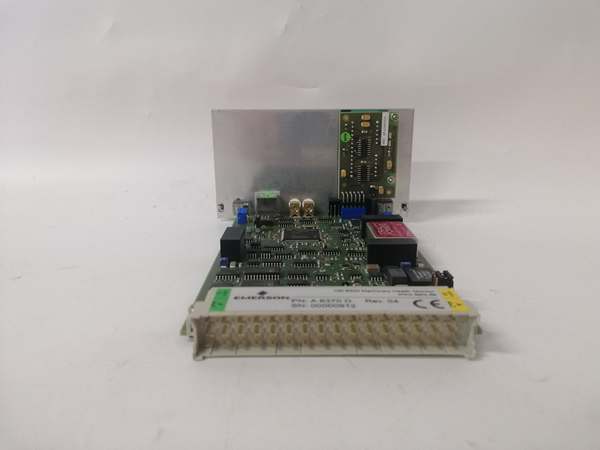
Emerson A6370D
Field Application & Problem Solved
Critical industrial processes (like petrochemical refining or nuclear power auxiliaries) demand network redundancy that goes beyond single-ring setups— a single ring failure can trigger safety shutdowns costing millions. I was called to a Gulf Coast refinery in 2024 where a single-ring switch failure took down their FCC unit’s catalyst control system for 90 minutes. The A6370D solves this with dual independent rings: one for control traffic, one for safety systems, each with sub-1ms failover. Its PoE++ ports power high-demand devices like AI vision systems and industrial PCs, while the extended 85°C operating range handles the refinery’s hot process areas— something standard switches couldn’t endure.
You’ll find this switch in safety-critical environments: petrochemical FCC units, nuclear power plant secondary cooling systems, offshore oil platform control rooms, and pharmaceutical batch processing lines. At a South Carolina nuclear plant, we installed 6 A6370Ds in a dual-ring mesh to connect 144 devices— including 36 high-power thermal cameras, 72 vibration sensors, and 36 safety PLCs. When a lightning strike damaged one ring’s fiber cable, the HSR protocol rerouted control traffic in 0.8ms— no safety trips, no production loss. The 4 independent PoE rails let us isolate safety cameras on one rail and process sensors on another, ensuring a power overload on non-critical devices doesn’t affect safety systems. The quad power inputs, fed by separate plant transformers, eliminated power-related failures entirely.
Its core value is “fault tolerance by design.” Critical processes can’t afford single points of failure— the A6370D eliminates them with dual rings, quad power inputs, and redundant components (fans, power supplies). The 740W PoE budget and 60W per port support the next generation of industrial devices: AI edge computers, 3D machine vision systems, and high-definition thermal imagers that standard PoE+ switches can’t power. For network teams, the dedicated ring ports separate redundancy traffic from device traffic, simplifying troubleshooting. Integration with 5G/4G LTE means remote sites stay connected even if fiber is cut— a must for offshore or remote critical infrastructure. It’s not just a switch; it’s a safety component that meets IEC 61508 SIL 2 requirements for functional safety.
Installation & Maintenance Pitfalls (Expert Tips)
PoE++ Rail Management: Isolate Critical Loads
Rookies mix safety and non-safety devices on the same PoE rail, risking safety system outages from overloads. A Texas chemical plant did this— a 60W AI camera overload on Rail 1 shut down 8 safety interlock sensors on the same rail, triggering a unit shutdown. The A6370D’s 4 rails (Ports 1-6: Rail 1; 7-12: Rail 2; 13-18: Rail 3; 19-24: Rail 4) let you segment by criticality: assign safety devices to Rail 1/2 (locked via AMS) and non-critical to 3/4. Set rail-specific budgets (e.g., 150W for safety rails, 220W for non-critical) to prevent cross-rail overloads. Use the “PoE Fault Isolation” feature— if a rail faults, only that rail shuts down, not the entire switch. For 60W devices, reserve one port per rail (max 4x 60W devices total) to avoid rail saturation.
Dual Ring Configuration: Avoid Cross-Ring Traffic Leakage
Configuring both rings to share the same VLAN causes traffic leakage, leading to failover delays. A Pennsylvania refinery made this mistake, with control traffic bleeding into the safety ring, increasing latency to 5ms. Assign dedicated VLANs to each ring: VLAN 10 for Control Ring, VLAN 20 for Safety Ring. Use the 4 dedicated ring ports (Ports 25-28) — never use PoE or uplink ports for rings. Set Ring 1 as HSR (safety traffic, sub-1ms failover) and Ring 2 as MRP (control traffic, 20ms failover) — match protocol to traffic criticality. Enable “Ring Health Mirroring” in AMS to send ring status to the DCS— this triggers alarms before failures occur. Test each ring independently by cutting one fiber at a time; traffic should stay on the other ring with no latency spike.
Power Supply Load Balancing: Leverage Quad Inputs
Connecting all 4 power inputs to the same plant power feed negates redundancy— a single transformer failure takes down the switch. A Louisiana offshore platform did this, losing network connectivity during a power feed fault. Connect inputs 1-2 to Plant Power Bus A and 3-4 to Bus B (separate transformers). Enable “Load Balancing” mode— the switch distributes 25% of load to each input, preventing overloading a single feed. Set “Power Feed Alarm Threshold” to 90%— alert if one input carries more than its share (indicates a fault). For remote sites, connect one input to a battery backup (24V DC) — the switch auto-switches to backup in 5ms. Never mix AC and DC inputs on the same switch— use AC for main feeds, DC for backup only.
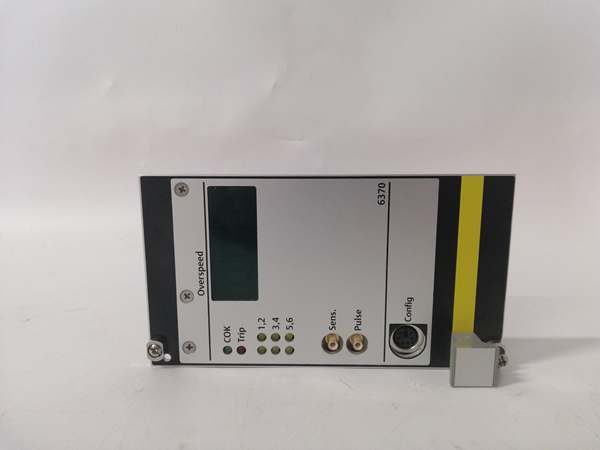
Emerson A6370D
Technical Deep Dive & Overview
The A6370D is Emerson’s flagship fault-tolerant industrial switch, built for safety-critical and high-power applications. It uses a quad-core ARM Cortex-A53 processor paired with a 128 Gbps ASIC— enough to handle 24x 1Gbps PoE++ connections, 6x 10Gbps uplinks, and dual ring traffic simultaneously with sub-50µs latency. Unlike entry-level models, it supports Layer 3 routing (OSPF, BGP, RIP) for connecting geographically separate critical systems (e.g., a refinery’s crude unit and hydrocracker). The processor includes a dedicated core for redundancy protocols, ensuring ring failover isn’t delayed by other traffic.
Ruggedization meets IEC 61508 SIL 2 standards, with a double-conformal-coated circuit board (resists oil, chemicals, and humidity) and extended -40°C to 85°C operating range— ideal for desert or high-temperature process areas. Redundant hot-swappable fans (N+1) and power supplies ensure component failures don’t take down the switch. The 4 independent PoE rails include overcurrent, overvoltage, and short-circuit protection per rail, isolating faults. EMC protection is enhanced (±25kV ESD, ±6kV surge) to handle harsh industrial environments like offshore platforms or mining sites. A key safety feature is the “Fail-Safe Mode”— if the management processor fails, the switch continues forwarding traffic and maintaining rings.
Its PoE++ capability is a standout: 60W per port powers devices like Emerson RXi Industrial PCs (45W) and high-definition thermal imagers (55W) — devices that require dedicated power supplies with standard switches. The 740W total budget and 4 rails let you power a mix of high and low-power devices without overloads. The 6 SFP+ uplink ports support 10Gbps fiber (up to 40km with ER modules), linking remote critical nodes to the core network. Security features include role-based access control (RBAC), 802.1X with EAP-TLS, and MAC address whitelisting— meeting NERC CIP requirements for critical infrastructure. 5G/4G LTE integration (via optional SFP+ modem) provides backup connectivity if fiber is cut.
Ecosystem integration is seamless with Emerson’s safety and control tools: it’s certified for DeltaV SIS (Safety Instrumented System) and AMS Device Manager, so safety teams can monitor switch health alongside safety valves and transmitters. Firmware updates use dual-partition flash— install updates on the inactive partition, then switch over with no downtime. The web GUI includes a “Safety Dashboard” showing ring status, PoE rail loads, and power feed health— all in compliance with IEC 62443 cybersecurity standards. For large networks, it integrates with Emerson’s Network Advisor software for centralized management. The A6370D isn’t just a network device; it’s a critical component of the plant’s safety and reliability infrastructure, designed to keep processes running even when everything else fails.