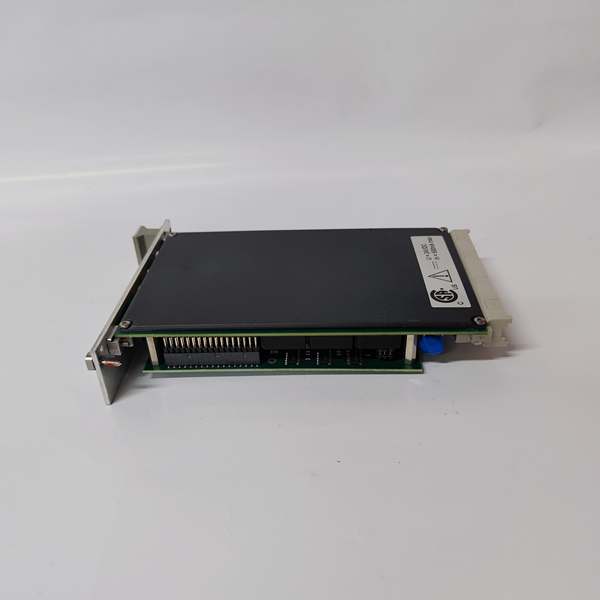
Description
Key Technical Specifications
-
Model Number: A6210
-
Manufacturer: Emerson Automation Solutions
-
Port Configuration: Configurable 16x 10/100/1000BASE-T (PoE+) + 4x 1GBASE-X (SFP) uplink ports
-
PoE Support: PoE+ (IEEE 802.3af/at), 30W per port, 190W total power budget
-
Switching Capacity: 40 Gbps
-
Forwarding Rate: 29.8 Mpps
-
Redundancy Protocols: MRP (Media Redundancy Protocol), STP/RSTP/MSTP
-
Operating Temperature: -40°C to 75°C (-40°F to 167°F)
-
Power Supply: Dual redundant 24V DC / 48V DC inputs
-
Protection Rating: IP30 (rack-mount), IP65 (with optional rugged enclosure)
-
Management: Web GUI, CLI, SNMP v3, Emerson AMS Device Manager, NetFlow v5
-
EMC Compliance: IEC 61000-4-2 (ESD ±15kV), IEC 61000-4-4 (EFT ±2kV), IEC 61000-4-5 (Surge ±2kV)
-
Mounting: 1U rack-mount, DIN-rail compatible (native)

EMERSON A6210
Field Application & Problem Solved
Small-to-mid industrial sites and remote control nodes face a unique challenge: limited space and budget, but still needing industrial-grade reliability. I was called to a Colorado natural gas processing plant in 2024 where they’d installed a consumer-grade 16-port switch in a remote wellhead control cabinet— it failed within 2 months due to -20°C winter temperatures, shutting down 3 wellheads. The A6210 solves this: its compact 1U design fits in tight cabinets, PoE+ ports power remote sensors and cameras without separate wiring, and industrial ruggedization handles extreme temperatures. Unlike office switches, it prioritizes control traffic and supports MRP redundancy, so a single cable cut won’t take down the wellhead controls.
You’ll find this switch in space-constrained industrial environments: remote wellheads, small chemical batch plants, power plant auxiliary systems (like boiler feedwater pumps), and food processing lines. At a California winery’s fermentation facility, we installed 3 A6210s to connect 40 temperature sensors and 8 IP cameras— each switch fit in a 12-inch-wide control cabinet alongside the DeltaV controller. When a wildfire caused a temporary power surge, the switch’s dual redundant power inputs kept it running, and MRP redundancy ensured fermentation temperature data kept flowing to the main DCS. The PoE+ ports powered the cameras and sensors, eliminating the need for electricians to run separate 24V DC lines— cutting installation time by 3 days.
Its core value is “compact reliability.” Small plants and remote nodes can’t accommodate large 2U switches, and they can’t afford the downtime that comes with consumer gear. The A6210’s 1U form factor and native DIN-rail mounting let it fit in the smallest control cabinets—critical for offshore platforms or underground mining nodes. For maintenance teams, its simplified web GUI (with industrial presets) means configuring redundancy or VLANs takes minutes, not hours. The 190W PoE budget is perfectly sized for 16 mid-power devices (like 15W vibration sensors or 30W PTZ cameras), avoiding the overkill (and cost) of larger switches. It’s not built for hundreds of devices, but for the 60% of industrial applications that need 8-16 ports with industrial-grade performance.
Installation & Maintenance Pitfalls (Expert Tips)
PoE+ Budget: Avoid Overloading with High-Power Combinations
Rookies plug 7x 30W PTZ cameras into the A6210-16P, exceeding its 190W budget— this forces the switch to shut down non-critical ports. A Montana water treatment plant did this, taking down 3 flow sensors when they added 2 more cameras. Calculate your PoE load upfront: most industrial sensors use 5-15W, so reserve 30W ports only for cameras or wireless access points. Use the A6210’s “PoE Priority” feature to tag control-related devices (like DeltaV I/O modules) as high priority— these get power first if the budget is tight. Enable budget alerts in AMS Device Manager to get notified when usage hits 80% (152W). For devices that don’t need PoE (like servers), use non-PoE ports or external power supplies to free up budget.
MRP Configuration: Set Correct Ring Port Roles
Configuring both MRP ring ports as “manager” causes network loops and crashes. A New Mexico solar farm made this mistake with 4 A6210s, leading to a 45-minute outage of their inverter controls. Each MRP ring needs one manager switch (sets the ring’s “break” port) and all others as clients. On the A6210, assign two dedicated ports as ring ports (e.g., ports 15 and 16) — don’t use these for regular devices. Set the ring recovery time to 50ms (the A6210’s minimum) for control networks. Test monthly by unplugging a ring cable: the switch’s “Ring Status” LED should flash amber for 50ms, then return to green. If recovery takes longer, update the firmware— older versions had 100ms+ failover times.
DIN-Rail Mounting: Secure for Vibration-Prone Areas
Using the wrong DIN-rail clips or loose mounting causes the A6210 to vibrate loose in pump rooms or compressors. An Oklahoma oil field had this issue— the switch disconnected from the rail during a pump startup, taking down wellhead sensors. The A6210 comes with two spring-loaded DIN-rail clips for 35mm standard rails— use both, not just one. Tighten the clip screws to 0.5 N·m (don’t over-tighten, as it cracks the plastic). For high-vibration areas (like near reciprocating compressors), add a rubber vibration pad between the switch and rail. After mounting, tug the switch gently— it should stay firmly in place. Loose mounting is a hidden failure point that’s easy to fix during installation.
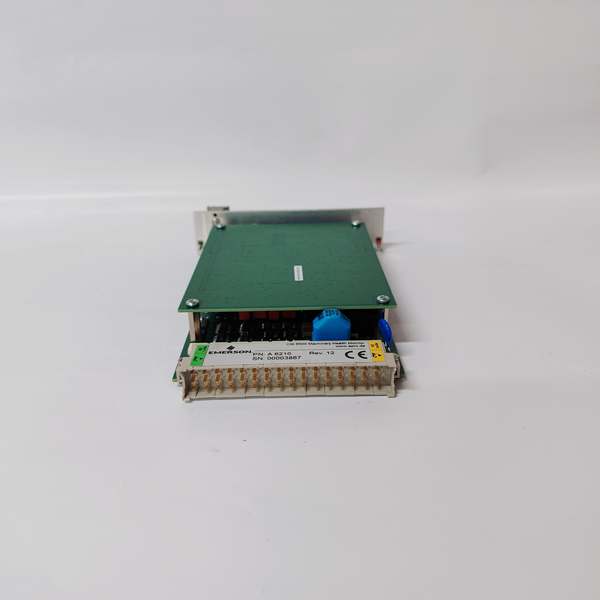
EMERSON A6210
Technical Deep Dive & Overview
The A6210 is a compact Layer 2 managed switch built for space-constrained industrial environments. It uses a single-core ARM Cortex-A9 processor paired with a efficient switching ASIC to handle 40 Gbps of traffic— enough to support 16 simultaneous 1Gbps PoE+ connections and 4x 1Gbps SFP uplinks without latency. Unlike Layer 1 unmanaged switches, it supports VLANs and traffic prioritization, so control data (like inverter setpoints) gets priority over non-essential traffic (like video). Its Layer 2 focus keeps configuration simple—perfect for plant technicians who aren’t network experts.
Ruggedization is a key design focus: the conformal-coated circuit board resists oil, dust, and moisture—critical for food processing plants or offshore wellheads. The fanless design (standard on all models) eliminates moving parts that fail in dusty environments, and the -40°C to 75°C temperature range means it works in Arctic oil fields or desert solar farms. The dual redundant 24V/48V DC inputs accept the most common plant power sources, with automatic failover if one feed drops—no more single points of failure from power supplies.
Its PoE+ ports are a game-changer for remote nodes. Running separate data and power cables to a wellhead or solar inverter costs $500+ per device— the A6210’s PoE+ ports deliver both over a single Cat5e cable, cutting installation costs by 60%. The 30W per port is enough for most industrial devices: IP cameras, wireless gateways, and even small edge computers. For security, it supports 802.1X authentication and MAC filtering to block unauthorized devices—critical for preventing cyberattacks on remote control nodes.
Integration with Emerson’s ecosystem sets it apart from generic compact switches. It’s recognized by AMS Device Manager, so you can monitor port status, PoE usage, and temperature from the same dashboard as your DeltaV controllers. Firmware updates happen remotely via AMS—no need to send a technician to a remote wellhead. The web GUI uses industrial terminology (e.g., “Control VLAN” instead of “802.1Q VLAN”) to make configuration intuitive for plant teams. For small plants and remote nodes that need reliability without complexity, the A6210 isn’t just a switch—it’s a compact, cost-effective solution that keeps critical control networks running.