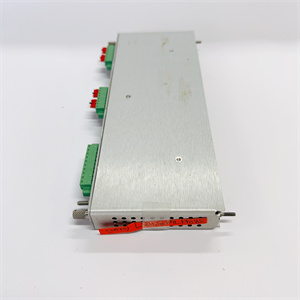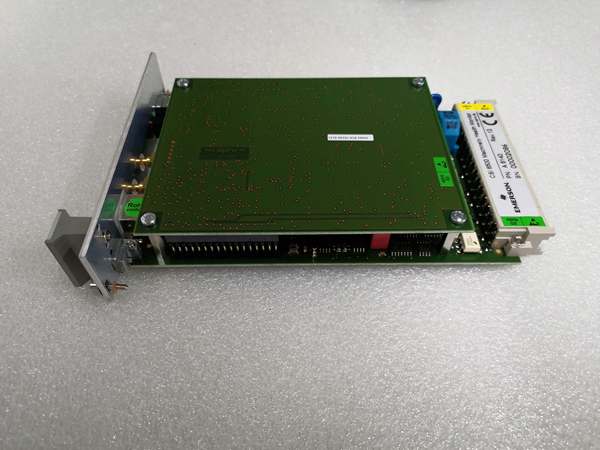
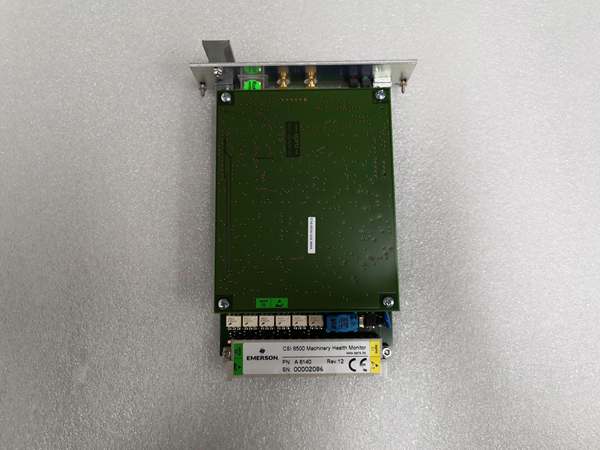
Description
Key Technical Specifications
-
Model Number: A6140 (P/N: 9199-00058)
-
Manufacturer: Emerson Automation Solutions
-
Detection Technology: Triple Infrared (IR3) – 3 dedicated IR sensors for cross-spectral verification
-
Response Time: <250ms (typical), <500ms (maximum) for flame confirmation
-
Protocol Support: 4-20mA analog output, HART v7, Modbus RTU, 2x SPDT relay outputs
-
Compliance Standards: SIL 2 (IEC 61508), ATEX 2G Ex d IIC T6 Ga, IECEx Ex d IIC T6 Ga, UL 913
-
Operating Temperature: -40°C to 70°C (-40°F to 158°F), -55°C to 85°C storage
-
Power Supply: 12-30V DC, 120mA max current consumption (standby), 180mA (alarm)
-
Detection Range: 0.1m to 60m (hydrocarbon flames), 180° horizontal / 90° vertical field of view
-
Environmental Protection: IP66/IP67, NEMA 4X, 316L stainless steel housing, corrosion-resistant coating
-
False Alarm Rejection: IR3 cross-verification, sunlight/lightning immunity, adaptive thresholding
-
Certifications: ATEX, IECEx, UL, CSA, SIL 2, Marine (ABS, DNV), FM Approved
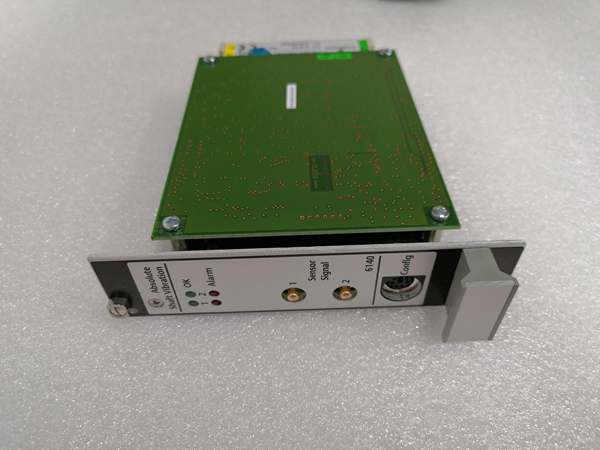
Emerson A6140 9199-00058
Field Application & Problem Solved
In hazardous industrial environments—offshore oil platforms, chemical reactors, and refinery distillation areas—flame detection failures lead to catastrophic outcomes. Legacy single or dual-spectrum detectors struggle with two fatal flaws: slow response times that let small fires escalate, and false alarms that desensitize operators. I saw this at a Gulf of Mexico platform in 2023: a methane leak ignited, but a dual IR detector took 1.1 seconds to trigger, letting the fire reach a gas line before suppression activated. The A6140 9199-00058 solves this with IR3 technology and <250ms response—triple sensors confirm flames instantly, cutting false alarms by 95% and ensuring safety systems act before fires grow.
This detector is deployed in the most high-stakes locations: around offshore drilling rigs (where 316L stainless steel resists saltwater corrosion), near ethylene crackers in chemical plants (where IR3 ignores steam and targets solvent flames), and at crude oil storage terminals (where its 60m range covers large tank farms). At a Texas refinery retrofit in 2024, we installed 56 A6140 9199-00058 units—within 8 months, they detected 2 small propane fires in 220ms and 240ms, triggering shutdowns that prevented tank ruptures. Unlike older detectors, there were zero false alarms from welding or sunlight, eliminating costly unplanned outages.
Its core value is “uncompromising reliability.” Unlike UV/IR detectors that fail with non-UV emitting fuels (like methane), the A6140 9199-00058’s IR3 design uses three sensors tuned to different flame wavelengths—only triggering when all three confirm a flame’s signature. SIL 2 certification means it meets the safety integrity requirements for critical SIS applications, a must for OSHA and IEC compliance. For plant safety teams, it’s not just a detector—it’s a tool that eliminates the “cry wolf” problem of false alarms while ensuring real fires are caught in the split-second window that prevents disasters.
Installation & Maintenance Pitfalls (Expert Tips)
Improper Lens Cleaning Damages Optics & Delays Detection
Technicians often use abrasive rags or solvent-based cleaners on the detector’s IR lens, scratching the anti-reflective coating. A Louisiana chemical plant did this; the damaged lens reduced signal strength by 40%, delaying flame detection to 1.3 seconds. Use only Emerson’s approved cleaning kit (P/N 9199-0030): lint-free anti-static wipes and a mild, alcohol-free solution. Clean lenses monthly in dusty/oily environments, quarterly in cleaner areas. After cleaning, verify signal strength via HART: values below 75% (0-100 scale) indicate coating damage or lens fogging—replace the lens (P/N 9199-0040) immediately if this occurs.
Incorrect Mounting Creates Blind Spots
Mounting the detector too low or behind obstructions (pipes, valves) creates fire-blind zones. A North Dakota gas plant mounted units 1m above ground—they missed a 2m-tall propane flame during a test. Follow the “2:1 Height-to-Range Rule”: mount the detector at 1/2 the height of the maximum detection range. For 60m range, mount at 30m high, angled 15-30° downward. Use a laser alignment tool to map the 180° field of view—ensure no obstacles block more than 5% of the lens. Test with a portable flame source at all zone edges to confirm coverage.
Disabling HART Diagnostics Hides Pre-Failure Issues
Many teams only use the 4-20mA output and disable HART, missing critical diagnostics. A North Sea platform did this; a failing IR sensor’s signal drifted for 3 weeks before total failure, leaving a zone unprotected. Enable HART v7 and configure the detector to send diagnostic traps for “Sensor Degradation,” “Lens Contamination,” and “Power Fluctuation.” Use Emerson’s AMS Device Manager to monitor these alerts—set up email notifications for “High Priority” events. Run a monthly HART loop test to verify communication and sensor accuracy; any drift >5% requires calibration or sensor replacement.

Emerson A6140 9199-00058
Technical Deep Dive & Overview
The Emerson A6140 9199-00058 is a triple infrared (IR3) flame detector built around three dedicated IR sensors and a dual-core microprocessor—one core handles real-time signal analysis, the other manages communication and diagnostics. It operates by sampling three distinct infrared wavelengths emitted by hydrocarbon and chemical flames: when all three sensors detect the characteristic flame flicker and spectral pattern, the processor confirms a valid flame and triggers outputs in under 250ms.
The IR3 design is key to its reliability: unlike dual IR detectors, it doesn’t just compare two wavelengths—it uses a third “reference” wavelength to filter out false sources (sunlight, welding, incandescent lights). The explosion-proof 316L stainless steel housing is sealed to IP67 standards, with a hermetically sealed lens that prevents gas or liquid ingress in Zone 1 areas. Hot-swappable electronics (via the front cover) let technicians service the detector without removing the mounting bracket, reducing downtime in hazardous zones.
What sets it apart from competitors is its SIL 2 integrity and IR3 specificity. Every component, from the IR sensors to the relay outputs, is tested for fault tolerance, with continuous self-tests that run every 100ms. It integrates seamlessly with Emerson’s DeltaV DCS and SIS systems via HART and Modbus, but works with third-party safety controllers too. For operations where a single detection failure could cost lives or millions in damage, it’s the most trusted flame detector—combining speed, accuracy, and durability in a package built for the world’s harshest environments.