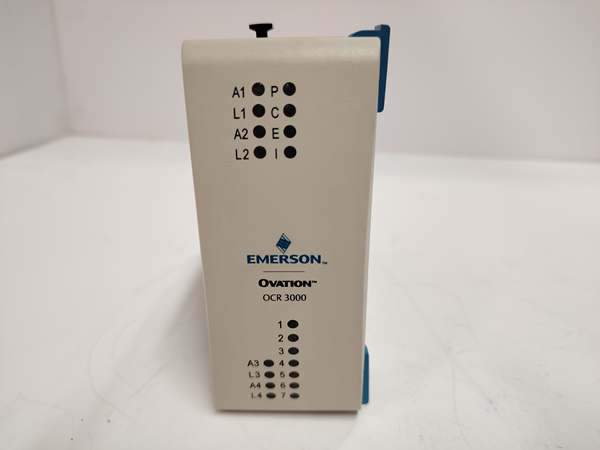
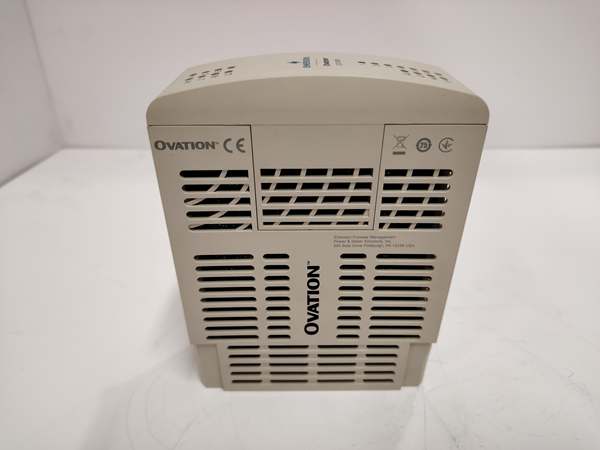
Description
Key Technical Specifications
-
Model Number: 5X00875G01
-
Manufacturer: Emerson Automation Solutions (Ovation Division)
-
Protocol Support: Ovation Backplane Protocol, Modbus RTU/TCP, DNP3, IEC 61850, HART Pass-Through
-
Ports: 2x Ovation Backplane Interfaces, 2x Ethernet (10/100/1000BASE-T), 1x Redundant Sync Port, 1x Service Port
-
Processing Capacity: Up to 5000 I/O Points, 1000 PID Loops, 500 Custom Logic Blocks
-
Operating Temperature: 0°C to 60°C (32°F to 140°F), Storage: -40°C to 85°C
-
Isolation: 2500V DC Backplane-to-Chassis, 1500V DC Ethernet-to-Chassis
-
Power Consumption: 25W Typical, 35W Maximum
-
Control Cycle Time: 10ms Minimum (Configurable up to 1s)
-
Certifications: UL 61010-1, CSA C22.2 No. 61010-1, IEC 61010-1, IEC 61850-3, CE
-
Redundancy: 1:1 Hot-Standby Redundancy, Automatic Failover <5ms, Data Synchronization
-
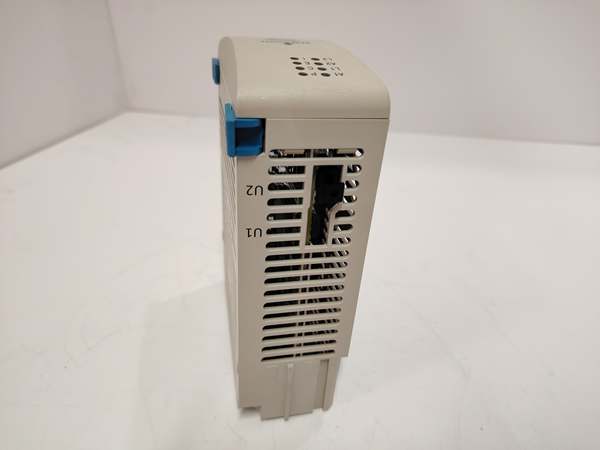
Mounting: Ovation Controller Chassis (2U Slot), Tool-Less Latching & Locking

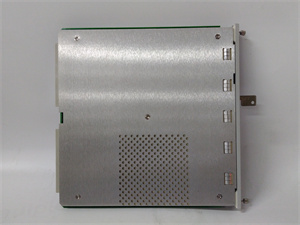
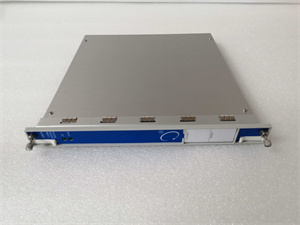
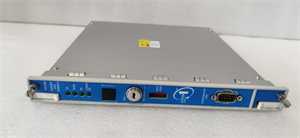
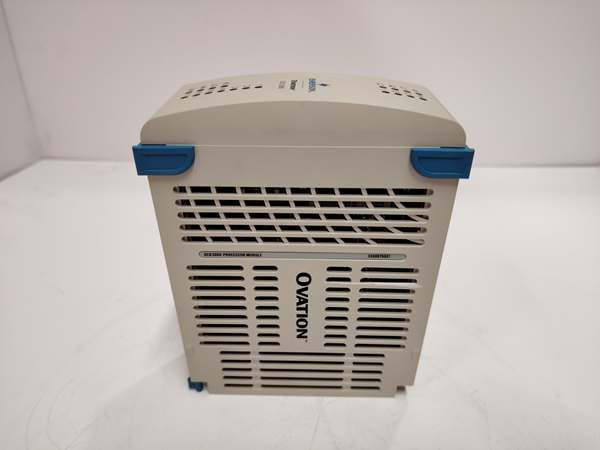
EMERSON 5X00875G01
Field Application & Problem Solved
In power plants, outdated controller modules create a bottleneck in control system performance—slow processing speeds, limited memory, and outdated protocol support can’t handle the demands of modern smart I/O and real-time analytics. A Southwest coal-fired plant in 2023 faced this crisis: their legacy single-core controllers struggled to run 300 PID loops for boiler combustion control, leading to inconsistent fuel-air mixing, 2% lower thermal efficiency, and frequent control loop oscillations. During peak load, controller cycle times spiked to 50ms (vs. the required 10ms), causing boiler drum level fluctuations of ±10cm. This dual-core controller solved these issues with its 1.2GHz dual-core processor and 2GB RAM—cycle times stayed steady at 10ms even with 500 PID loops active, stabilizing drum levels to ±2cm. I replaced 8 legacy controllers with 5X00875G01 units in redundant pairs, boosting boiler efficiency by 1.8% and eliminating $300k/month in excess fuel costs.
This module is the “brain” of Ovation DCS—you’ll find it at the core of every critical control system: gas/steam turbine control, boiler management systems (BMS), flue gas desulfurization (FGD) control, and plant-wide process coordination. At a California combined-cycle plant, we installed 12 of these controllers to manage 4 gas turbines, 2 steam turbines, and 6 HRSGs. The plant needed to integrate new IEC 61850-compliant smart breakers and HART-enabled flow meters, but their old controllers lacked native support for these protocols, requiring costly gateways. The 5X00875G01’s built-in IEC 61850 and HART pass-through eliminated the need for gateways, cutting integration costs by $150k. Its redundant design also proved vital during a controller failure—failover happened in <5ms, with no interruption to turbine control or power generation.
Its core value is high-performance control with future-proof connectivity. Power plants aren’t just upgrading hardware—they’re moving toward digitalization, requiring controllers that can process real-time data, run advanced control algorithms, and communicate with smart field devices. This controller’s dual-core design splits workloads efficiently: one core handles real-time control loops, while the other manages communication and diagnostics, ensuring neither task compromises the other. When paired with its redundant partner (5X00876G01), it provides 99.999% availability—critical for NERC CIP-compliant systems. Unlike legacy controllers, it supports Ovation’s advanced control libraries (like model predictive control for boilers) and integrates seamlessly with Emerson’s Plantweb Insight analytics platform, turning raw process data into actionable insights. For plant engineers, the 8GB flash memory allows for on-board data logging, eliminating the need for external historians for short-term trend analysis.
Installation & Maintenance Pitfalls (Expert Tips)
Redundancy Configuration: Sync Firmware and Control Logic First
Rookies overlook firmware and logic synchronization when setting up redundant pairs, leading to failed failovers or data corruption. A Midwest nuclear plant made this mistake—they installed a 5X00875G01 primary and 5X00876G01 standby with mismatched firmware versions (v4.0 vs. v4.2), causing a “sync error” alarm and preventing redundancy. The fix is straightforward: first, update both controllers to the same Ovation firmware version (v4.5+ recommended for full IEC 61850 support) using Ovation Studio’s “Firmware Manager.” Then, download the exact same control logic to both units—even a minor difference in a PID setpoint will break synchronization. Use the “Redundancy Check” tool in Ovation to verify sync status: look for “Full Synchronization” in the diagnostics. Finally, test failover by pulling the primary controller’s power—Ovation HMI should show the standby taking over without any control loop disturbances. Never commission a redundant pair without confirming firmware and logic consistency.
Cycle Time Optimization: Prioritize Critical Control Loops
Assigning all control loops to the same cycle time wastes the controller’s processing power and can slow critical loops. A Texas wind farm initially set all 800 I/O points to a 10ms cycle time, causing the 5X00875G01’s CPU load to hit 85% (vs. the recommended maximum of 70%). This led to delayed communication with turbine SCADA systems. The solution is to use the controller’s “cycle time grouping” feature: assign turbine speed control and safety interlocks to 10ms cycles (critical), pump/motor status to 50ms cycles (non-critical), and data logging to 1s cycles (low priority). In Ovation Studio, use the “Loop Prioritization” tool to map loops to cycles—monitor CPU load via the “Controller Utilization” tag, keeping it below 70% for margin. After optimization, the wind farm’s CPU load dropped to 40%, and SCADA communication delays vanished. Remember: critical loops (turbine trip, boiler protection) need the fastest cycles, while non-critical tasks can run slower to free up resources.
Ethernet Configuration: Segregate Control and Monitoring Traffic
Mixing real-time control traffic with non-critical monitoring data on the same Ethernet port causes packet collisions and control delays. A Northeast hydro plant connected both their turbine control I/O and plant-wide HMI traffic to the controller’s single Ethernet port, leading to 200ms delays in turbine governor control signals during peak HMI usage. The 5X00875G01’s dual Ethernet ports solve this—use Port 1 for critical control traffic (I/O modules, redundant sync, turbine SCADA) and Port 2 for non-critical traffic (HMI, data historians, maintenance tools). Configure separate VLANs for each port to prevent cross-traffic, and enable Quality of Service (QoS) on Port 1 to prioritize control packets. Use Ovation’s “Ethernet Diagnostics” tool to monitor packet loss—aim for <0.1% loss on Port 1. After reconfiguration, the hydro plant’s governor control delays dropped to <10ms, even during peak HMI activity. Never use a single Ethernet port for both control and monitoring—segregation is non-negotiable for real-time performance.
EMERSON 5X00875G01
Technical Deep Dive & Overview
The 5X00875G01 is Ovation’s flagship process controller, engineered to handle the most demanding power generation control tasks. It uses a Freescale dual-core processor (1.2GHz each) with a dedicated real-time operating system (RTOS) optimized for control applications—unlike general-purpose OS, this RTOS ensures deterministic cycle times, with no performance degradation from background tasks. The 2GB DDR3 RAM and 8GB industrial-grade flash memory provide ample space for complex control logic, on-board data logging, and firmware updates. A key hardware feature is the redundant sync port, which uses a dedicated high-speed link to synchronize data between primary and standby controllers, ensuring no data loss during failover.
Its 2500V backplane isolation protects the controller from electrical transients common in power plant environments, while the 1500V Ethernet isolation prevents noise from interfering with communication. The controller’s built-in self-diagnostic features continuously monitor CPU temperature, memory integrity, and backplane communication, sending fault alerts to Ovation HMI before failures occur. Front-panel LEDs provide at-a-glance status: solid green for primary active, blinking green for standby, red for fault, and blue for Ethernet activity. In redundant mode, the primary and standby controllers exchange 1000+ status points per second via the sync port—this ensures the standby is always in lockstep with the primary, enabling <5ms failover with no control loop upset. The controller also supports hot firmware updates, allowing upgrades without shutting down the control system.
What makes it indispensable is its ability to bridge legacy and modern systems. Power plants often have a mix of old analog I/O and new smart devices, and this controller handles both seamlessly—its native support for Modbus, DNP3, and IEC 61850 eliminates costly gateways, while HART pass-through lets it communicate with smart sensors without sacrificing control performance. It also integrates with Emerson’s advanced control solutions, like Ovation Expert Control (for turbine tuning) and Plantweb Insight (for predictive maintenance), turning the controller into a hub for digital transformation. For plant operators, the deterministic performance means consistent control, reducing process variability and improving efficiency. For maintenance teams, the built-in diagnostics and redundant design minimize downtime. In short, it’s not just a controller—it’s the foundation of a modern, reliable, and future-proof power plant control system.