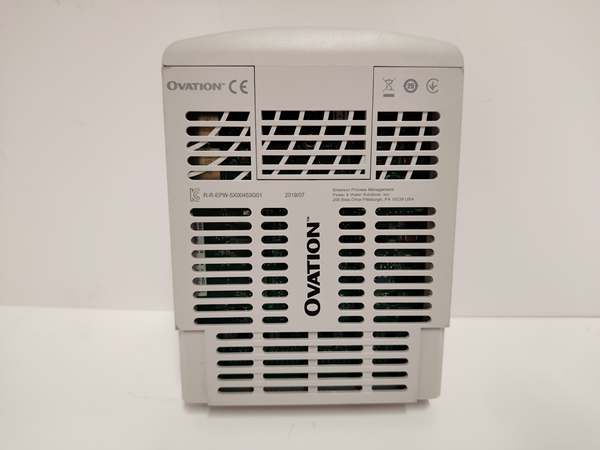
Description
Hard-Numbers: Technical Specifications
- Acquisition Performance:
- Input Channels: 8 independent differential analog input channels
- Supported Signal Types: 4-20mA DC, 0-20mA DC, 1-5V DC, 0-10V DC, Thermocouples (K/J/T/E/S/R/B), RTD (Pt100, Cu50)
- Sampling Rate: Up to 10kHz per channel (5kHz when all 8 channels active), configurable 5Hz-100Hz
- Resolution: 24-bit ADC
- Measurement Accuracy: Current/Voltage ±0.02% FS, Thermocouple ±0.1°C (0-500°C), RTD ±0.05°C (0-200°C)
- Input Impedance: Voltage ≥10MΩ, Current ≤25Ω
- Signal Processing:
- Filtering: Programmable digital filtering (low-pass, high-pass), 0.1Hz-1kHz adjustable
- Range Scaling: Customizable engineering unit conversion (e.g., 4-20mA to 0-1000m³/h)
- Peak/Valley Capture: ≤1ms response time for transient extremes
- Diagnostics: Open circuit, short circuit, over-range detection with real-time alarm upload
- Communication:
- Interface: High-speed Ovation backplane bus (Genius Bus) or Ethernet-based communication
- Data Rate: 100Mbps, latency ≤1ms (Ethernet), ≤5ms (backplane)
- Protocols: Ovation DCS proprietary, HART communication support for intelligent field devices
- Integration: Ovation Configuration Studio software for parameter configuration and calibration
- Environmental:
- Operating Temperature: 0°C to +60°C (non-condensing)
- Storage Temperature: -40°C to +85°C
- Humidity: 5% to 95% non-condensing (IEC 60068-2-3)
- IP Rating: IP20 (module本体, dependent on cabinet protection)
- EMC Compliance: EN 61000-6-2/3/4/5 (ESD, surge, EFT, radiation)
- Physical:
- Dimensions: 32mm (W) × 177mm (H) × 228mm (D) or 12.8cm × 5.4cm × 16.5cm (varies by revision)
- Weight: 0.4-0.5kg
- Mounting: Ovation standard rack installation (19-inch cabinet compatible)
- Power: Backplane bus powered (DC5V), consumption ≤15W or <12W (24VDC input variant)
- Terminal Type: Phoenix connector, supports 0.5mm²-2.5mm² wire
- Reliability:
- MTBF: ≥180,000 hours (Emerson test data)
- Isolation: Channel-to-channel and channel-to-ground 2500V AC rms for 1 minute
- Safety Level: SIL 2 (IEC 61508)
- Certifications: CE, UL, CSA, ATEX (Zone 2/22), RoHS
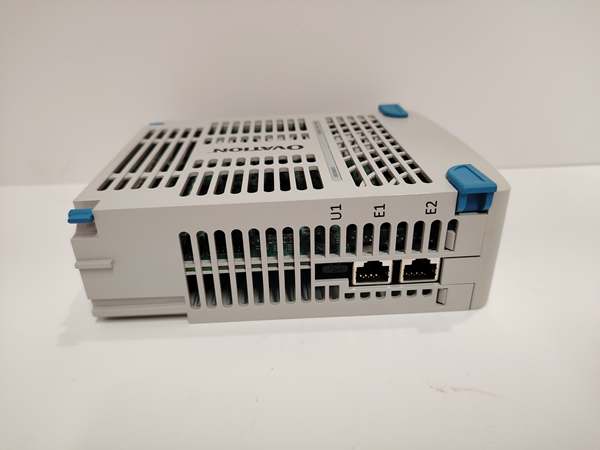
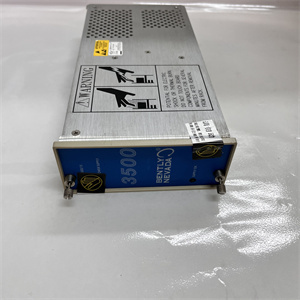
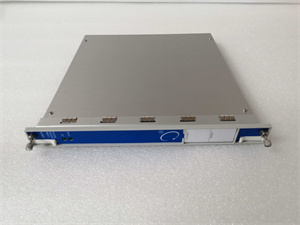
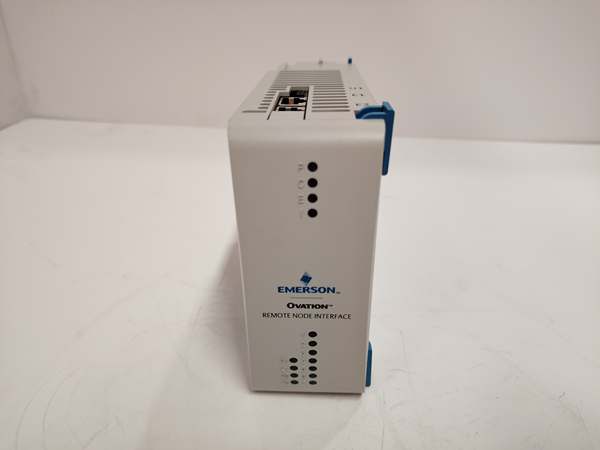
Emerson 5X00453G01
The Real-World Problem It Solves
Standard analog input modules sampling at 50-100Hz cannot capture high-frequency transient events in dynamic processes. A turbine governor valve oscillating at 200Hz or a pressure surge spiking in 5ms appears as a blur—critical data lost between samples, leading to missed protection trips or delayed fault detection. The 5X00453G01 brings 10kHz per-channel sampling to Ovation systems, capturing millisecond-level transients for precise event reconstruction. Its 24-bit resolution sees micro-volt changes in 4-20mA signals, detecting subtle shifts in process variables that standard 13-bit modules filter as noise. With multi-signal support, you eliminate specialized modules—configure channels for mA, V, TC, or RTD in the same module, reducing rack space and sparing complexity.
Where you’ll typically find it:
- Power plant turbine control systems capturing high-speed pressure and flow transients during load rejections
- Pharmaceutical bioreactor temperature monitoring with sub-degree precision for batch optimization
- Steel rolling mill stand speed feedback requiring kHz-level acquisition for thickness control
- Chemical reactor emergency shutdown systems needing peak capture for safety incident forensics
Bottom line: This is a high-frequency signal acquisition workhorse for Ovation DCS—capture what others miss with 10kHz sampling, 24-bit resolution, and multi-signal flexibility in one rugged module.
Hardware Architecture & Under-the-Hood Logic
The 5X00453G01 is a high-performance analog input module designed to interface with Ovation DCS controllers via high-speed backplane or Ethernet communication. Its core architecture centers around a high-resolution ADC (Analog-to-Digital Converter) with signal conditioning front-end for various sensor types, real-time processing engine for filtering and diagnostics, and deterministic communication interface for sub-millisecond data delivery.
-
Input Multiplexing and Signal Conditioning:
- Each of 8 channels connects to a programmable signal conditioning block. For voltage/current inputs, a precision instrumentation amplifier with selectable gain stages buffers the signal before ADC conversion. Input protection circuits (TVS diodes, current limiting) protect against ESD, surge, and overvoltage events up to ±2kV EFT and ±15kV ESD (per EMC specs). For thermocouple inputs, a cold-junction compensation (CJC) circuit with ±0.05°C accuracy linearizes the Seebeck curve. RTD inputs use constant current source excitation with 3-wire or 4-wire lead resistance compensation—critical for long runs where wire resistance introduces measurement error.
-
High-Speed ADC Architecture:
- A 24-bit sigma-delta ADC digitizes conditioned signals at configurable rates. The ADC oversamples internally (e.g., 256x oversampling) to achieve 24-bit effective resolution with anti-alias filtering. Maximum single-channel throughput is 10kHz (100µs sample period), enabling capture of events 10x faster than standard AI modules. When all 8 channels are active, the module multiplexes ADC resources, maintaining 5kHz per channel—still 50-100x faster than legacy 100Hz modules. The ADC provides 24-bit resolution (16,777,216 codes), yielding sub-microamp resolution on 20mA ranges (≈1.2µA per LSB) and sub-millivolt on 10V ranges (≈0.6µV per LSB).
-
Real-Time Processing Engine:
- An FPGA or ASIC implements per-channel processing pipelines in parallel. Each pipeline performs: (1) Digital filtering (configurable 0.1Hz-1kHz cutoff), (2) Range scaling (linear polynomial or user-defined breakpoints), (3) Peak/valley detection (stores min/max with timestamp ≤1ms), and (4) Diagnostic checks (open circuit detection by detecting ADC saturation at full-scale/zero-scale, short circuit by detecting overrange, overrange by comparing to user-defined limits). The processing engine updates filtered/scaled data at the configured sample rate, with peak events stored in local buffer and uploaded on alarm.
-
Communication Interface:
- Two primary modes: (1) Ovation backplane bus (Genius Bus) for rack-mounted installations, providing deterministic 5ms latency to controller; (2) Ethernet-based communication for remote I/O node installations, supporting 100Mbps data rate with ≤1ms latency. The module implements Ovation’s proprietary protocol with error checking, sequence numbering, and redundancy support (dual NIC for ring topology). For intelligent field devices (e.g., HART transmitters), the module supports HART pass-through—modem injects HART FSK on 4-20mA lines, extracts digital data, and delivers it to Ovation via DCS tag references.
-
Isolation and EMC Protection:
- Each channel provides galvanic isolation up to 2500V AC rms between input and backplane/ground. This isolation prevents ground loops from coupling noise into measurement circuits—critical in plants where instrumentation grounds are distributed (e.g., refinery process units, power generator exciters). The isolation barrier uses optocouplers or transformers rated for 2500V breakdown voltage. On the EMC front, the module includes: (1) Differential mode filtering on input lines to suppress common-mode noise from long cable runs, (2) Common-mode filtering on input and power lines to reject ESD/surge, (3) Shielding on internal PCB sections to reduce radiated emissions. The module meets EN 61000-6-4 (radiated) and EN 61000-6-2 (ESD ±8kV contact, ±15kV air, EFT ±4kV).
-
Diagnostics and Fault Handling:
- The module continuously monitors health: ADC checksums, input voltage/current out-of-range, communication link integrity, internal temperature, and isolation circuit continuity. Faults trigger three levels of response: (1) Local LED indication (per-channel RUN green, ERR red, plus global PWR green, COM yellow), (2) Alarm relay or digital output closure (if equipped), (3) DCS alarm tag generation with fault code and timestamp. For non-critical faults (e.g., single channel overrange), the module isolates the faulty channel and continues operating others—preventing a single bad sensor from taking down the entire acquisition rack.
-
Hot-Swap and Modularity:
- The 5X00453G01 supports hot-swappable replacement in Ovation I/O cabinets equipped with hot-swap backplanes (e.g., base unit 1B30044H01). During swap, the backplane maintains power to other modules, and the new module auto-configures via backplane discovery protocol. The module’s 180,000-hour MTBF is achieved through industrial-grade components (e.g., tantalum capacitors, automotive-grade ICs), conformal coating on PCBs, and 100% burn-in testing at factory. The compact 32mm width allows high-density mounting—up to 16 modules in a 19-inch rack (assuming double-width slots), saving cabinet space in sprawling plant I/O rooms.
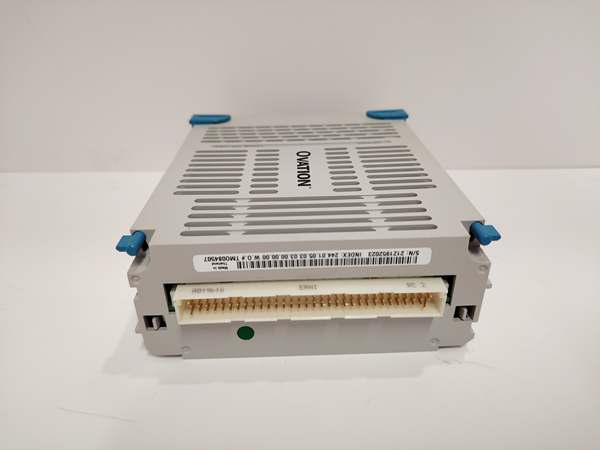
Emerson 5X00453G01
Field Service Pitfalls: What Rookies Get Wrong
Misconfiguring Single vs. Multi-Channel Sampling RateAn engineer sets the module to 10kHz sampling per channel in Ovation Configuration Studio, expecting all 8 channels to capture 10kHz transients. However, the 5X00453G01 has a per-channel maximum of 10kHz, but total ADC throughput is shared. With all 8 channels active, the maximum per-channel rate drops to 5kHz. The engineer assumes 10kHz across all channels, misses critical events during batch startup where multiple transients occur simultaneously, and blames the module for “data loss.”
- Field Rule: Always verify the aggregate sampling rate in Ovation Configuration Studio’s module diagnostics. The rule of thumb: max per-channel rate = total ADC bandwidth ÷ number of active channels. For 10kHz on all 8 channels, you’d need dual modules or accept 5kHz. Check the module’s “Max Sampling Rate (All Channels Active)” parameter—it’s typically 5kHz, not 10kHz.
Ignoring 3-Wire RTD Lead Resistance CompensationA tech wires a Pt100 RTD using 2-wire configuration (only +, – leads) across a 100-meter run to the 5X00453G01. The wire resistance (≈0.39Ω/100m at 20°C for 18AWG) adds to the RTD resistance, causing a +0.4°C reading error at 0°C and +0.8°C at 100°C. The engineer trusts the “±0.05°C” spec, but batch recipes drift, leading to off-spec product quality.
- Quick Fix: For RTD runs >10 meters, always use 3-wire or 4-wire configuration. The 5X00453G01 supports 3-wire RTD—connect the +, -, and third compensation wire (C). The module’s excitation current flows through the compensation lead to measure wire resistance and subtract it from the total resistance. Verify lead colors from sensor documentation—typical Pt100 3-wire: red (+), black (-), yellow (compensation). Configure the channel as “RTD 3-wire” in Ovation Studio, not “RTD 2-wire.”
Disabling Filtering in High-Noise EnvironmentsA process engineer sets digital filtering to “minimum” (0.1Hz cutoff) on channels measuring 4-20mA flow transmitters in a refinery I/O room near VFD cabinets. The low filter passes high-frequency noise from VFD switching (up to 20kHz), causing flow readings to jitter by ±0.5mA. The engineer blames the transmitters, replaces them, but the issue persists.
- Field Rule: In environments with VFDs, large motors, or power electronics, always apply moderate to high filtering. Start with 10Hz-100Hz cutoff and increase if jitter persists. The 5X00453G01’s filter is digital—no phase delay penalty like analog RC filters. Configure filter per-channel based on signal characteristics: slow-changing temperature signals can use 1-10Hz, fast pressure signals may need 50-200Hz. Never disable filtering entirely in industrial settings unless the signal source is isolated and noise-free.
Overlooking Peak Capture Window for Transient DetectionA safety system engineer configures the 5X00453G01 for peak detection but sets the capture window to “continuous” (default) on a channel monitoring pressure relief valve discharge. During a 50ms pressure spike, the peak capture misses the event because the peak detection algorithm samples at the configured rate (5kHz) but the capture window only updates on DCS scan (e.g., 100ms). The safety interlock never sees the peak, and the relief valve doesn’t trip in time.
- Field Rule: For transient detection, enable “peak/valley capture with timestamp” in Ovation Studio and set the capture mode to “immediate” or “event-triggered.” The module’s FPGA can store peak values in a local buffer and upload on event (e.g., overrange threshold crossed). Configure the DCS tag to read the peak value and timestamp, not just the live value. Test by injecting a transient signal using a calibration source and verify the peak appears within 1ms in Ovation trends.
Mixing Thermocouple Types Without Re-Configuring ChannelsA tech replaces a Type K thermocouple with a Type J on a reactor temperature channel but forgets to reconfigure the 5X00453G01 from “K-Type TC” to “J-Type TC” in Ovation Studio. The module applies K-Type CJC (Seebeck curve) to the J-Type signal, causing a -20°C to +30°C error across the -200°C to +1200°C range. The reactor runs at 350°C, reads 320°C, and the batch undercooks.
- Quick Fix: Always verify the sensor type matches the channel configuration in Ovation Studio after sensor replacement. The 5X00453G01 supports multiple thermocouple types (K, J, T, E, S, R, B), but each requires different linearization coefficients. Reconfigure the channel by selecting the correct TC type in the “Signal Type” dropdown, then re-calibrate using a thermocouple simulator or known temperature reference (e.g., ice bath 0°C). Never assume “TC” generic setting works—use the specific type.
Forgetting Ground Loop Elimination in Long mA RunsAn engineer routes 4-20mA transmitter cables (200-meter runs) from a remote field junction box to the 5X00453G01 in a control room. The transmitter negative (-) is grounded at the field end, and the module’s negative terminal is grounded at the control room. Ground potential difference (up to 5V in some plants) creates a ground loop, causing ±0.5mA current flow on top of the 4-20mA signal. The reading shifts, and DCS alarms on “signal out of range.”
- Field Rule: For 4-20mA runs >50 meters, ground at only one end—typically the control room end (module side). Leave the field transmitter’s negative (-) floating (isolated from ground). If you must ground both ends (e.g., for safety), use an isolated input module or add an isolated 4-20mA splitter at the module terminals. The 5X00453G01’s channel isolation (2500V AC) helps, but ground loops can still occur if wiring isn’t properly isolated. Verify ground potential difference between transmitter and module is <1V before commissioning.
Assuming Hot-Swap Works Without Compatible BackplaneA tech hot-swaps a faulty 5X00453G01 in an older Ovation I/O cabinet without hot-swap backplane support. The backplane lacks the mechanical keying and electrical isolation circuits for hot-swap. During insertion, the module’s power pins momentarily short the backplane’s 24VDC supply, blowing a fuse and taking down the entire I/O rack.
- Quick Fix: Verify the cabinet’s base unit (e.g., 1B30044H01) supports hot-swap by checking the Emerson hardware manual. Hot-swap backplanes have gold-plated contacts and isolation diodes on power pins. If hot-swap isn’t supported, de-energize the entire backplane before removal—pull the 24VDC bulk supply, wait 30 seconds for capacitors to discharge, then swap. Never hot-swap in non-rated cabinets; you risk damaging the backplane, the module, and adjacent modules.
Please note: The listed price is for reference only and is not binding. Final pricing and terms are subject to negotiation based on current market conditions and availability.