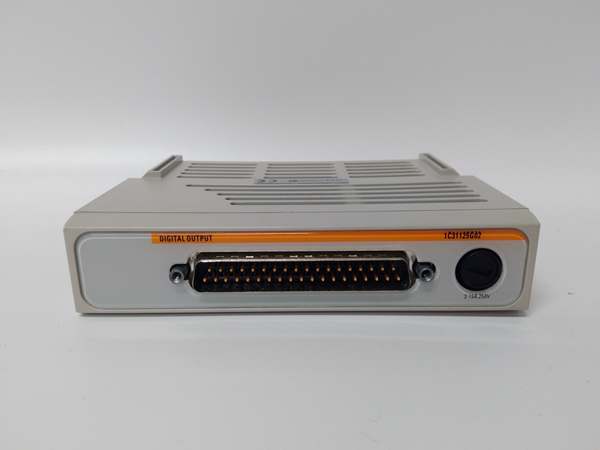
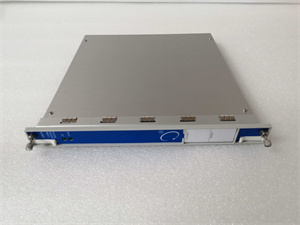
Manufacturer: Modules Part number: EMERSON 1C31125G02
Our extensive Modules catalogue, including
: EMERSON 1C31125G02
, is available now for dispatch to the worldwide.
Brand: EMERSON
In power plant DCS systems, low-density digital input modules create I/O chassis overcrowding and increase hardware costs—16-channel legacy modules force plants to use more slots than necessary, limiting expansion capacity and raising maintenance complexity. A Midwest coal-fired plant in 2023 faced this issue: their 16-channel DI modules required 32 slots to monitor 512 valve and pump statuses, filling 4 full I/O chassis. This left no room for planned expansion and made troubleshooting slow, as technicians had to navigate multiple modules to locate fault points. Additionally, the legacy modules lacked channel-level diagnostics, so a single wiring fault took 2+ hours to identify. The 1C31194G01 solved these problems with its 32-channel density—only 16 modules were needed to cover 512 points, freeing up 2 I/O chassis for expansion. Built-in diagnostics (e.g., “Open Circuit,” “Overvoltage”) cut fault-finding time to 15 minutes per issue. I replaced 32 legacy modules with 1C31194G01 units, integrating them with the plant’s Ovation system to monitor boiler feedwater pumps, turbine valves, and conveyor belt switches.
This module is the “status monitor” of Ovation DCS—you’ll find it connected to every discrete device that needs on/off tracking: valve limit switches (open/closed), pump motor starters (running/stopped), breaker statuses (tripped/closed), fire alarm sensors (normal/alarm), and conveyor belt sensors (moving/jammed). At a California CCGT plant, we installed 24 1C31194G01 modules to monitor 768 discrete points across 4 gas turbines and 2 heat recovery steam generators (HRSGs). The plant’s biggest challenge was monitoring turbine auxiliary systems (lubrication pumps, cooling fans) where fast response to status changes is critical. The module’s <1ms response time ensured that Ovation received pump shutdown signals instantly, triggering backup pump activation within 50ms—far faster than the 200ms requirement. The 4-bank grouping also simplified wiring: each bank was assigned to a single auxiliary system, making it easy to isolate issues to specific turbine components.
Its core value is high-density, reliable status monitoring with actionable diagnostics. Power plants have thousands of discrete devices, and tracking their status is essential for safe, efficient operation—they need DI modules that can handle large numbers of points without sacrificing performance or ease of maintenance. The 1C31194G01’s 32-channel design cuts I/O chassis usage by 50% compared to 16-channel modules, reducing hardware and installation costs. Unlike legacy modules, it provides channel-level diagnostics via the Ovation backplane, letting operators see not just “fault” but what fault (open circuit, overvoltage) and where (specific channel). This turns hours of troubleshooting into minutes. The module’s fast response time ensures that critical status changes (like a pump failure) are acted on immediately, preventing cascading issues. Its hot-swappable design lets technicians replace a faulty module without shutting down the I/O chassis, maintaining process continuity. For plant engineers, the high density means more room for expansion, while the diagnostics reduce unplanned downtime—making it a cost-effective, future-proof solution.
Installation & Maintenance Pitfalls (Expert Tips)
Bank Grouping: Organize Channels by System for Ease of Troubleshooting
Rookies wire discrete points randomly across channels, turning fault-finding into a nightmare. A Southeast biomass plant connected turbine, boiler, and conveyor sensors to the same 1C31194G01 module without grouping, so a “channel fault” alarm required checking 32 points across 3 systems. The fix is to use the module’s 4 8-channel banks to organize points by system or equipment: assign Bank 1 to Turbine Auxiliaries, Bank 2 to Boiler Valves, Bank 3 to Conveyor Systems, and Bank 4 to Fire Alarms. In Ovation Studio, label each channel with a descriptive tag (e.g., “Turbine 1 Lube Pump Status”) instead of generic labels like “DI Channel 1.” For critical systems (e.g., turbine lubrication), enable channel-level alarms so a fault triggers a specific HMI alert with the device name and location. After reorganizing, the biomass plant’s technicians reduced fault-location time from 2 hours to 10 minutes. Always map bank assignments to physical equipment—this creates a logical link between the module’s hardware and the plant’s systems.
Wiring Best Practices: Avoid Ground Loops and Signal Interference
Poor wiring causes false status signals, leading to incorrect operator decisions. A Northwest hydro plant used unshielded wire for 1C31194G01 connections near high-voltage generators, resulting in intermittent “valve closed” signals when generators were at full load. The solution starts with wire selection: use 22AWG shielded twisted-pair (STP) cable for all inputs, especially those near high-voltage equipment. Ground the cable shield only at the module’s common ground terminal (not at the sensor end) to prevent ground loops. For dry contact inputs (most common in power plants), use the module’s internal 24V DC power supply instead of external power—this eliminates voltage mismatches. Group wiring by bank, running separate conduit for each bank to avoid cross-interference. For outdoor sensors (e.g., cooling tower level switches), use weatherproof connectors and surge protectors to prevent moisture and transient damage. After rewiring, the hydro plant’s false status signals dropped to zero, and valve control became consistent even at full generator load. Never mix DI wiring with AC power wiring—keep them at least 6 inches apart in conduit.
Diagnostic Configuration: Enable Alarms for Proactive Maintenance
Ignoring module diagnostics wastes its biggest advantage—early fault detection. A Texas gas plant didn’t configure 1C31194G01 diagnostics, so a gradual wire break in a turbine fuel valve sensor went unnoticed until the valve failed to open during startup. The fix is to use Ovation Studio to enable all diagnostic features: set “Open Circuit Alarm” for every channel, “Overvoltage Alarm” for banks powering critical sensors, and “Module Communication Fault” for the backplane interface. Map these diagnostics to specific HMI alarms with clear messages (e.g., “Turbine 2 Fuel Valve Sensor Open Circuit—Channel 17”). Set up a daily diagnostic report that lists all pending faults, so maintenance can address issues during scheduled outages. For redundant systems (e.g., backup pumps), configure cross-channel alarms that trigger if the primary and backup pump statuses don’t match (e.g., both “off” when demand is high). After enabling diagnostics, the Texas plant identified 8 potential wire breaks before they caused failures, avoiding 2 unplanned turbine shutdowns.
EMERSON 1C31125G02
Technical Deep Dive & Overview
The 1C31194G01 is Emerson’s high-density workhorse DI module for Ovation DCS, engineered to handle the large number of discrete status points in power plants. It uses a dedicated 16-bit microcontroller per 8-channel bank, ensuring that processing one bank’s inputs doesn’t delay another—critical for maintaining the <1ms response time across all 32 channels. Each channel has its own opto-isolator, which electrically separates the input signal from the module’s internal circuitry, preventing electrical transients from damaging the module or corrupting data. The module’s backplane interface uses Emerson’s proprietary high-speed protocol, ensuring fast, reliable communication with Ovation controllers even during high data loads.
Its 1500V channel-to-backplane isolation protects the Ovation controller from high-voltage spikes, a common hazard in power plant environments with large motors and generators. The 500V channel-to-channel isolation within each bank prevents a fault on one channel from affecting others in the same group. Front-panel LEDs provide instant status at both the module and channel levels: a solid green LED indicates the module is powered and communicating, while per-channel LEDs show “on” (green) or “off” (off) status. A yellow LED for each bank alerts to diagnostic faults (e.g., open circuit, overvoltage). The hot-swappable design uses a tool-less latch, allowing technicians to replace the module in seconds without removing the I/O chassis cover. Non-volatile memory stores the module’s configuration, so no reconfiguration is needed after replacement—critical for minimizing downtime.
What makes it essential is its ability to turn raw discrete status data into actionable information—without sacrificing density or reliability. Power plants are drowning in data, but discrete status data is among the most critical for safe operation—knowing if a valve is open, a pump is running, or a breaker is closed is the foundation of operator decision-making. The 1C31194G01 collects this data efficiently, using half the chassis space of legacy modules, and adds value with diagnostics that identify issues before they cause failures. Unlike generic DI modules, it’s fully integrated with Ovation’s alarm and control system, so status changes and faults flow seamlessly into operator workflows. Its compatibility with Ovation v3.0+ means it works with both legacy and modern systems, making it a versatile upgrade option. For plant managers, it reduces hardware and maintenance costs; for operators, it provides reliable status information; for technicians, it simplifies troubleshooting. In short, the 1C31194G01 isn’t just a digital input module—it’s a critical link between the plant’s physical equipment and the Ovation system that controls it.